

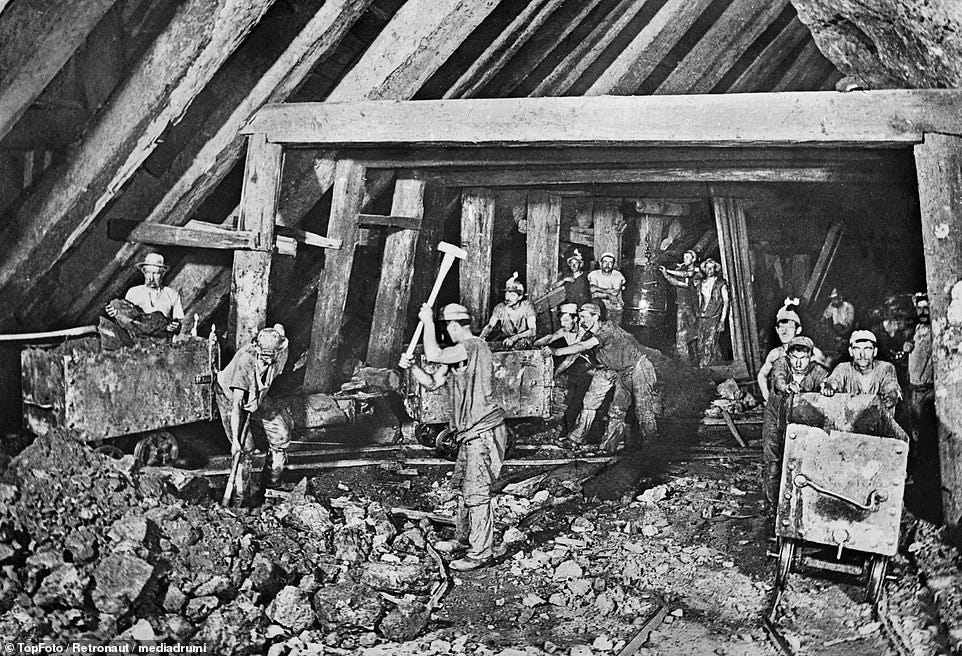
Britain had the institutions, skills, and technologies for industrialization. The deeper question is whether those advantages were enough without local coal.
If you’re following me but don’t yet receive these essays by email, you’re missing most of them. Substack doesn’t email articles to followers, only to subscribers. You can get every new essay free in your inbox by subscribing 👉:
For thousands of years, every human society faced the same fundamental problem. People could develop better tools, build larger cities, expand trade, and organize increasingly sophisticated economies, but they could not escape the limits imposed by the energy available to them.
Then, in Britain, those limits suddenly began to break.
But why Britain? Historians have proposed many answers, including institutions, science, trade, empire, wages, and culture. Coal has long occupied a prominent place in this debate because Britain happened to possess unusually large deposits close to major cities, ports, and industrial regions.
But simply observing that Britain had coal does not prove that coal caused the Industrial Revolution.
One way to test the importance of coal is doing thought experiments based on different but still plausible geographies. These “counter-factuals” enable us to think deeper about the relationship between energy and industrialized societies.
What if the British Isles had contained no coal?
Answering those questions in a systematic way is the topic of this article. In later articles in this series, I will try to answer:
What if Europe had contained no coal at all?
And what if coal had never existed anywhere in the world?
What if coal existed but could not have been reached with pre-industrial technologies?
Coal and its influence on human history

If you’re following me but don’t yet receive these essays by email, you’re missing most of them. Substack doesn’t email followers, only subscribers. You can get every new essay free in your inbox here:
If you enjoy this article, you should read my From Poverty to Progress book series.

Counterfactuals
Counterfactual history asks a deceptively simple question: what would have happened if one important condition had been different?
Historians sometimes distrust these questions because there is no way to observe the alternate history. But counterfactual reasoning can be useful when the goal is not to invent a story, but to test the causal importance of a specific factor. Counterfactuals can clarify whether an event or condition was actually necessary for an observed outcome.
The logic is straightforward. Britain historically possessed large quantities of accessible coal and then experienced the world’s first Industrial Revolution. That sequence alone does not prove that coal was necessary.
If we imagine Britain without coal and still conclude that it probably industrializes at roughly the same time, then coal becomes less important to the explanation. If industrialization shifts to Belgium or another Commercial society with accessible coal, then British coal mainly explains where the Industrial Revolution began. If removing accessible coal prevents industrialization altogether, coal becomes much more important.
Counterfactuals become dangerous when too many things are changed at once. Once we alter Britain’s coal deposits, we cannot simply invent whatever technologies, institutions, or energy sources are needed to produce the outcome we expect. The further an imagined world moves from actual historical conditions, the less confidence we should have in our conclusions.
For this reason, I will try to change as little as possible in each counter-factual. When coal is removed from a region, its population, institutions, technologies, skills, trade networks, and other geographical characteristics initially remain the same. I will then ask how people would likely have responded using the energy sources and technologies that were realistically available to them.
The results should therefore be viewed as probabilities rather than predictions. The purpose is not to claim that we can know an alternate past. It is to test how sensitive the Industrial Revolution appears to changes in the geography of energy.
Counterfactuals covered in this series
This series focuses on four counterfactuals that progressively remove coal from larger geographical areas:
What if the British Isles had no coal? This counter-factual tests whether Britain’s own coal deposits were necessary for it to industrialize first. That is the topic of this article.
What if Britain had coal, but it was inaccessible with pre-industrial technology? This counter-factual tests whether merely possessing coal mattered, or whether geology had to make it economically usable.
What if Europe, including Britain, had no coal? This counter-factual tests whether industrialization would simply have shifted to another part of the world.
What if the world had no coal? This counter-factual tests the strongest claim of all: whether the Industrial Revolution could have occurred at all without coal.
A longer list of additional counterfactuals appears near the end of the article, but these four are the most useful because each tests a different level of geographical dependence.
Possible outcomes
For each case, I will consider four possible categories of outcomes:
Britain and the rest of the world industrialize roughly as they did historically.
Britain fails to industrialize, but another nation does.
Britain industrializes, but industrialization cannot spread widely because global energy supplies are too constrained.
No Industrial Revolution occurs anywhere.
The Pre-industrial Energy Baseline
I will pick a somewhat arbitrary date that occurs before most experts believe that the British Industrial Revolution occurred (opinions vary). I will use England and Wales as the geographical location.
Around 1600, England and Wales still depended mostly on the traditional energy sources that had powered human societies for centuries. But one important difference was already emerging: coal had become a significant part of the energy system before the Industrial Revolution began.
E. A. Wrigley estimated total annual energy consumption in England and Wales in 1600-1609 at about 17 gigajoules per person.
These numbers should not be interpreted as equivalent amounts of useful work.
Food and fodder measure chemical energy consumed by people and animals.
Wood and coal largely measure heat energy.
Wind and water represent captured mechanical energy.
The table is therefore best understood as a reconstruction of the major energy flows entering the economy.
Even with that qualification, the pattern is important. About 80 percent of England’s energy still came from food, fodder, and wood. These were ultimately tied to current biological production. Coal already supplied almost one-fifth of the total without requiring additional farmland, pasture, or forests. About two-thirds of British coal in 1600 was used for domestic heating and cooking. So do not assume that coal = industry.

Compared with Agrarian Societies
As I have argued elsewhere, pre-industrial England was a Commercial society that operated on very different principles from the Agrarian societies of Eurasia (pretty much every large society in recorded history).
A typical Agrarian society depended almost entirely on energy captured from current biological flows (food, fodder, and wood). England and Wales around 1600 still relied heavily on those same sources, but had already added a substantial amount of coal.
Note that the Agrarian figures are very rough estimates rather than measurements of one specific society. Their purpose is to show the likely structure of an energy system still almost entirely dependent on current biological flows.
The comparison suggests that England did not yet possess vastly more total energy per person than a typical Agrarian society. Pre-industrial England’s distinctive advantage was that nearly one-fifth of its energy already came from coal in addition to the other traditional energy sources (which were not all that different from Agrarian societies).
Did Any Other Society Beat England at the Time?
It is difficult to make precise national comparisons for 1600 because comparable energy accounts rarely exist.
It is likely that the Netherlands was the only society in the world that rivaled England in per-capita energy consumption before the Industrial Revolution. Holland was one of the most advanced Commercial societies in the world and made unusually heavy use of peat but very little use of coal.
In some Dutch cities and regions, per-capita energy consumption may have exceeded that of England because peat supplied large quantities of domestic and industrial heat. Around 1650, for example, Leiden was consuming about 36 GJ per person in fuel energy, mostly peat, which was far above England’s total 16.9 GJ per person around 1600.


That comparison is theoretically important. The Dutch had developed an advanced Commercial society and had partially escaped dependence on wood through peat, yet they did not make the transition to an Industrial society.
So England may not have had the highest per-capita energy consumption in every part of Europe around 1600. But it is same to assume that in 1600 England was:
on the leading edge of per capita energy consumption
no other society came close to its per-capita coal consumption
Counter-factual #1: Britain has no coal, but Europe does
The first counter-factual removes all usable coal from the British Isles while leaving the rest of Europe unchanged. Britain keeps its agriculture, cities, institutions, trade networks, technologies, skills, ports, rivers, and sailing fleet. Belgium, northern France, the Ruhr, and other European coalfields remain exactly where they were historically.
This tests whether British coal was necessary for Britain to industrialize first, or whether Britain could have substituted other energy sources well enough to remain the center of the Industrial Revolution.
England’s lost energy in this scenario
Around 1600, coal already supplied about 3.2 gigajoules per person, almost 19 percent of the energy consumed in England and Wales. Removing coal would reduce total energy use from about 16.9 to about 13.7 gigajoules per person.
That would push England back toward the energy levels typical of Agrarian societies, which experience virtually no increase in per-capita GDP over the course of one generation.
An Agrarian society could command enough energy to feed its population, reproduce itself, maintain buildings, move goods, and support a limited amount of manufacturing and urban life. But most of its energy came from food, fodder, wood, wind, and water. These sources were sufficient for survival and reproduction, but they left relatively little surplus energy available to support sustained economic growth.
England without coal would therefore begin this counter-factual with essentially the same energy constraint that had limited earlier societies. Its institutions, technologies, cities, and trade networks might be more advanced, but the amount of energy available to support further growth would be much closer to the traditional Agrarian ceiling.
Then the problem gets much worse as England attempts to industrialize.
Historically, English coal consumption expanded rapidly during the seventeenth and eighteenth centuries. By around 1700, coal provided roughly half of England’s total energy. By 1800, coal dominated the energy system.
So the counter-factual does not merely remove 3.2 gigajoules per person from England in 1600. It removes the energy source that historically supplied most of the enormous increase in energy consumption that followed.
A coal-free England therefore faces two separate problems.
It begins with far less surplus energy available for economic growth,
and then it must somehow find alternative energy sources capable of expanding rapidly enough to support population growth, urbanization, manufacturing, industrial heat, and eventually large-scale mechanical power.
The first is challenging. The second may be impossible to overcome.
Alternative energy strategies
But before we assume that Britain could not industrialize without domestic coal resources, we should explore alternative energy strategies. Britain would have several possible responses.
Domestic energy sources:
Expand domestic wood production
Expand domestic peat extraction
Expand waterpower in upland Britain
Expand wind power for mills and transport
Expand animal power, particularly horses
Imported energy sources:
Import wood from Scandinavia and the Baltic
Import peat from Ireland or the Netherlands
Import coal from Belgium, northern France, or the Ruhr
None of these strategies are impossible. The question is whether they could be expanded cheaply enough, at sufficient scale, and in the right locations to support sustained industrial growth.
Expanding domestic wood production
Wood would be Britain’s most obvious substitute for coal because it could perform many of the same heating functions. It could heat homes, fire bricks, brew beer, boil salt, make glass, and provide industrial process heat. Charcoal could also support metalworking.
The geographical problem is that the largest remaining wood resources were not located where future industrial demand was greatest. And wood is heavy, bulky and difficult to transport on land.
Southern and eastern England had already experienced centuries of agricultural expansion and forest clearance. Larger forest resources remained in Wales, northern England, Scotland, and some isolated English woodland regions. These areas could certainly supply more fuel.
But increasing wood production would require either:
cutting forests faster or
managing much larger areas specifically for fuel.
The scale becomes the main obstacle. By around 1800, replacing Britain’s actual coal consumption with wood would have required something on the order of one-third or more of England’s land area to be devoted to woodland, depending on assumptions about forest productivity and combustion efficiency.
Either strategy would create a direct conflict with food production. Any land devoted to woodland cannot be used for food production very efficiently. Medieval England (and all other Agrarian societies) evolved a careful land use pattern that balanced:
Cropland for food
Cropland for fodder for domesticated animals
Rangeland for animals
Woodland for fuel and construction
Cities and village
Any major increase of woodland would have force significantly lower land use for the other purposes. If not done carefully, the results could be catastrophic potentially causing famine or the need to slaughter domesticated animals.
And remember that Britain’s population was growing rapidly during exactly the same period. More people required more grain, meat, fodder, housing, and construction timber. A coal-free Britain would therefore face a difficult choice between using land to feed people, feed animals, grow construction timber, or grow fuel.
Transport would make the problem worse.
Wood is bulky and relatively low in energy density. Forests near London, Birmingham, Bristol, and other major markets would be exploited first because transport costs were lowest. Once those nearby supplies became more expensive, fuel would have to come from progressively farther away.
Road transport would be especially costly.
Wagons required horses,
Horses required fodder (which requires more land for fodder production), and
Poor roads limited the weight that could be moved economically. Rivers and coastal shipping could reduce costs substantially, but only forests near navigable waterways could take advantage of them.
Domestic wood could therefore replace part of Britain’s missing coal, especially at first. It could not plausibly match the continued expansion of coal consumption without forcing increasingly severe tradeoffs between fuel, food, and land.
Expanding domestic peat extraction
Another option that does not come at the expense of other land uses is peat extraction from wetlands. Britain possessed peat deposits, particularly in East Anglia, the Somerset Levels, northern England, Scotland, and other wetland regions.
Peat could substitute for coal in domestic heating and some industrial processes. It also had one advantage over wood: expanding peat extraction did not require devoting productive agricultural land to growing trees.
But Britain’s peat geography was far less favorable than the Dutch Republic’s.
Large peat deposits were concentrated in particular wetlands rather than spread evenly across the country. Peat had to be cut, drained, dried, and transported. Wet peat was especially bulky and contained much less usable energy per unit of weight.
Transport was therefore a major constraint. Peat extracted near waterways or coastal shipping routes could serve nearby cities reasonably well. Peat located far inland would become expensive quickly because large volumes had to be moved to deliver a given amount of useful heat.
Peat also accumulated far too slowly to be treated as renewable on historical timescales. Heavy exploitation would gradually exhaust the best deposits.
Domestic peat could therefore contribute meaningfully to Britain’s heating supply, but it would probably remain a regional supplement rather than a national replacement for coal.
Expanding waterpower in upland Britain
Waterpower offers the strongest domestic alternative for mechanical work.
Britain possessed many favorable waterpower regions, particularly in the Pennines, Wales, the Scottish uplands, and river valleys with sufficient flow and gradient. Historically, some of the earliest textile factories relied heavily on waterpower.
Without coal, Britain would have had much stronger incentives to improve waterwheels, dams, reservoirs, millraces, gears, and mechanical transmission. This could support substantial mechanization.
Factories might have concentrated even more heavily in upland valleys where dependable waterpower was available. Textile manufacturing in particular could still expand considerably.
But waterpower imposed a geographical penalty. The factory had to move to the river. Labor, suppliers, housing, and transportation networks then had to move with it.
The best water sites would be used first. Additional industrial expansion would require less favorable sites, larger dams, longer millraces, more complicated engineering, or greater seasonal storage.
Waterpower also could not solve Britain’s industrial heat problem. A waterwheel could turn machinery, but it could not directly smelt iron, fire bricks, make glass, or heat millions of homes.
Water could therefore replace part of the mechanical role that coal later performed through steam, but not the thermal role that coal already performed before widespread steam power.
Expanding wind power for mills and transport
Wind would remain highly valuable, particularly for transportation. Britain’s geographical position gave it excellent access to maritime wind power. Sailing ships could continue moving enormous quantities of goods around the coast and across the Atlantic without consuming fuel.
Additional windmills could also grind grain, pump water, and perform some industrial work in exposed regions.
But stationary wind power faced severe limitations. Wind was intermittent. It could not be turned on whenever production demanded it. Suitable wind regimes were geographically uneven, and the amount of power available varied substantially by location and weather.
Wind was therefore particularly useful for transport and selected mechanical tasks, but it could not provide reliable industrial heat or the continuous power increasingly demanded by factories.
Expanding animal power
Britain could also breed more horses and oxen. Animal power was flexible. Horses could pull wagons, operate machinery, haul raw materials, and move goods between farms, mines, towns, and ports.
But additional animal power created another land problem.
Every additional working animal required pasture, hay, oats, or other fodder. Expanding horsepower on a large scale would therefore increase demand for agricultural land at exactly the same time that population growth was increasing demand for human food.
Animal power could also replace only mechanical work. It could not substitute for coal in heating or metallurgy.
Heavy reliance on horses would therefore increase the cost of transportation and mechanical work while tightening Britain’s agricultural constraint.
The Limits of Domestic Energy
Taken together, these domestic strategies could have increased England’s energy supply substantially above the coal-free level of about 13.7 gigajoules per person. Better forest management, greater peat extraction, more watermills and windmills, and additional animal power would all help.
But there were severe limits to how far they could scale.
Wood presented the largest opportunity, but also the largest land requirement. Wrigley estimated that replacing England’s actual coal consumption in 1700 with sustainably harvested wood would have required roughly 2.5 to 3 million additional acres of woodland.
By 1815, the equivalent had risen to about 15 million acres. Later estimates using lower sustainable forest yields make the required acreage even larger. In other words, England could substitute wood for some coal, but England could not follow the historical growth of coal without eventually sacrificing enormous amounts of agricultural land.
Waterpower could expand considerably, particularly in Wales, the Pennines, northern England, and Scotland. Britain ultimately developed tens of thousands of water and wind-powered mill sites, so substantial unused mechanical potential remained in 1600.
But recent research suggests that usable waterpower in the regions that later became Britain’s industrial heartland was much more limited than older theoretical estimates implied.
Peat, wind, and animal power could also expand, but each faced tighter geographical or functional constraints. Peat was concentrated in particular wetlands. Wind was intermittent and could not provide industrial heat. Additional horses and oxen required additional fodder, placing still more pressure on agricultural land.
A deliberately generous estimate of the additional energy England might eventually obtain from domestic sources looks something like this (estimates supplied by ChatGPT; do not take exact numbers seriously):
These estimates are estimates supplied by ChatGPT; do not take exact numbers seriously, but I think that they clearly illustrate the problem. The table is intended to establish the approximate scale of possible expansion rather than imply that every gigajoule is interchangeable.
These upper-bound estimates are deliberately favorable to the alternative energy sources. The exact ceiling is uncertain and depends on forest yields, peat availability, river geography, land use, technological improvements, and how aggressively England was willing to sacrifice other uses of land. I will explain those assumptions in the Methodology Appendix.
Also note that England cannot simultaneously do all of them.
Even using the favorable end of these estimates, England probably reaches a domestic energy ceiling in roughly the high teens or low twenties of gigajoules per person.
If you compare the bottom three numbers, you can easily see the scale of the problem. England might have been able to match 1600 energy consumption with increased production of non-coal domestic energy resources. But by 1700, domestic substitutes are nowhere near enough. And by 1800, domestic substitution cannot even account for half of the energy Britain actually produced in that year.
Domestic substitutes could have raised Britain energy ceiling, but coal effectively removed it. There was no long-term domestic substitute that British coal provided.
But, of course, England in 1600 was a Commercial society with trade links to much of the world. It would have intuitively sought imported substitutes.
Importing coal from Europe
Once domestic energy sources reach their limits, importing coal from continental Europe becomes Britain’s most important alternative strategy.
Several major coal regions were potentially available. The closest were the coalfields:
around Mons in the Spanish Netherlands
the Liège basin in the independent Prince-Bishopric of Liège.
Northern France
the Ruhr region of the Holy Roman Empire
You can read more about each in this article:

The Spanish Netherlands probably offered one of the most favorable early routes. The coalfields around Mons and the Borinage already had access to the Haine River, which connected them with the Scheldt. The Haine was an important route for the coal industry by the sixteenth century. Coal could therefore move by water toward ports connected to the Scheldt before being loaded onto larger vessels for shipment across the Channel or North Sea.
The Prince-Bishopric of Liège possessed another important coalfield. Its mines lay close to the Meuse river, giving coal access to a major river route toward the Dutch Republic and North Sea. But river transportation was not frictionless. Tolls, transshipment, navigation difficulties, and political boundaries could raise costs. By the eighteenth century, coal from Liège was moving down the Meuse toward Dutch markets, showing that the route was physically possible even before modern railways.


The Ruhr offered much larger potential supplies, but its early geography was less favorable for Britain. Coal first had to move from individual mines to the Rhine or another navigable route. It then had to travel downstream through the Holy Roman Empire and Dutch Republic, reach a North Sea port, and be transferred to seagoing vessels before crossing to Britain.
Northern coalfields within the Kingdom of France could also contribute. Their greatest advantage was the short sea distance to southern England. Their weakness was that many deposits lay inland, so the cost of getting coal from the mine to a Channel port could exceed the cost of the Channel crossing itself.
Could Europe Supply Enough Coal?
The first question is whether continental coalfields could physically expand enough to replace Britain’s missing production.
Around 1700, England was already producing roughly 2.5 to 3 million tons of coal per year. By 1800, British production had increased to roughly 11 to 15 million tons annually. Any continental substitute would therefore have to support an enormous increase in mining, not merely supply a few shiploads to London.
The coal was certainly in the ground. The harder question was how quickly it could be extracted.
The Mons and Borinage coalfields provide the clearest example. Production there was only about 11,500 tons in 1764, but rose to roughly 350,000 tons by 1789 and approached one million tons near the end of the century. By the early nineteenth century the wider Hainaut coalfields were producing more than two million tons annually.
The Liège basin also had substantial capacity. It produced about 350,000 tons in 1810 and later expanded into a multi-million-ton coalfield.
Northern France developed more slowly, but the Anzin mines alone were producing more than 300,000 tons annually by 1789. The Nord and Pas-de-Calais coalfields ultimately contained enormous resources.
The Ruhr had by far the largest long-term potential, but it was still producing less than roughly half a million tons annually around 1800. Its enormous nineteenth-century expansion came only after major improvements in mining, drainage, river navigation, canals, and eventually railroads.
No single continental field was remotely capable of replacing Britain’s entire coal economy around 1800 at its existing production level.
But that is not quite the right counter-factual. If Britain had no coal, British demand would create much stronger incentives to expand continental mining decades earlier. Capital, skilled miners, pumps, drainage technologies, and transport investments would likely flow toward the coalfields of the Spanish Netherlands, Liège, northern France, and eventually the Ruhr.
I therefore think continental Europe probably contained enough coal to meet Britain’s long-term energy requirements.
The serious constraint would be how rapidly production could expand and, even more importantly, how much that coal would cost by the time it reached British consumers.
Transport costs
For each of these coalfields the problem was not simply whether a region could produce enough coal. We also need to consider the transport costs, which were considerable.
Coal had to complete an entire transportation chain:
coal mine → European river or port → sea voyage to Britain → English port → final consumer or factory
Every additional stage added cost and transshipment from one mode of transport to another was largely by hand.
Sea transportation was relatively cheap. Britain historically moved enormous quantities of coal from Newcastle to London by ship. By the seventeenth century, coal carriage had become one of the largest components of England’s merchant shipping. More than a million tons of coal per year were probably being carried by sea before 1700.
Road transportation was another matter. Around 1700, moving coal a mile
by water added only about 7 pence per ton.
by road added 2 shillings per ton (over 3 as expensive, for those of you who do not speak Imperial)
(and most importantly) required additional costs from loading and unloading between each stage.
This would make English geography extremely important after the coal reached Britain. London would be in an excellent position. Imported coal could arrive directly on the Thames and reach a huge concentration of households and industries with relatively little inland transportation.
Other coastal cities such as Bristol, Hull, Liverpool, and ports along the Channel and North Sea would also have substantial advantages.
Inland industrial centers would face a much greater problem. Birmingham, for example, could not simply unload coal from a ship beside its factories. Coal would have to travel inland by wagon, river navigation, or eventually canal. Before the major eighteenth-century canal network, that last leg could dramatically increase the delivered price.
The geographical disadvantage would therefore operate at both ends of the trade. Continental coalfields needed cheap access to a European port, while British consumers needed cheap access from an English port.
I asked ChatGPT to calculate the marginal costs of importing coal from the Continent compared to the Newcastle in England. The Newcastle row is the baseline, set at 100 for coal delivered to a major English port. The continental figures are rough counterfactual estimates that include the extra cost of:
inland movement on the European side,
transshipment,
sea transport,
port handling, and
the final inland leg in England.
Though the cost of importing Continental coal was clearly higher than domestic coal, a lack of British coal fields does not seem to create a fundamental constraint on energy needs. Britain would likely be able to pay the increased costs. The major consequences were likely:
Slower initial growth caused by the need to pay for more expensive coal
A very different geography of industry in Britain. Industry likely would have been concentrated near port cities, navigable rivers, and canals (at least until the invention of the railroad)
But Would Britain Have Learned to Use Coal?
Before asking whether Britain could import enough coal, we need to ask a more basic question: would the British have been interested in using coal at all?
Coal was not an obviously superior fuel to people who had never built their homes, industries, and technologies around it. It was dirty, smoky, and unfamiliar. Some uses required special furnaces, chimneys, grates, storage systems, and handling practices. In metallurgy, raw coal could contaminate the product. Early steam engines were so inefficient that they only made economic sense where coal was extremely cheap.
So access to imported coal would not automatically mean widespread use.
Historically, Britain learned to use coal gradually over several centuries.
Domestic coal mining created a large and expanding market long before the Industrial Revolution.
Households learned to substitute coal for wood.
Builders adapted fireplaces and chimneys.
Merchants created coal yards and distribution networks.
Shipowners developed a large coastal coal trade.
Workers and entrepreneurs learned alongside consumers.
Mining created repeated technical problems. Mines had to be drained, ventilated, supported, illuminated, and connected to the surface. Coal had to be cut, hauled, sorted, loaded, transported, stored, and sold.
British workers gradually acquired specialized skills for solving those problems. Miners learned how to work deeper seams. Metalworkers produced stronger tools, pumps, chains, boilers, and cylinders. Engineers learned how to move water and heavy materials. Merchants, mine owners, carriers, and port operators developed increasingly complex organizations for coordinating production and distribution.
Industrial users also experimented with coal. Brewers, brickmakers, glassmakers, salt producers, lime burners, and other manufacturers learned how to redesign furnaces around mineral fuel. Workers learned which types of coal worked best for different purposes and which industrial processes could tolerate coal’s smoke and impurities.
Some of the most important technologies of the Industrial Revolution emerged directly from this learning process.
Deep coal mines filled with water. That created strong incentives to improve drainage technology. Early steam engines were extremely inefficient, but they could still be useful at coal mines because the fuel was available cheaply at the mine mouth. Coal mining therefore created both the problem and the market that helped make early steam power commercially useful.
Ironmaking followed a similar path. British metalworkers had to learn how to convert coal into coke and how to redesign furnaces so that mineral fuel could replace charcoal without ruining the iron.
This was not simply invention in the abstract. It was cumulative learning-by-doing inside a large domestic coal economy.
Without domestic coal, Britain would lose much of that process.


British households might eventually begin importing coal for heating, particularly in London and other coastal cities. But imported coal would initially be more expensive, so adoption would probably be slower and more geographically restricted.
More importantly, Britain would have no large domestic mining industry generating coal-specific skills and problems. There would be fewer British coal miners, fewer mining engineers, fewer mine owners experimenting with drainage and ventilation, fewer manufacturers supplying specialized mining equipment, and fewer opportunities for workers to acquire practical knowledge about coal.
That would weaken the entire chain of cumulative innovation. Britain might eventually learn to use imported coal productively. But it would probably do so later, at higher cost, and with less domestic experience than it had historically.
The absence of domestic coal would therefore impose two separate disadvantages. Britain would:
have to buy its energy from abroad at higher cost.
lose much of the learning process that taught it how to turn coal into the foundation of an Industrial society.
Would Britain Still Industrialize?
So now, lets move on to the likely outcome to our counter-factual: Would Britain still industrialize if it lacked domestic coal fields, but there were coal fields on the Continent?
I am comfortable with the following conclusions of this counter-factual:
Britain would remain one of the wealthiest and most technologically advanced Commercial societies in the world.
It is very plausible that Britain would surpass the Netherland as the richest nation in the world
British settlers in what is now the United States, Canada, Australia, and New Zealand would still have imported the key foundations of Commercial societies.
The Industrial Revolution would still have happened, although my guess is that it would have been later and slower to develop if it took place in Europe.
Once any nation industrialized, Britain would have been very quick to join in.
What I am much less certain about is which society would have industrialized first.
Britain, the Netherlands, the future United States, and the coal-rich regions of the Spanish Netherlands and Prince-Bishopric of Liège all possessed important pieces of the necessary combination. Britain and the Netherlands had the most advanced Commercial societies. The future United States inherited many of those institutions and possessed enormous coal resources. The regions around Liège, Mons, and the Borinage combined a long Commercial tradition with nearby coalfields.

The question is which of these societies would first have brought together a mature Commercial society, accessible coal, and enough cumulative enabling technologies to make large-scale coal use economically transformative.
I do not think the counter-factual gives us a confident answer.
But I do think it gives us a more important one. Removing Britain’s domestic coal probably does not eliminate the Industrial Revolution. It changes its timing, slows its early development, and makes the location of the first breakthrough much less certain.

In subsequent articles in this series, I will try to answer:
What if Europe had contained no coal at all?
And what if coal had never existed anywhere in the world?
What if coal existed but could not have been reached with pre-industrial technologies?
If you’ve been enjoying these essays but only follow me here, you’re not getting them by email. Followers see Notes; subscribers receive every new piece on the history and future of progress.
Subscribe free here 👉:
See also my other articles on:
Coal and its influence on human history (the series)
If you’re following me but don’t yet receive these essays by email, you’re missing most of them. Substack doesn’t email followers, only subscribers. You can get every new essay free in your inbox here:
If you enjoyed this article, you should read my From Poverty to Progress book series.