

This page provides concise answers to common questions about my thinking. If you notice a problem with a bad link or a missing question, leave a comment at the bottom of this article.
Questions
What are the Five Keys to Progress? (my key theory)
How have the Five Keys to Progress overcome these fundamental constraints?
What is the goal of this Substack column?
Promote an awareness and understanding of human material progress as one of humanity’s greatest achievements.
Study the history of material progress to identify the origins and causes of progress and how progress works in our daily lives. In particular, I look for common patterns and trends across nations, eras, industries, technologies, institutions that enable us to identify causes of material progress.
Apply that knowledge to develop theories, policies, and practices that promote future progress and also those that undermine current and future progress.
Build coalitions to implement those policies and practices in the real world.
What is material progress?
This Substack column focuses on the concept of “material progress” and particularly gaining an understanding of its causes.
I define material progress as “the sustained improvement in the material standard of living of a large group of people over a long period of time.” Typically, I write about material progress for entire nations, but the concept can be applied to smaller groups.
For it to count, material progress must be widespread and sustained. A temporary improvement or an improvement enjoyed only by a small elite does not qualify. I generally look for improvements lasting roughly a generation or longer.
Note that I sometimes use “progress” as short hand for “material progress.”
Read more about how I define material progress.
What is the Progress-based perspective?
The Progress-based perspective places sustained improvements in material living standards at the center of how we understand history, economics, technology, and public policy.
It begins with three questions:
How did humans escape the poverty that characterized most of history?
What innovations and behaviors made sustained progress possible?
How can societies preserve and expand those conditions today?
It is intended as a perspective separate from conventional Left-Right ideology.
What are the causes of material progress?
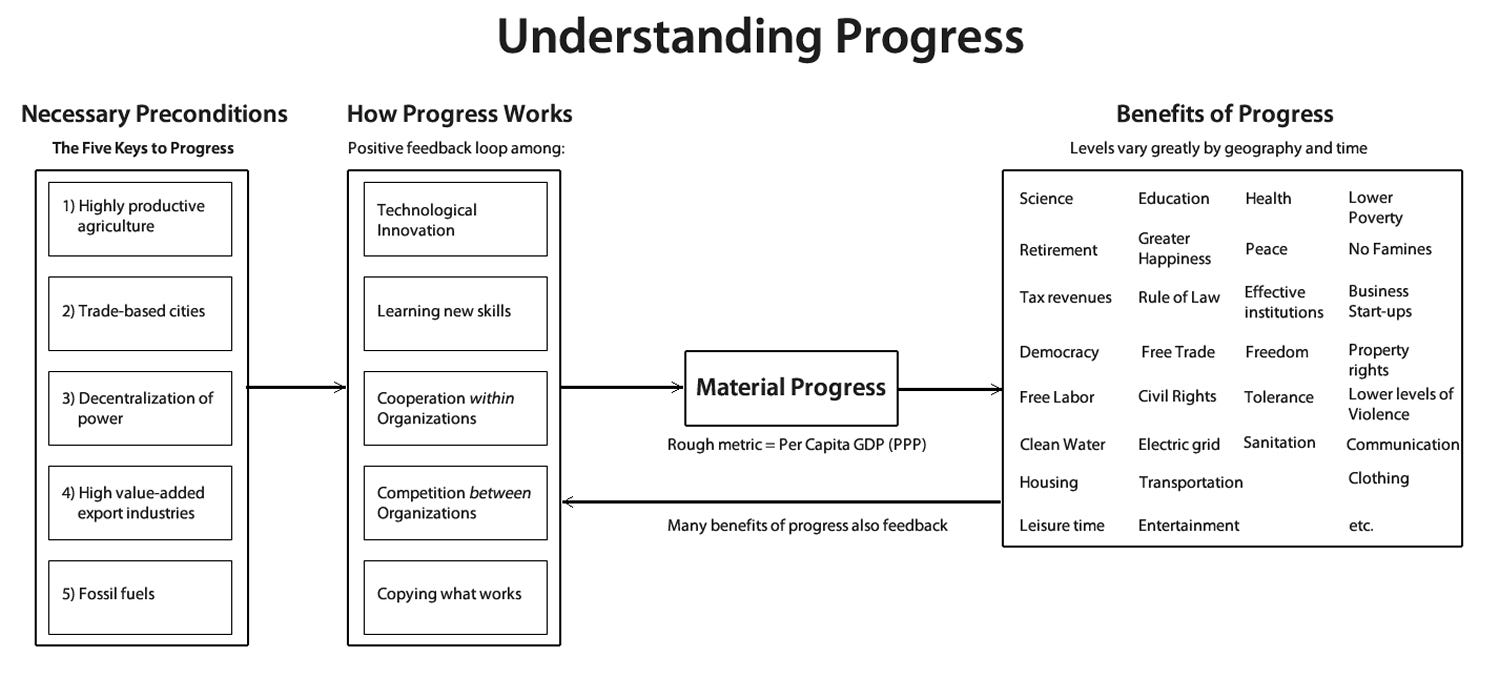
Material progress results from the interaction between the Five Keys to Progress and the human behaviors described in How Progress Works. Both concepts are fundamental to my thinking and are explained in the following entries.
What are the Five Keys to Progress?
The Five Keys to Progress are the necessary pre-conditions that I argue are necessary for a nation to transform from poverty to sustained material progress:
A highly efficient food production and distribution system. This enables societies to overcome geographical constraints to food production so that large numbers of people can focus on solving problems other than getting enough food to eat.
Trade-based cities packed with a large number of free citizens possessing a wide variety of skills. These people innovate new technologies, skills, and social organizations and copy the innovations made by others.
Decentralized political, economic, religious, and ideological power. It is of particular importance that elites are forced into transparent, non-violent competition that undermines their ability to forcibly extract wealth from the masses. This also allows citizens to freely choose among institutions based upon how much they have to offer to each individual and society in general.
At least one high-value-added industry that exports to the rest of the world. This injects wealth into the city or region, accelerates economic growth and creates markets for smaller local industries and services.
Widespread use of fossil fuels. The incredible energy density of fossil fuels injects vast amounts of useful energy into society enabling it to solve a wide variety of problems. Without this energy, life would return to the daily struggle for survival that dominated most of human history.
No single key is sufficient by itself. Material progress emerges when the all operate together in one city or region.
To keep the material progress going, a nation needs to sustain a sufficient amount of each of the five keys. If a society does that, it can likely solve all other problems that are solvable within the current level of technology.
Read more about the Five Keys to Progress.
How does progress work?
Once the necessary conditions exist (the Five Keys to Progress explained above), material progress emerges from a feedback loop involving six human behaviors:
Technological innovation. This includes radical innovations such as the railroad, electrical grid, computers, and the internet, as well as the ongoing incremental improvement and differentiation of thousands of other existing technologies.
People learning new skills to support those technologies. Without these skills, technologies are not useful, a fact that is often forgotten.
People cooperating within organizations. Those people work together using a wide variety of skills and technologies to accomplish a common goal.
Competition between organizations for scarce resources. In the past, this was usually food, while now it is usually revenue. This competition forces organizations to embrace new technologies, skills, and processes to out-compete other organizations. It also forces people within the group to cooperate more closely and enables new organizations to be founded and older organizations to fail.
People copying successful technologies, skills, and organizations and then modifying them to solve different problems. This enables innovations that work to spread into new companies, new sectors of the economy and new geographical regions. This step is critical to ensure that progress is widely shared.
Consumption of vast amounts of useful energy. Without energy, none of this can happen. Today the vast majority of that energy comes from fossil fuels.
All of these are innate behaviors that humans instinctively perform (although some humans do them far more than others). Some of them are presumably encoded in our DNA, while others are conditioned by culture.
Absent the Five Keys to Progress, these behaviors create long, slow change without any material progress for the masses.
Once the Five Keys to Progress evolve, however, these behaviors interact to turn society into a large decentralized problem-solving network that produces material progress out of everyday individual actions.
Read more about How Progress Works.
What about other potential causes of progress?
I don’t deny that other causes also matter, but most are either:
Downstream of the causes outlined in the Five Keys to Progress and How Progress Works, or
Results of material progress rather than causes
I deal with these other competing theories in my Mythbusting Theories of Material Progress series.
Is the world actually experiencing progress?
Yes. My argument is that material progress can be observed across measures including income, health, life expectancy, literacy, education, food supply, sanitation, housing, electricity, transportation, communication, and other aspects of material living standards.
This does not mean that every country or every person progresses at the same rate.
See my Evidence of Progress series.
Does progress mean that everything is getting better?
No.
Progress is an empirical claim about long-term changes in material living standards. It does not mean that every social indicator improves, every person benefits equally, recessions and wars disappear, or future progress is guaranteed.
Progress can slow, stop, or reverse. There is no guarantee of material progress in the future. That is why we must protect it.
Why was there so little progress for most of human history?
For most of history, humans faced severe constraints involving food, geography, energy, population growth, elite extraction, and limited opportunities for specialization and innovation.
Most people spent much of their time producing enough food to survive. Surpluses were often absorbed by population growth or extracted by political, military, and religious elites.
As a result, technological and organizational change occurred, but usually too slowly to generate sustained improvements in living standards.
Read more about the impact of geography on progress.
What were the fundamental constraints on human societies?
Throughout most of human history, societies were constrained by four fundamental forces:
Biology (human, plant, and animal)
Geography (mainly the geographical dispersal of the above)
Human biology limited what individuals could physically do. Food production consumed much of humanity’s labor and restricted population density and specialization. Available energy was limited largely to human muscles, animals, biomass, wind, and water. Geography determined which foods, resources, technologies, and transportation systems were available to a society.
Together, these constraints severely limited how rapidly societies could solve problems and improve material living standards.
Read more about constraints in human history.
How have the Five Keys to Progress overcome these fundamental constraints?
For the vast majority of human history, the amount of food that could be acquired from a specific geography, was the fundamental constraint.
This made First Key to Progress: A highly efficient food production and distribution system, the key gating constraint on material progress. With a few exceptions, non-agricultural societies could not generate enough of a food surplus so that a significant percentage of the population could solve problems other than acquiring enough food to eat.
The invention of new subsistence and energy technologies enabled the emergence of new Society Types (explained below). Each Society Type allowed humans to organize themselves in more complex ways and solve problems that earlier societies could not.
After the Agricultural Revolution, the problem shifted to elites extracting the food surplus for their own purposes: military conquest and glorification of their own social status. This meant that only a small portion of the limited food surplus could flow to trade-based cities, where the vast majority of innovation occurs.
Humanity had to invent means to overcome this fundamental constraint. Commercial societies (explained below) invented four of the Five Keys to Progress:
efficient food production and distribution,
trade-based cities populated by free citizens with diverse skills,
decentralized power, and
high-value-added export industries.
These keys increased the food surplus and redistributed a much higher percentage away from extractive elites and towards trade-based cities.
Once Commercial societies evolved, the constraining key on future material progress was fossil fuels. Other energy sources had too many geographical and energy density constraints to enable material progress outside narrow geographical areas.
With the British Industrial Revolution, the fifth and final Key to Progress was invented. The British Industrial Revolution added the fifth Key to Progress: widespread use of fossil fuels. This enabled societies that had previously been trapped in poverty by geographical and energy constraints to potentially break through those constraints.
Finally, the American-backed global trade system enabled societies throughout the world to acquire many of the inputs required for the Five Keys to Progress on the global marketplace rather than having to possess all of them locally. But they must first create the Fourth Key, globally-competitive export industries, to pay for all those inputs. A poor nation simply does not have a large enough domestic market to create transformative economic growth.
This is where we are today. Nations compete to build globally-competitive export industries and channel the resulting revenue into the other four keys. The ones that succeed can experience transformative economic growth within one generation. The ones that do not experience far less economic growth. And the worst off are still trapped in poverty by the same geographical constraints that have trapped their populations for millenia.
Read more about how progress spread across the globe.
What are Society Types?
Society Types are a way of classifying human societies according to how they acquire food and energy and how those fundamental economic systems shape the rest of society.
The concept Society Types makes it much easier for us to understand the broad strokes of human history.
The major Society Types are:
Hunter-Gatherer societies: majority of calories from hunting wild animals and gathering wild plants.
Fishing societies: majority of calories from fishing, gathering shellfish or hunting marine mammals.
Herding societies: majority of calories from herding domesticated or mammals.
Horticultural societies: majority of calories from cultivating plants and domesticated animals with hand tools.
Agrarian societies: majority of calories from cultivating plants and domesticated animals using animal traction plows.
Commercial societies (see below for more details): majority of calories acquired by purchasing food on the market, but without widespread usage of fossil fuels.
Industrial societies: majority of calories acquired by purchasing food on the market plus widespread usage of fossil fuels.
Each new Society Type became possible because of innovations in subsistence or energy technology. Those innovations changed population density, occupations, organizations, political systems, trade, and the possibilities for technological innovation.
Read more about Society Types.
What is a Commercial society?
A Commercial society is a society in which most people obtain the majority of their food through markets rather than producing it themselves, but widespread fossil-fuel use has not yet transformed the economy.
Famous examples of Commercial societies include the:
Medieval city/states of Northern Italy (Venice, Florence, Genoa, Milan, and many more)
Late Medieval city/states of Flanders (Ghent, Bruges, Ypres, and Antwerp in modern-day Belgium)
The Dutch Republic (1579-1795)
Pre-industrial England, particularly in the southeast (roughly 1500-1800)
While these societies were small in number and populations, they played an outsized role in history. These societies developed four of the Five Keys to Progress. And, in doing so, they invented the first material progress for the masses.
Read my introduction to Commercial societies.
Where and when did sustained material progress begin?
I believe that material progress for the masses started with the Commercial city-states of Northern Italy, then Flanders, the Netherlands, and England. While they were often small in population compared to neighboring Agrarian regimes, these societies were the “incubators of modern material progress.”
These Commercial societies developed increasingly sophisticated combinations of productive agriculture, trade-based cities, decentralized institutions, skilled populations, and export industries.
Progress later spread much more widely through industrialization, migration, trade, technological copying, and economic development.
Read more about the Commercial societies of Northern Italy 1200-1500s.
What role did the Industrial Revolution play?
Contrary to the beliefs of most economic historians (and laymen), the Industrial Revolution did not start modern material progress. Instead, it accelerated and broadened an existing trend. But the Industrial Revolution was nonetheless a transformative shift in humanities ability to overcome geographical constraints that had locked them in poverty for millenia.
The Industrial Revolution added the Fifth Key to Progress (widespread usage of fossil-fuel energy) to social and economic systems that had already developed many of the other foundations for progress. This dramatically increased the amount of useful energy available for transportation, manufacturing, agriculture, construction, and other forms of problem-solving.
Perhaps most importantly, the Industrial Revolution created an entire suite of technologies that potentially enabled other nations to overcome the geographical constraints that held them in poverty for millenia. But to do so, they must first copy the Five Keys to Progress.
Read more about the historical significance of Britain’s Industrial Revolution.
Why are fossil fuels important to progress?
Fossil fuels provide extremely concentrated sources of useful energy. Coal, oil, and natural gas allowed societies to overcome energy constraints that had limited production, transportation, agriculture, heating, construction, and other economic activities for most of human history.
My argument is not that fossil fuels have no costs. It is that abundant energy has been one of the necessary foundations of modern material progress. And fossil fuels are the most-effective form of abundant energy and will likely continue to be so for a long time to come.
Read more about energy and progress.
Is future material progress inevitable?
No!
I do not subscribe to the Whiggish view that human history is a gradual revealing of material progress.
Human material progress was not inevitable. I believe that it was unlikely, perhaps even a freak accident.
For the vast majority of human history, there was no progress. This was largely due to fundamental geographical constraints on food production, and elites expropriated what little food surplus was created.
Even after progress evolved, few societies experienced it until the last 30 years.
Future progress is also not inevitable. It depends on us maintaining the Five Keys to Progress in at least one large nation.
The maintenance of the Five Keys to Progress in the United States is particularly important because that nation has been a driving force in global progress since 1870. Its role has been particularly important since 1945 and 1990.
Many, perhaps most, political ideologies seem to want to deliberately assault the Five Keys to Progress and How Progress Works. If they succeed, they will destroy progress.
Past progress does not mean that the end state will be a good one. I believe that the extinction of our species is almost a foregone conclusion, although it is unlikely to occur within our lifetimes. We could also establish a very dystopic world in the medium term or even possibly in the near term.
Read “Does Progress always move in a straight line?” for more.
What is the greatest threat to future material progress?
I believe that the two biggest threats to future material progress are:
Political ideologies that seem to want to deliberately assault the Five Keys to Progress and How Progress Works. If they succeed, they will destroy progress.
Bureaucracies (public, private and NGO) that gradually stifle merit-based non-violent competition in favor of bureaucratic stability. This is related to the first threat, as expansion of bureaucracy is typically pushed by ideologically-motivated individuals, although bureaucracies seem to grow over time regardless.
The lack of desire of most people, including those who should know better, to decisively roll back both of the above trends. This has led to a gradual growth of both of the above over the last century in wealthy Western societies.
Read more about the dangers of ideology to future progress.
What is Progress Studies?
Progress Studies is the systematic study of how improvements in human living standards occur.
It asks why some societies experienced sustained progress, why others did not, how successful technologies and institutions spread, what conditions accelerate problem-solving, and which policies help or hinder progress.
Read my Introduction to Progress Studies series.
What should be the goals of public policy?
My Progress-based reform agenda emphasizes:
Promoting long-term economic growth.
Creating a prosperous working class.
Creating pathways for young people from low-income families to enter that working class.
Testing policies according to measurable results rather than intentions or ideology.
Reforming political institutions to encourage experimentation and competition.
The basic principle is to expand the conditions that allow individuals, organizations, and communities to solve problems successfully.
Read more about policies to promote material progress and Upward Mobility.
What is Upward Mobility?
I define Upward Mobility as the long-term increase in the material standard of living of an individual. Progress applies this idea to a large group of people. Upward Mobility applies it to an individual.
A society can experience broad progress while still leaving some people behind, so maintaining progress also requires pathways that enable individuals to participate in it.
Read my Upward Mobility series.
How is Upward Mobility different from social mobility?
Social mobility usually measures whether a person moves upward or downward relative to other people in income, wealth, education, or social status.
Upward Mobility measures whether an individual’s actual material standard of living improves over time.
Social mobility is zero-sum and largely about relative position. Upward Mobility is positive-sum.
Read more about Social Mobility vs. Upward Mobility.
Where can I read more?
The best starting points are: