

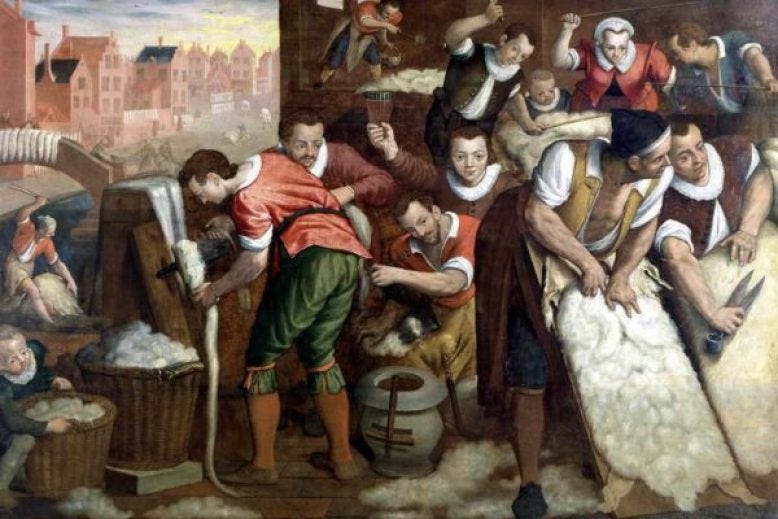
The history of the English wool trade is central to transforming England into a Commercial and eventually an Industrial society. For six centuries, from the 1200s to the early 1800s, wool shaped not only the English economy but also politics, diplomacy, and daily life. The wool trade provided the English crown with tax revenues, financed wars, created merchant companies, and introduced a large part of the population to the rhythms of a market economy. The wool trade also tied England to Flanders and the Low Countries, whose textile industries were the first to demand English wool in bulk.
The story of the English wool trade is best understood in four phases:
Raw wool exports (13th–14th centuries) – England sold most of its wool unprocessed to Flanders, gaining vast export revenues but depending heavily on foreign industry.
Wool cloth exports, Old Draperies (14th–16th centuries) – England built a powerful domestic cloth industry producing heavy broadcloth that dominated the European market. This export industry played a key role in transforming England into a Commercial society.
Wool cloth exports, New Draperies (16th–18th centuries) – Immigrant skill and fashion change produced lighter, cheaper fabrics, gradually displacing the Old Draperies and opening the way to cotton.
Cotton textile exports (18th–19th centuries) – Cotton finally surpassed wool, but only because wool had already created the skills, capital, institutions, and trade networks that made industrialization possible. This phase is typically identified with the Industrial Revolution, but it is equally accurate to call it as the final step in the transformation of the English Commercial economy.
Before tracing these phases, however, it is important to understand the biological needs of sheep, the geographic strengths of England, and the central role of Flanders in shaping the trade. These background factors explain why wool became England’s great comparative advantage.
Read on…


Here are some more articles on English and British history:
Why Commercial societies are the most important type of society that you have never heard of
Did the British Industrial Revolution occur in the 17th century?
The historical significance of the Industrial Revolution in Britain
Why European settlers in New England and Middle Colonies did so well
If you enjoy reading this article, you might also be interested in reading my “From Poverty to Progress” book series:

Biology of sheep
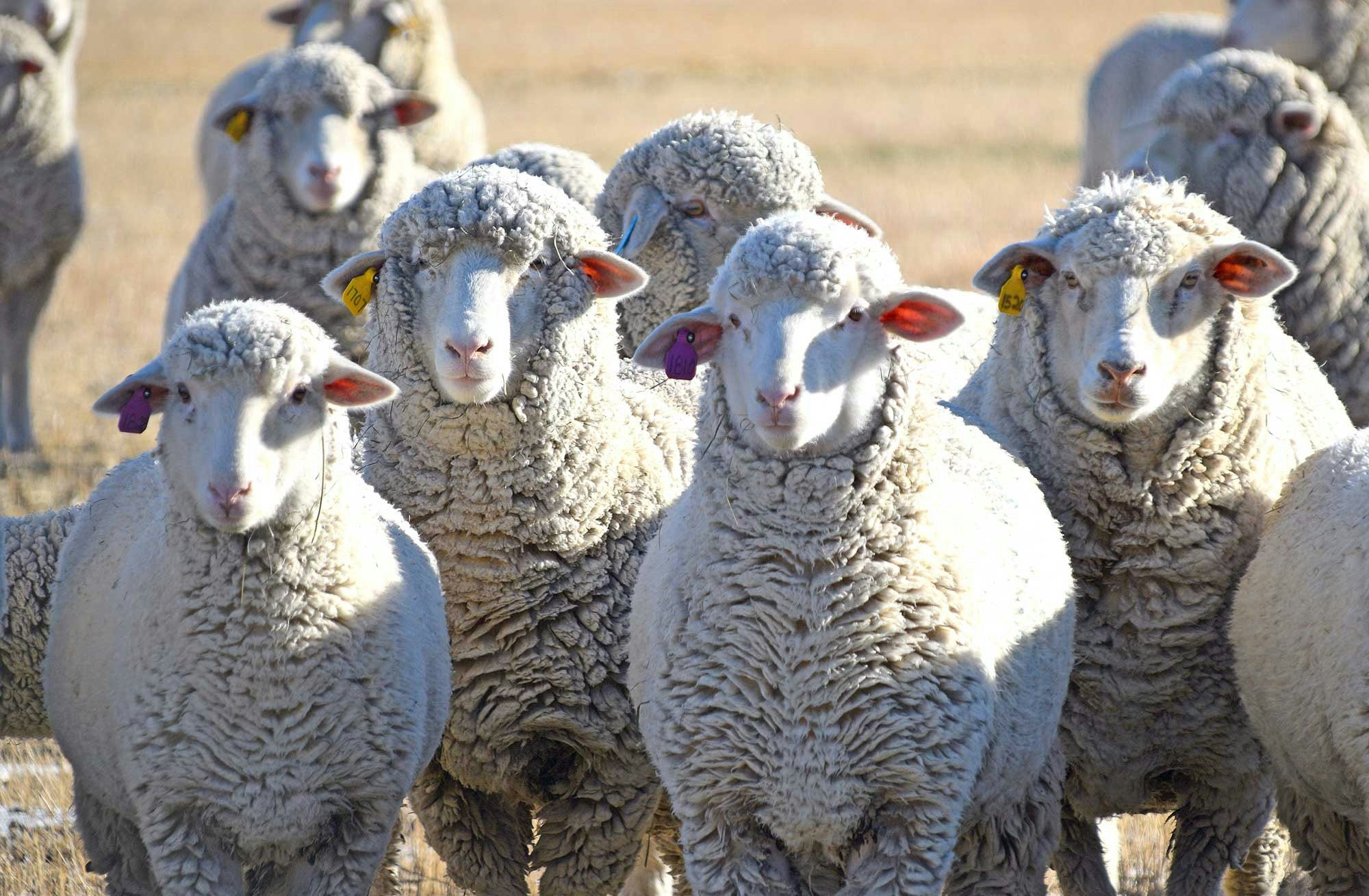
Sheep do not produce high-quality wool in every environment. To grow long, fine, and strong fibers—known as staples—sheep require several conditions. They need mild winters that avoid extreme cold stress, good year-round grazing with protein-rich grasses, and relatively dry soils that keep fleeces clean. Sheep also require careful breeding, selective culling, and management against parasites, which thrive in wetter or more tropical environments.

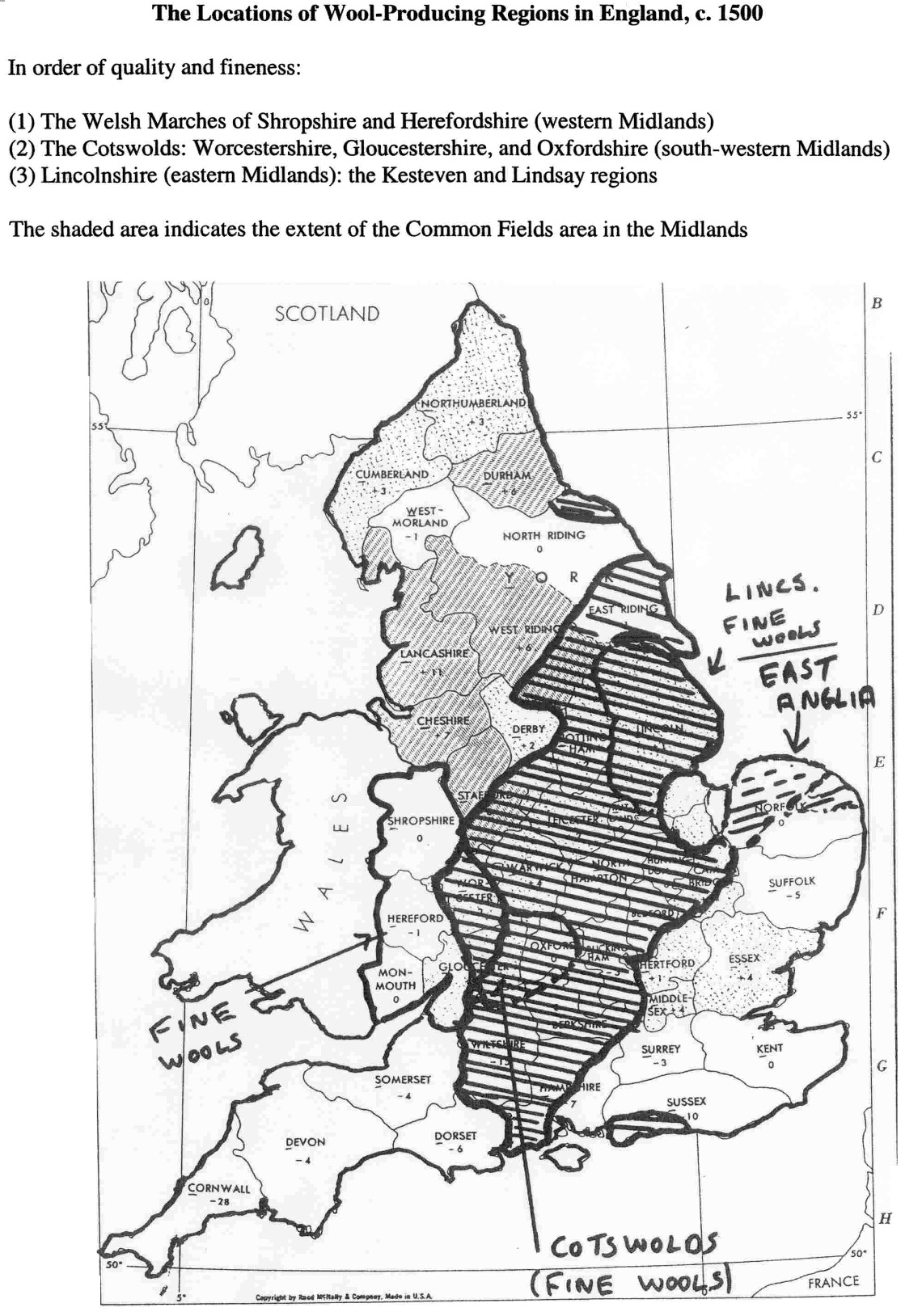
The finest wool in medieval Europe came from regions where these conditions were met. Spanish merino sheep, bred on the dry plateaus of Castile, produced short but exceptionally fine fibers prized in Italy. England’s native breeds, especially in the Cotswolds, Lincolnshire, and the Welsh Marches, developed longer staples—fibers that were both strong and smooth—ideal for weaving heavy, durable broadcloth. These staples made English wool distinctive and sought after.
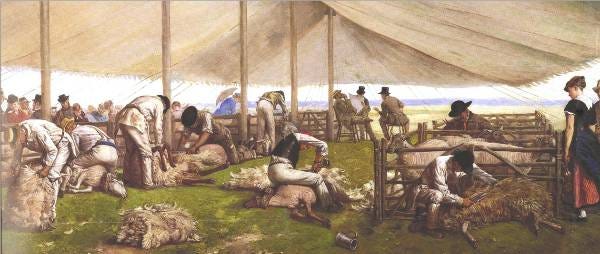
Producing such wool also required skill in shearing, sorting, and packing. Fleeces had to be skirted (removing dirty edges), sorted by quality, and packed in uniform sacks or tods. Buyers in Flanders expected clean, even, and predictable bales, and English producers learned to meet those standards.
England’s geography
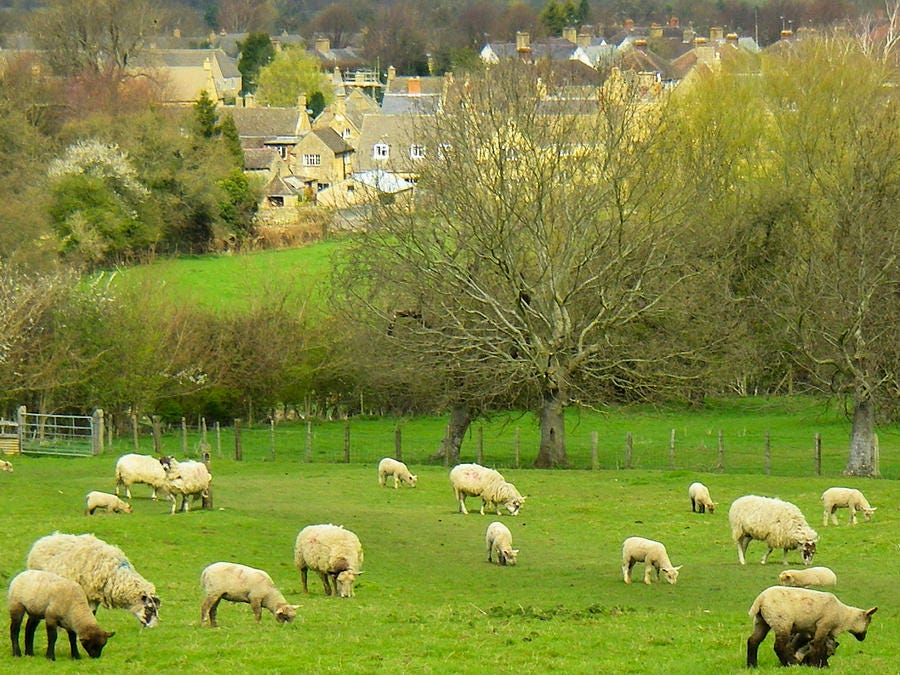
England’s geography made it one of the best regions in Europe for raising sheep at scale. The island’s climate was temperate, with cool summers and relatively mild winters. Rainfall was steady, supporting lush pastures. Many areas had rolling hills and light soils less suited to grain farming but perfect for grazing.
Large areas of common land gave peasants and tenants access to grazing rights. Lords and monasteries could establish extensive sheep walks, especially on downs and uplands. Regions such as the Cotswolds developed economies that revolved almost entirely around sheep.
Geography also gave England strategic advantages for trade. The island lay close to Flanders across the narrow English Channel, making water-borne transport relatively easy. Coastal ports from Boston and Lynn in the east to Southampton in the south handled exports, while London gradually emerged as the main hub. Rivers and packhorse routes linked inland wool-producing regions to the ports.
In short, England’s climate, landscape, and location combined to make it ideal both for producing wool and for exporting it.

Flanders industry
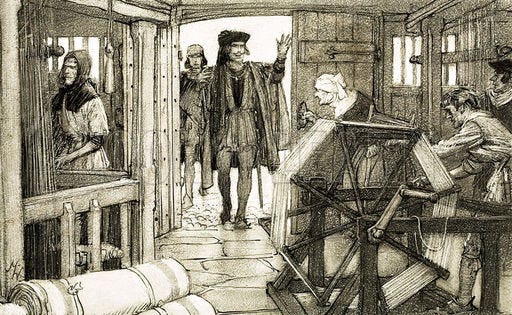
If English hills were the pasture of medieval Europe, Flanders was the loom. In the thirteenth and fourteenth centuries, Flanders (in modern-day Belgium) was Europe’s textile workshop. Towns like Bruges, Ghent, and Ypres were densely populated, well organized, and technologically advanced in weaving, dyeing, and finishing cloth. Guilds regulated quality and maintained training systems, ensuring consistent production.
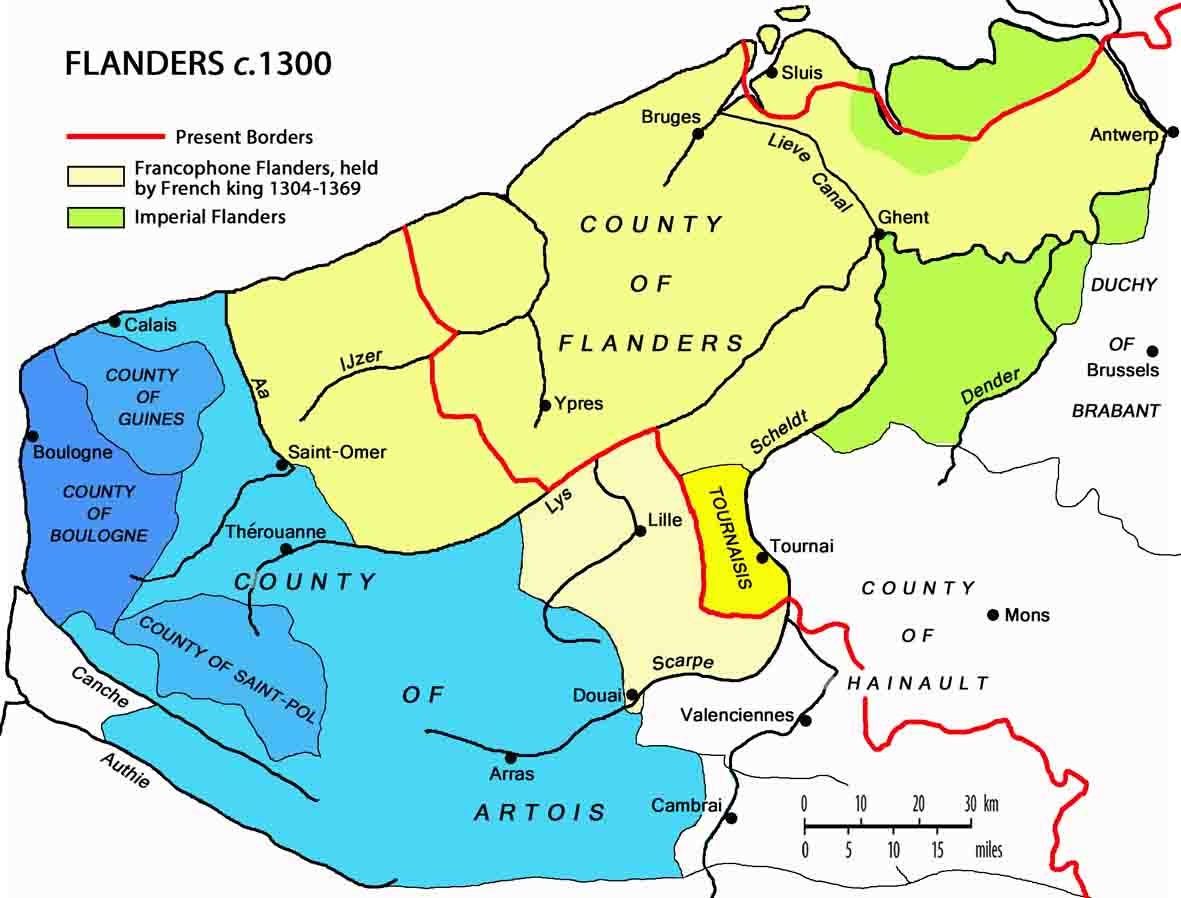
Dense towns, skilled guilds, tidal ports, and a web of navigable waterways had made the county the workshop of Europe. Its drapers—organized, capitalized, and technically sophisticated—turned English staples into the world’s best broadcloth. Flemish demand disciplined English production. Flemish buyers were finicky: they prized long, even staples, properly skirted fleeces, clean packing, and reliable weights.
Flanders had little pastureland of its own and relied almost entirely on imported wool. England’s proximity was critical. Wool could be shipped across the Channel in just a few days, making trade both fast and reliable. Flemish buyers demanded England’s long-staple wool for their broadcloth industry.
This demand shaped English practices. Flemish clothiers rejected dirty or uneven bales, forcing English shepherds to improve flock management and wool preparation. Flemish merchants also brought credit, often backed by Italian bankers, which allowed the trade to expand far beyond the limits of ready coin.
For two centuries, England and Flanders formed a symbiotic partnership:
England provided the raw material,
Flanders provided the processing skill.
Without Flanders, England’s wool would have had little market. Without England, Flanders would have lacked its best fiber.
Phase 1: Raw wool exports
Pastoral expansion and the rise of English wool
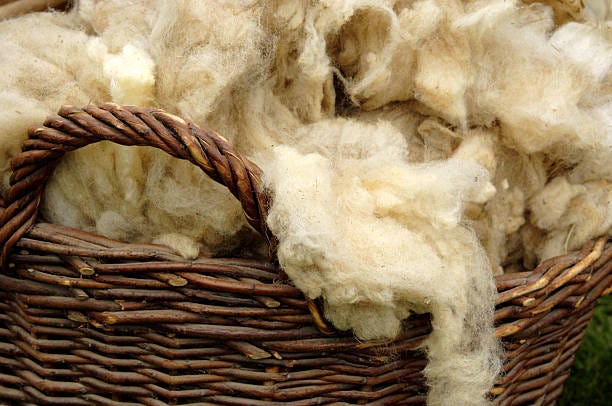
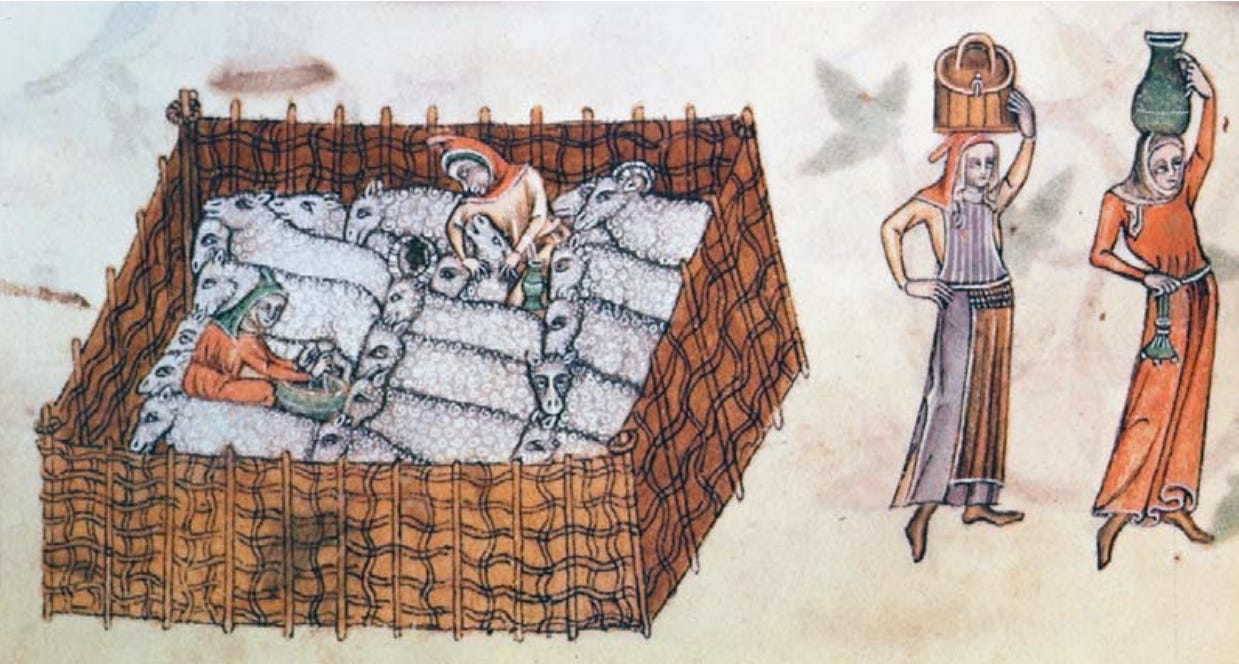
In the twelfth and thirteenth centuries, England’s pastures and climate allowed sheep farming to expand rapidly. Monasteries, particularly the Cistercians, organized large sheep runs on their estates, while lords and peasants grazed flocks on common land. Sheep required less labor than grain and produced wool, a product with strong overseas demand.
By the 1200s, English wool had gained a reputation for quality across Europe. Long-staple fleeces from the Cotswolds, Lincolnshire, and the Welsh Marches were especially prized. Flemish weavers paid premium prices for this wool, which they turned into fine cloth. Italian merchant-bankers extended credit through bills of exchange, allowing English wool to be bought on paper and paid for later in Bruges, Ghent, or Florence without transporting coin.

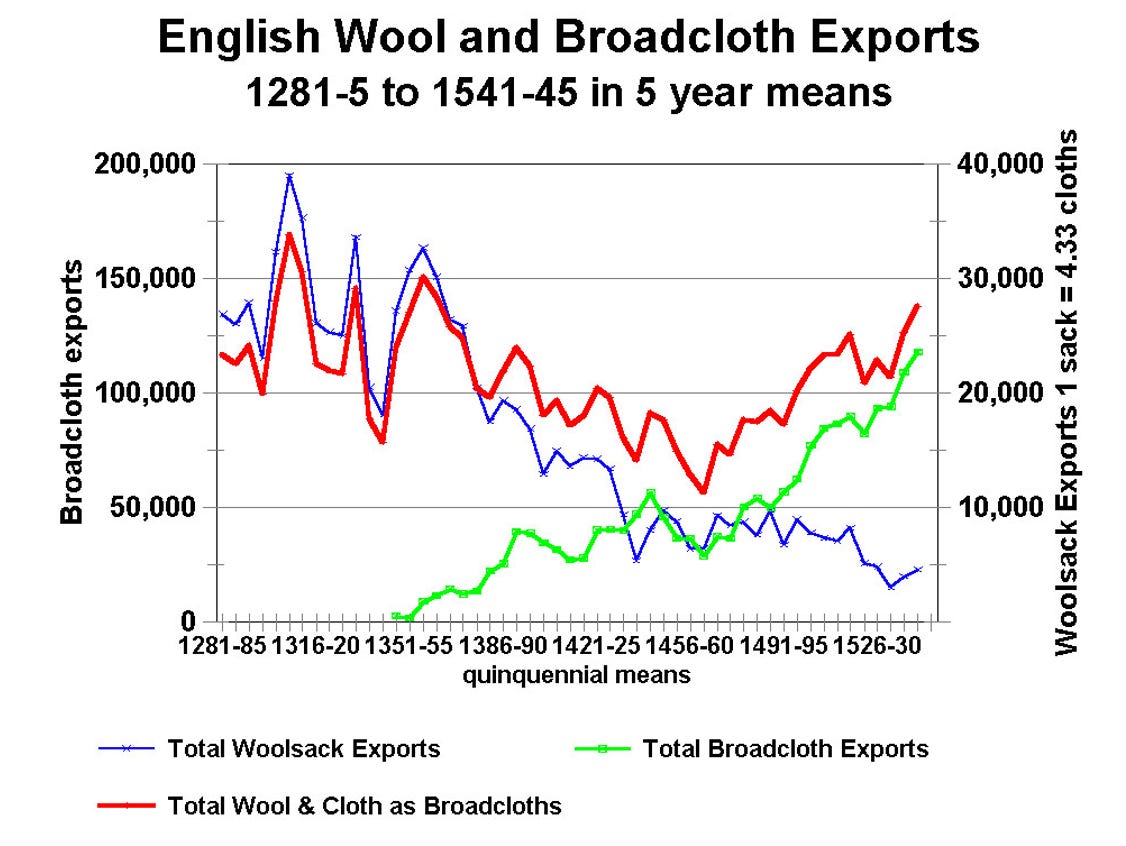
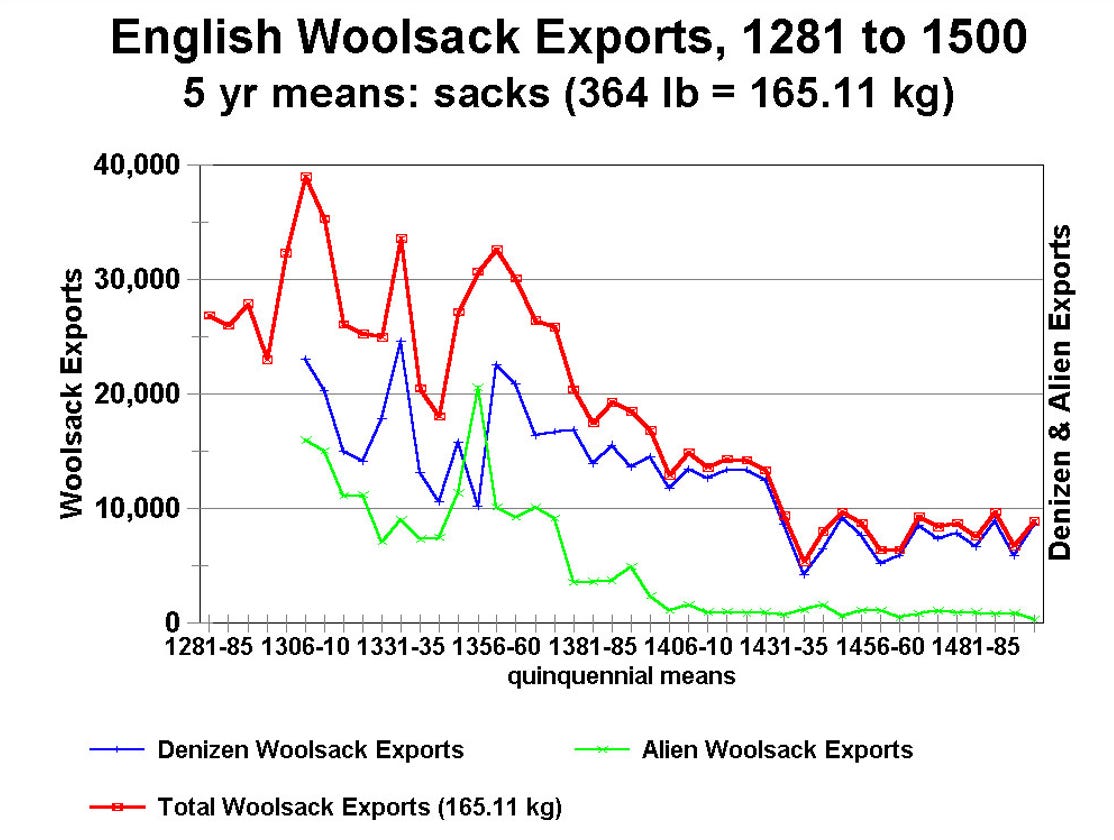
At this time, raw wool dominated the English economy. In the thirteenth and fourteenth centuries, it accounted for about 90 percent of the kingdom’s export revenues. England did have a cloth industry in some eastern coastal towns between York and London, but it was small and uncompetitive compared to Flanders. England’s wealth thus depended almost entirely on exporting unprocessed wool.

The crown discovers taxation
The scale of this trade gave English kings a new source of income. In 1275, Edward I introduced the “Great Custom,” a tax on every sack of exported wool. This innovation tied royal finances directly to international trade.
Kings quickly realized how useful this revenue could be. In the 1330s, Edward III raised wool export taxes sixfold to finance campaigns in France during the Hundred Years’ War. Wool taxes became the backbone of the crown’s war chest, allowing it to raise armies and maintain long wars.
Wool taxes became central to the ongoing power struggle between the English Parliament and the English monarch. With each war, the English monarch tried to leverage the military emergency into permanent sources of revenue outside the purview of Parliament, while Parliament tried to force more limited temporary taxes that kept the Crown on a tight fiscal leash. Parliament did not win a total victory until the Glorious Revolution centuries later.
England’s dependence on Flanders
During this period, England and Flanders formed a close but unequal partnership. Flanders relied on English wool to feed its looms, and England relied on Flemish weavers to buy its fleeces. Flemish merchants were selective buyers who rejected dirty or uneven bales, pushing English producers to improve flock management and packing. In this way, Flemish standards shaped English production.
But dependence was risky. If Flemish demand collapsed or political tensions rose, England’s economy and crown finances suffered. Unlike Flanders, which had diversified into manufacture, England in the thirteenth and early fourteenth centuries was still mainly a raw material exporter.
England compared to modern developing nations
England’s position in this period resembles that of many modern developing nations that export raw materials to wealthier industrial economies. Countries today that sell crude oil, copper, or unprocessed agricultural goods often depend heavily on a single export for revenue. Like medieval England, they face the problem of “commodity dependence.” And like medieval England, they could not free themselves from this dependence until they can create higher value-added export industries (the Fourth Key to Progress).


Just as England relied on wool buyers in Flanders, modern states rely on demand from industrial powers in Europe, North America, or East Asia. Prices are set abroad, and producers at home have little control. In both cases, the exporting country earns revenue but does not capture the greater value added by turning raw material into finished goods.
The eventual transition England made—moving from exporting raw wool to exporting cloth—was similar to what modern economists call “moving up the value chain.” It meant keeping more of the profits, employing more workers domestically, and developing skills that supported long-term industrial growth. The story of English wool in the thirteenth and fourteenth centuries is therefore not only medieval history but also a case study in the challenges that resource-exporting nations face today.
Phase 2: Wool cloth exports – The Old Draperies
The Calais Staple and monopoly control
The decisive change from raw wool to cloth exports took place in the later fourteenth century. England’s capture of Calais in 1347 in the Hundred Years’ War gave the crown a permanent foothold on the continent. In 1363, Edward III established Calais, France as the sole staple port for English wool exports.
All foreign merchants had to buy English raw wool at Calais, and
Only members of the Company of the Staple—a crown-licensed monopoly—could sell wool at Calais.
This was not just a logistical move. It was a deliberate effort by the crown to control and tax the raw wool trade more efficiently. By concentrating exports at Calais, the crown could monitor transactions and collect customs at the source. Duties were heavy: by the 1390s, taxes made up about half the price of wool exports.
England was like other Agrarian regimes, until…
Anyone who is a regular reader of my Substack column and book series should not be at all surprised at this royal behavior. As is typical in Agrarian societies, the English political elite formed a monopoly to tax economic growth and convert the surplus into:
Military power to defend the regime.
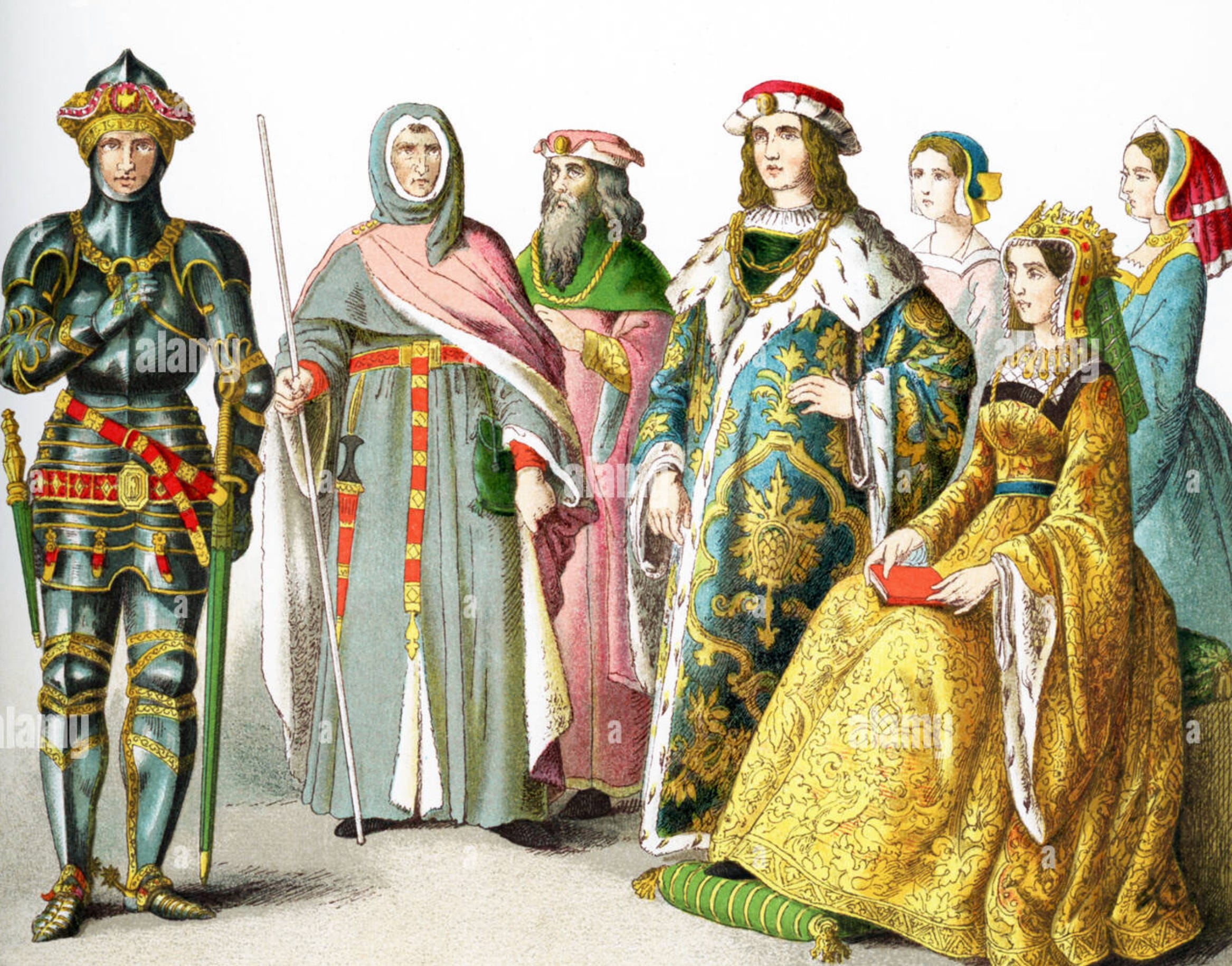
Conspicuous consumption by titled elites to flaunt their social status.
Military power to conquer other territories to gain even more tax revenue.
In this sense, the English monarch was not different from other predatory Agrarian regimes on the Continent. The difference was that Parliament was ultimately able to tame the beast, whereas elsewhere on the Continent, the centralizing monarchy won (except in the Netherlands, Scandinavia, and Switzerland,
The gradual evolution of the English textile industry was central to explaining why England became a Commercial society, while most of the rest of the European Continent remained an Agrarian societies.


Expansion of the cloth industry
These royal taxes on raw wool, however, had an unexpected result. While most royal taxes tend to stifle economic growth, these prohibitive English wool taxes spawned a new competitive export industry. This was not royal industrial policy. It was a very fortuitous accident. The English Crown just wanted tax revenue so it could fight wars, but these royal wool taxes fundamentally reshaped the English economy.
Royal taxes on raw wool changed incentives. Exporting raw wool became less profitable, while turning wool into cloth at home avoided much of the burden. Merchants and producers increasingly realized that they could capture more value by manufacturing. The crown did not always plan this outcome, but its fiscal hunger made cloth-making relatively more attractive than shipping raw fleeces.
Between 1390 and the late 1420s, the English cloth industry expanded rapidly. The Midlands and southeastern counties shifted their economies toward livestock and wool supply. More wool was channeled into domestic workshops, reducing reliance on Flemish buyers.
This shift was also shaped by royal policy. Heavy customs duties on wool discouraged exports, while cloth was often taxed more lightly. The effect was to push English entrepreneurs to invest in weaving, fulling, and dyeing.
But politics interfered. In the late 1420s, the Calais Staple introduced bullion laws, requiring foreign merchants to pay in silver and gold rather than bills of exchange. This backfired. Flemish clothiers turned to Spanish merino wool instead, prized for its fineness. English raw wool exports collapsed, falling by half. The reliance on cloth exports became even more pronounced.
The Crown changes incentives
These Royal taxes and monopolies changed market incentives in the wool industry radically. And they also gave the monarchy strong incentives to grow the wool cloth industry to raise revenues for its many wars. This institutional architecture mattered in three ways.
Customs on wool and later on cloth gave the monarchy semi-predictable cashflow, which in turn normalized bargaining with parliaments over taxation and trade rules—an early rehearsal for a negotiated commercial state.
The staple towns created enforceable standards for packing, weighing, and grading.
The regulations transformed merchant companies into partners of the crown, knitting elite commerce to national policy. Yet the same fiscal appetite also tempted rulers to weaponize trade: embargoes to coerce Flanders during diplomatic crises showed that commerce had become an instrument of statecraft.
Crisis and recovery
The mid-fifteenth century brought turbulence. Between 1435 and 1465, England experienced a severe commercial depression. War with France disrupted trade routes, political instability at home unsettled merchants, and the loss of key markets hurt exports. Many clothiers and exporters went bankrupt.
Yet recovery followed. Between 1465 and the 1520s, England rose to dominate the European cloth industry. This was a major pivot in English economic history, and one that later generations could build upon.
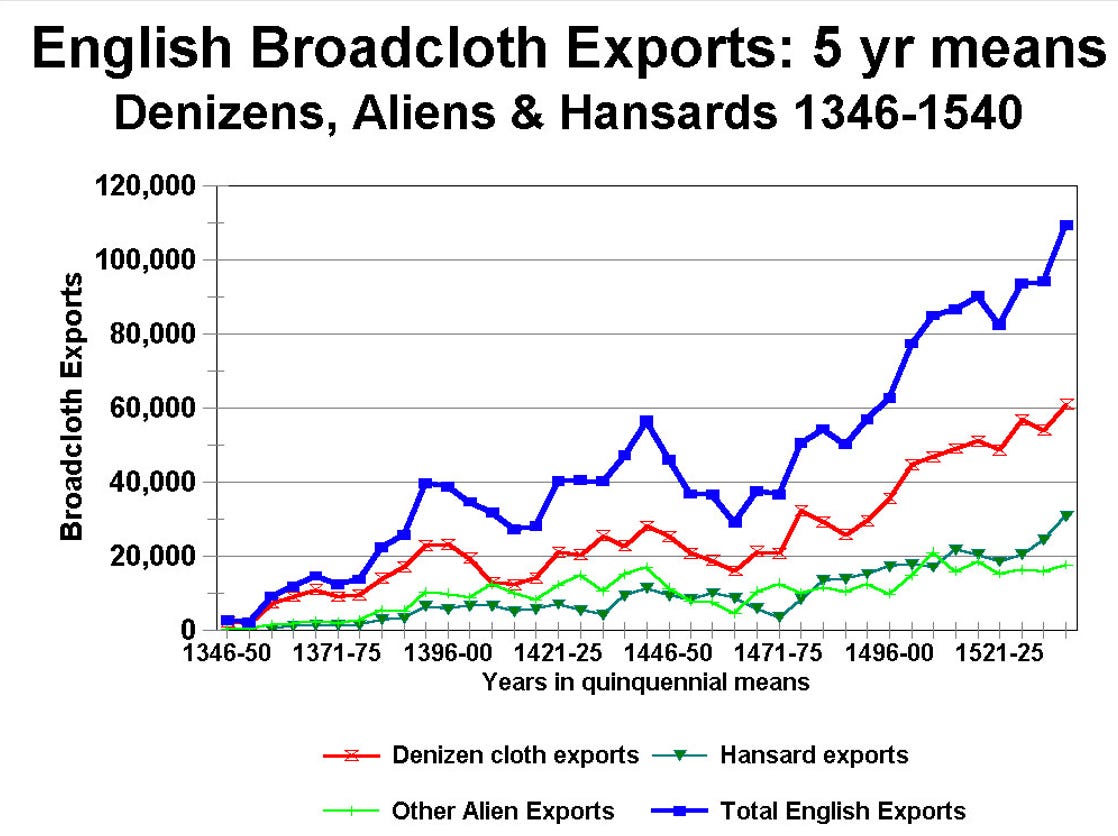
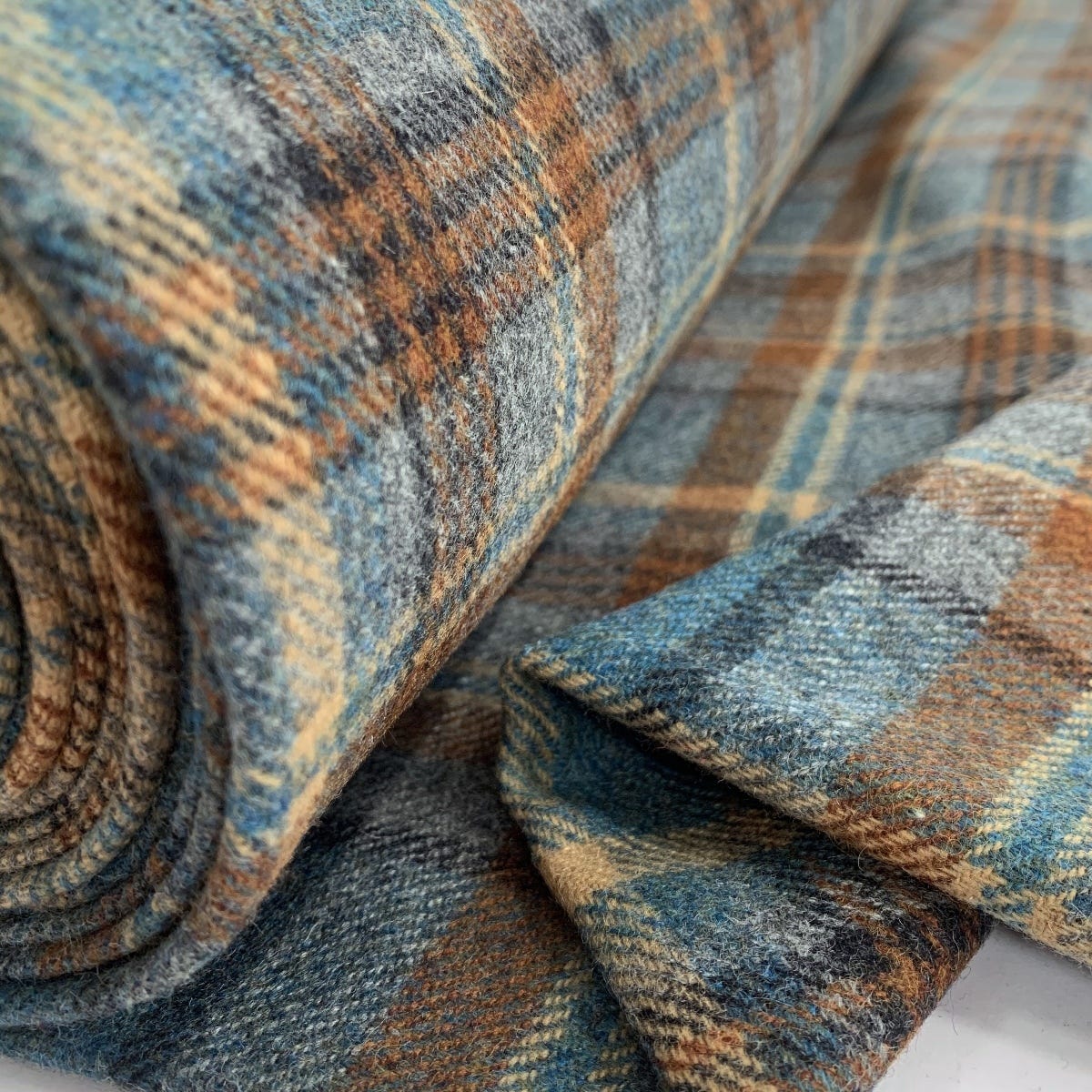
Heavy broadcloths—called the Old Draperies—became the kingdom’s signature export. These were fulled, sheared, and dyed to a high standard, creating a fabric so durable it could last a lifetime. Foreign consumers recognized English broadcloth as both high-quality and dependable.
The main market was Antwerp, which by the late fifteenth century had replaced Bruges as the commercial hub of northern Europe. Antwerp offered open fairs, abundant credit, and connections to German silver and copper mines, making it the perfect clearinghouse. English cloth flowed in by the tens of thousands of pieces, to be re-exported across Europe.
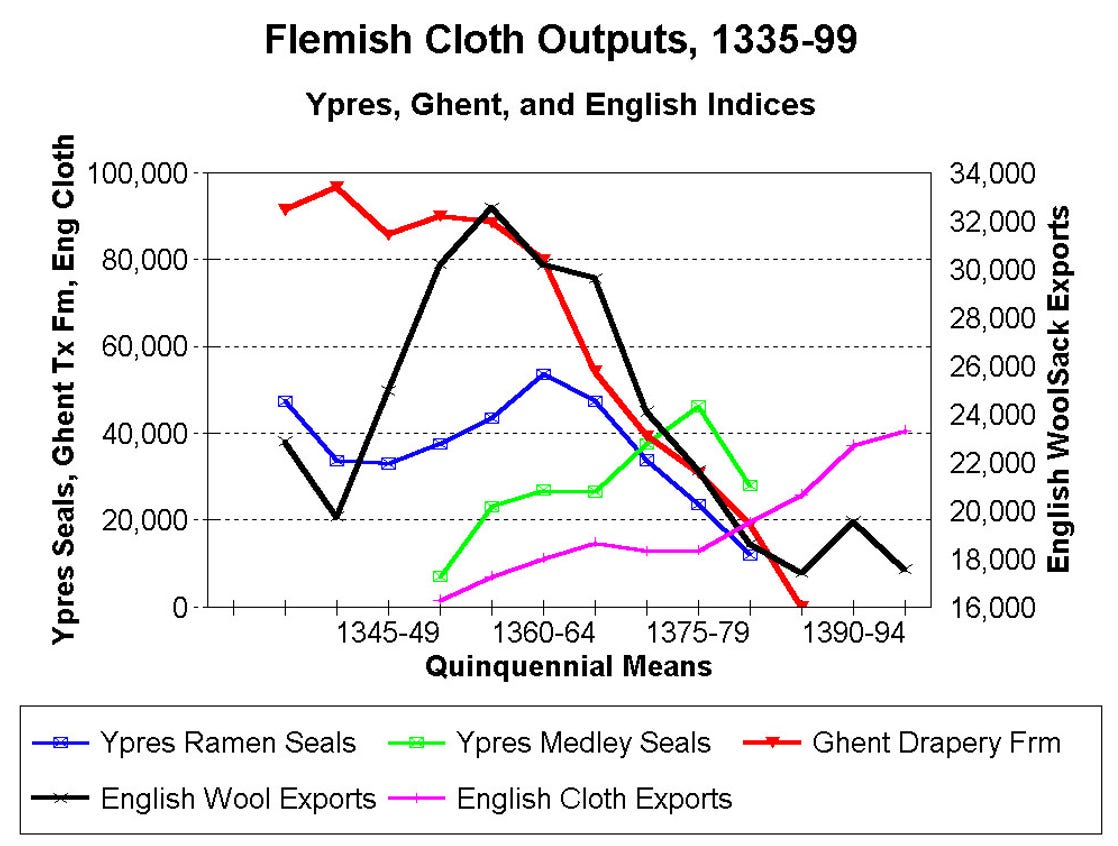
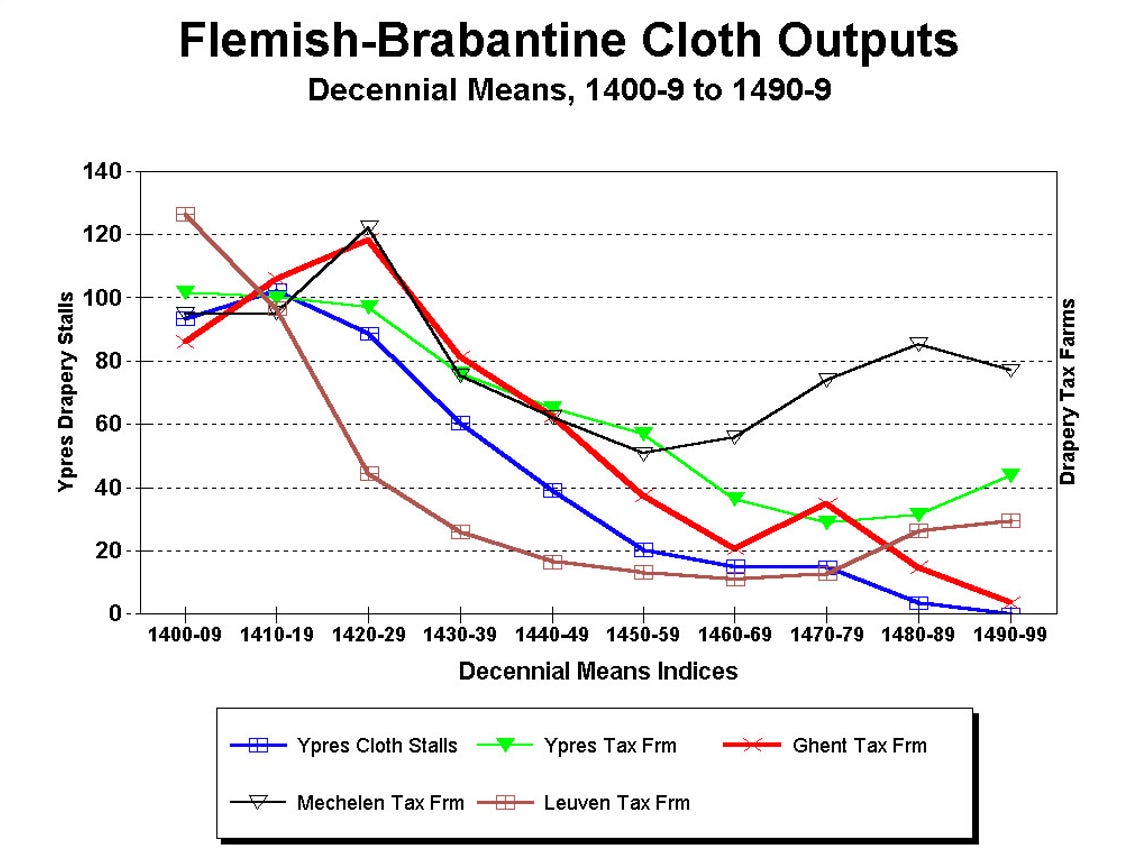
The result was a steep decline in the once-dominant Flemish cloth industry. The English had copied the Flemish textile manufacturers and beat them at their own game. English geography and sheep provided the raw materials, and Crown taxes provided the incentives to move up the value chain.
The Rise of London
By the 1470s, almost all of England’s cloth trade passed through London. London had long been the political capital of England, but it was the wool cloth trade that transformed it into a dynamic commercial city. London’s rise as the commercial capital was inseparable from the cloth trade.
The Merchant Adventurers, a company of exporters, organized the flow. London’s Blackwell Hall became the central market for cloth, where provincial clothiers consigned their pieces before they were shipped abroad. The Company of Merchant Adventurers to New Lands was a very early joint-stock ownership company that combined a Royal monopoly and private capital. Such an organization dominated the early English and British empire.
The putting-out system and rural industry
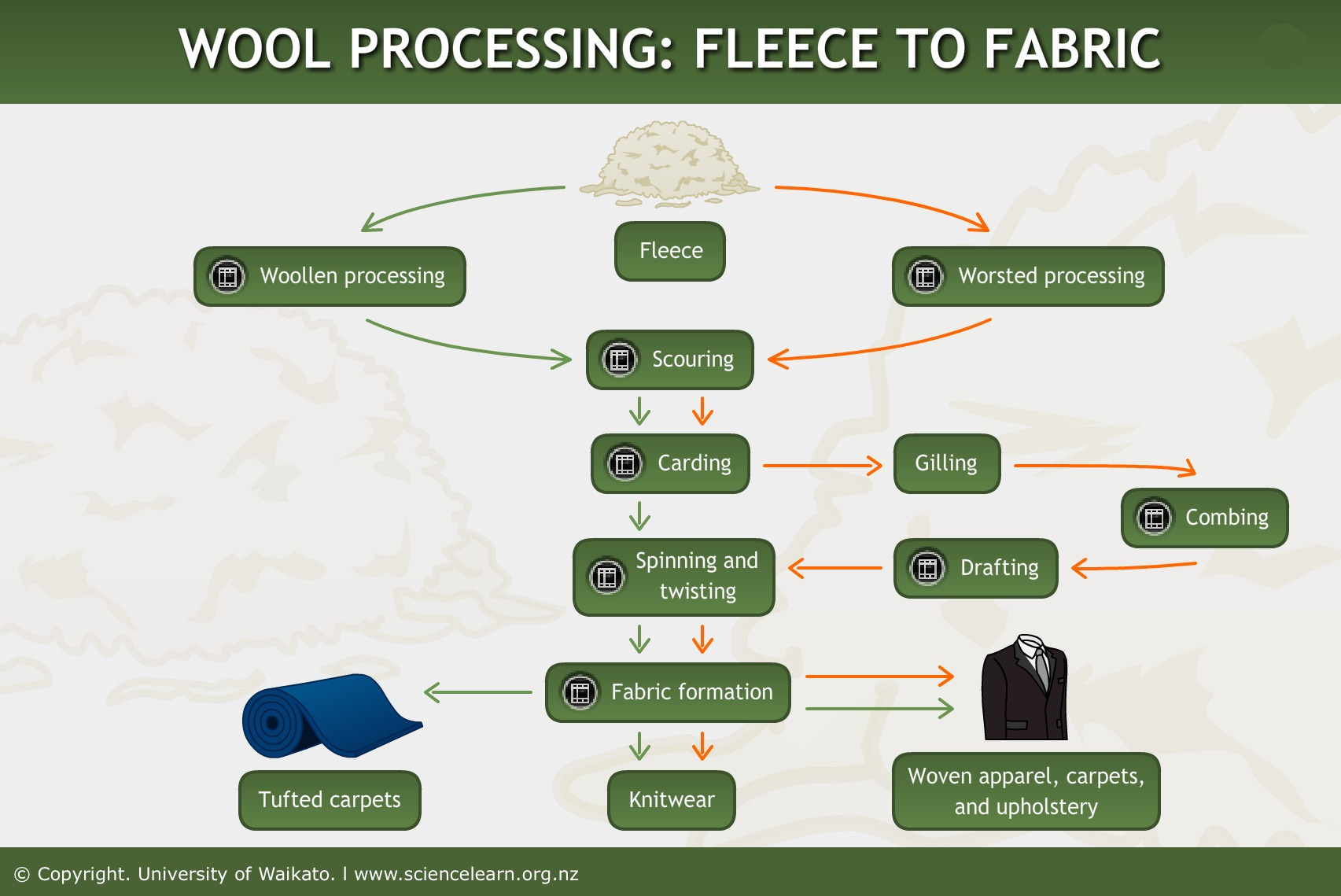
The backbone of wool production was the Putting-out system. The Putting-out system was a sophisticated manufacturing supply chain with many steps. Each step was managed by clothiers:
Clothiers purchased raw wool from sheep ranches,
Clothiers transported the raw wool to villages.
Clothiers paid peasant women working at home to do the carding and spinning .
Carding is disentangling, cleaning, and aligning the raw wool fibers. Spinning is twisting the carded wool to form yarn.Clothiers distributed yarn to weavers in rural villages. The weavers then interlaced the yarn to form cloth.
Clothiers collected the finished cloth from the weavers and distributed on the final steps:
The cloth was fulled in water-powered mills. Fulling is the cleansing of the wool cloth to eliminate oils, dirt, and other impurities and shrinking it down into a dense weave.
The cloth was dyed, to give it the proper color that end customers desired.
The cloth was cut into its proper standardized size
Finally, the clothiers shipped the finished cloth to the Continent. Continental tailors, especially in the Flanders, Germany, and Northern Italy, purchased these bolts of cloth and transformed them into clothing, upholstery, and other finished products.
The tailors then sold the finished product to merchant, who transported them to major redistribution centers in cities like Antwerp.
The finished product then gradually worked its way across the European continent to the final customer.
As you can see, the putting out system was not simple. In many ways it mirrors a modern international supply chain. The main difference is that:
The original raw material came from farms instead of mines
The manufacturing was distributed across families and small artisans rather than massive centralized factories.
This wool putting-out system had a transformative effect on the English economy. The system spread employment widely. Women and children spun yarn; men wove cloth or worked in mills. Whole villages became dependent on weekly cycles of advances and payments. The putting-out system linked rural households to national and international markets, embedding market discipline in everyday life.
Crown taxation reinforced this. By making wool exports costly, the crown nudged more wool into the hands of clothiers, who then organized rural labor. What might have remained a trade dominated by large landowners exporting bales instead became a dispersed, labor-intensive industry touching tens of thousands of households.
Guilds, standards, and the alnage
As cloth exports grew, quality control became vital. Alnagers, royal officials, measured cloth widths and lengths, sealed approved pieces, and levied dues. Statutes required uniform dimensions, protecting England’s reputation abroad. Dyeing, an expensive and technical process, was regulated by guilds that tested skill and punished fraud.
Once again, crown policy shaped incentives.
Alnage fees raised revenue, but they also rewarded compliance by certifying cloth for export. English broadcloth gained credibility in Antwerp and beyond because buyers trusted its statutory dimensions. In an era before brand names, state-backed regulation gave English producers a kind of collective trademark.
The depression and Antwerp dominance
The depression of 1435–65 demonstrated how vulnerable England was to external shocks. This was and still is a very common problem with nations that specialize in commodity exports.
But the subsequent recovery showed how crown taxation, merchant organization, and rural industry had permanently shifted incentives. By the 1460s, exporting raw wool was a shrinking business; exporting cloth was the future.
Between 1465 and the 1520s, England dominated the European cloth trade. While cloth is not as profitable as clothing, it was a big step up from the raw wool. Significant sections of the English economy, particularly in the Southeast were becoming commercialized. England (along with Flanders and the Netherlands) was moving up the value chain faster than just about any kingdom in the world.
Antwerp became the funnel through which English broadcloth supplied consumers from Italy to the Baltic. London merchants built fortunes, the crown gained customs revenue, and rural England was tied ever more closely to international commerce.
Incentives and the crown’s unintended strategy
The crown’s fiscal policies were not always strategic, but they were effective. By taxing wool heavily, the monarchy made cloth production relatively more profitable. By licensing companies like the Staplers and the Merchant Adventurers, it tied merchants directly to state interests. By enforcing standards through alnagers, it gave English cloth international credibility.
The crown wanted revenue to fight wars. In the process, it reshaped the entire economy. England moved decisively from being a raw material exporter to being a manufacturer of finished goods. The lessons of this phase—that taxation can redirect production, that protection of quality builds reputation, and that concentrated markets like London and Antwerp can anchor growth—would echo into later centuries.

From Agrarian to Commercial society
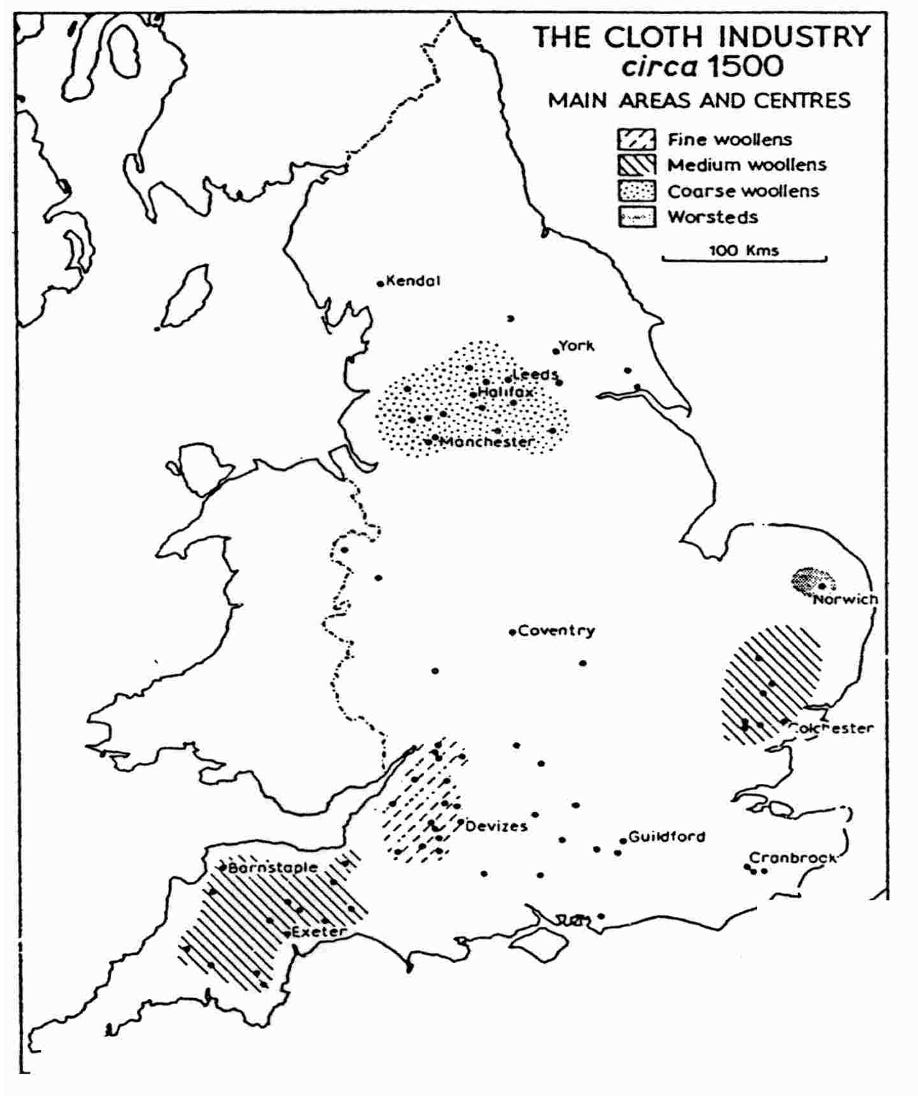
The rise of cloth exports did more than redirect wool from sacks to looms. It fundamentally changed the structure of English society, especially in the southeast and Midlands (see map below). These regions had once been dominated by an Agrarian system, where most people worked the land to produce food for subsistence or local markets. Agricultural surpluses supported lords, monasteries, and a small urban sector, but economic life was still rooted in farming.
The expansion of the wool cloth industry shifted this balance. Villages that once depended mainly on grain cultivation found themselves tied into national and international markets through spinning, weaving, fulling, and dyeing.
Families no longer relied only on the rhythms of the harvest. They now earned cash by producing cloth, spending their wages in markets, and entering contracts with clothiers. The economy of the southeast became more specialized, less tied to subsistence farming, and more dependent on trade.
In effect, large parts of England were transformed from an Agrarian society into a Commercial society. In a Commercial society, the majority of people acquire food not by growing it themselves but by earning wages or profits and then using money to buy food in the marketplace. This resembled the transformation that had already taken place in the city-states of Northern Italy and the textile towns of Flanders. Like those earlier pioneers, England’s southeast now lived by contracts, markets, and exports rather than by subsistence agriculture.
This transition marked the beginning of England’s long trajectory toward modern economic growth. And this happened centuries before the Industrial Revolution. The cloth trade did not just enrich merchants and the crown; it reshaped everyday life, altered land use, and created the habits of a commercial people.

From this point onward, southeast England and particularly London would increasingly resemble the Commercial societies of Italy and Flanders that had first invented commercial living. This theme—the movement from agrarian self-sufficiency to commercial specialization—runs through the rest of the history of wool, and ultimately explains why England was able to industrialize before other parts of Europe.
Regional impact
To be clear, I am absolutely not saying that all of Englands, Scotland, Wales, and Ireland were Commercial societies. That was clearly not true. Most regions within the British isles were either not much impacted by the wool trade or solely focused on raising sheep. Those regions within the British Isles still functioned like Agrarian societies throughout the Eurasia.
What made the impact of the wool cloth trade so important is that it was concentrated in certain regions. By the late fifteenth century, the putting-out system—where clothiers advanced wool and paid rural families to spin and weave it—was most concentrated in:
London: the great commercial hub of wool cloth exports.
East Anglia (in the southeast): particularly Suffolk and Essex, with towns such as Lavenham, Hadleigh, and Colchester—many of which grew wealthy enough to build elaborate wool churches.
The West Country (in the southeast) : especially Wiltshire, Gloucestershire, and Somerset, centered on towns like Trowbridge, Bradford-on-Avon, and Frome.
The West Riding of Yorkshire (north-central) : a newer center that became more important in the sixteenth century.
The Cotswolds and Thames Valley (south-central) around Cirencester and Newbury, which were tightly integrated into London’s export system.
These regions were semi-rural and dotted with market towns. They were not dominated by guilds or large urban workshops; rather, hundreds of small producers worked under contract to clothiers who organized supply and marketing.
Direct quantitative data are scarce before the 1540s, but historians such as Eileen Power, T.H. Lloyd, and John Hatcher estimate that tens of thousands of households in southern and eastern England were employed in spinning, weaving, and fulling by 1500. In Suffolk alone, perhaps one-third of all households were engaged in some part of the textile trade.
The most telling evidence comes from urban structure: towns like Lavenham, Long Melford, and Bury St Edmunds had per capita wealth and building patterns similar to the textile cities of Flanders. The construction of monumental wool churches—lavishly financed by merchant families—signals both high profits and deep commercialization.
Did these regions qualify as Commercial societies?
By your own framework, yes—southeast England around 1500 qualifies as a Commercial society, though not yet an industrial one. Most people still lived in villages, but their livelihoods depended on producing for distant markets rather than subsistence farming. They sold their labor and skills for cash, bought food instead of growing it, and lived within a dense web of contracts, credit, and competition.
In other words, southeastern England had moved beyond the Agrarian model of the rest of Eurasia. Its economy resembled that of Flanders and northern Italy a century earlier—trade-based, decentralized, and driven by specialized skill and market demand.
The Five Keys to Progress
Did these regions has the Five Keys to Progress (what I believe are the necessary preconditions of material progress)?
Almost.
England lacked fossil fuels (though not for long), but like the other Commercial societies in Northwest Europe, southeast England already possessed the first four of the Five Keys to Progress:
Efficient food production system,
Dense trade-based cities,
Decentralized power, in the form of:
The Magna Carta, which gave nobles rights that the King could not violate
English Common Law, which applied the rule of law to all monarchs, nobles, and later commoners.
Autonomy for cities, particularly London
House of Commons, whose approval the King needed to raise armies
A lack of a regular army that could be used by the king to oppress citizens (though the King desperately wanted that)
High-value export industry (wool cloth).
So while England as a whole was mixed—agrarian in the north and west, commercial in the southeast—the cloth-producing belt from East Anglia through the Thames Valley to Wiltshire was unmistakably commercial by 1500. It was this region, not yet industrial but already market-oriented, that supplied the social and institutional foundations for the Industrial Revolution centuries later.
Phase 3: Wool cloth exports – The New Draperies
Peak and decline of the Old Draperies
By the mid-sixteenth century, exports of heavy broadcloth reached their peak. In the 1550s, broadcloth was still the backbone of English exports, sustaining rural employment and filling the crown’s treasury with customs.
Yet decline followed. Antwerp, the main market for English cloth, fell into crisis as war raged between Spain and the Dutch provinces. The sack of Antwerp in 1576 was especially devastating. Spanish repression pushed merchants elsewhere, and the old broadcloth struggled to compete with lighter and cheaper fabrics now preferred by consumers across Europe.

Refugees and the birth of the New Draperies
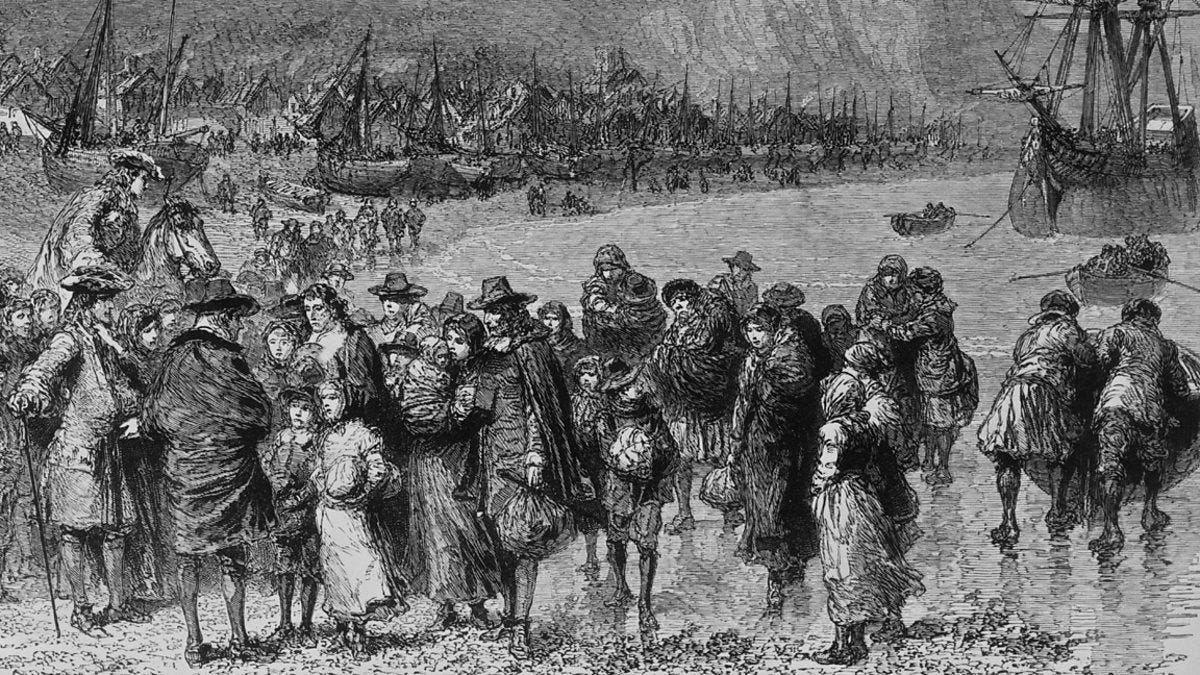
England responded with adaptability. Refugees fleeing the Spanish destruction of textile centers such as Hondschoote brought vital skills. Most were Protestants from the Low Countries—ethnically Flemish and Walloon—seeking safety from persecution. They settled in Norwich, Colchester, Sandwich, and other towns in southeastern England. This was exactly the English that was most commercialized, and the highly-skilled refugees played a key role in making the region even more commercialized.
These Flemish and Walloon immigrants introduced methods for making what became known as the New Draperies. They brought advanced weaving and dyeing techniques, especially for lighter worsteds, bays, and serges. They also carried knowledge of linen and cotton working. By training local English workers and establishing workshops, the refugees transferred a broad set of capabilities that allowed England to diversify its textile exports.
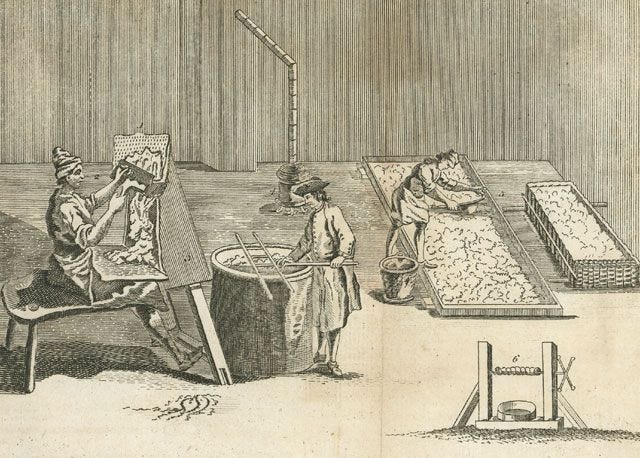
These fabrics—says, serges, bays, and worsteds—were lighter, less expensive, and better suited to southern and Mediterranean climates. They were woven from combed long-staple wool, which produced a smoother finish. They were also produced in smaller, more flexible workshops that could respond quickly to fashion.
English authorities allowed these refugees to establish workshops and train locals. The result was a transfer of technology and skill that helped England stay competitive as markets shifted.
The displacement of the Old Draperies
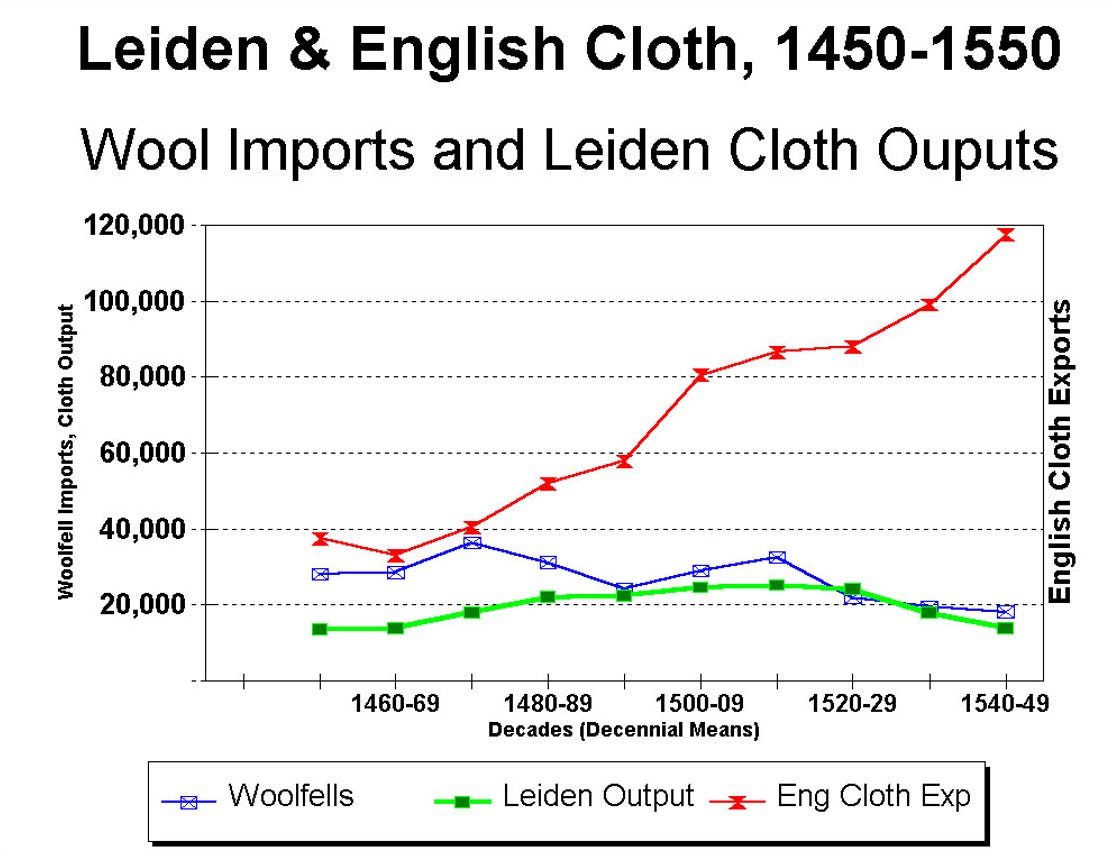
Over time, the New Draperies displaced the Old Draperies. Broadcloth remained important but no longer dominated as it had in the fifteenth and early sixteenth centuries. The New Draperies were cheaper, more adaptable, and in higher demand.
The transition was not without conflict. Producers in the traditional broadcloth districts resisted, arguing that lighter cloths threatened established standards and employment. But the market could not be reversed. By the seventeenth century, the New Draperies had become England’s leading textile export.
The Cockayne experiment and lessons learned
The Stuart monarchy attempted to accelerate this process through the Cockayne Project of 1614. The plan banned exports of unfinished cloth, forcing all dyeing and finishing to be done in England. The goal was to capture more value domestically.
But the project failed. Foreign merchants boycotted English cloth, claiming the finishing was inferior. Exports collapsed, and widespread unemployment followed. Within a few years, the scheme was abandoned.
The failure taught a critical lesson: state policy could not substitute for quality or reputation. Over time, English dyeing and finishing did improve, but it came gradually through skill, investment, and training rather than by decree.
Enclosure and the improvement of flocks
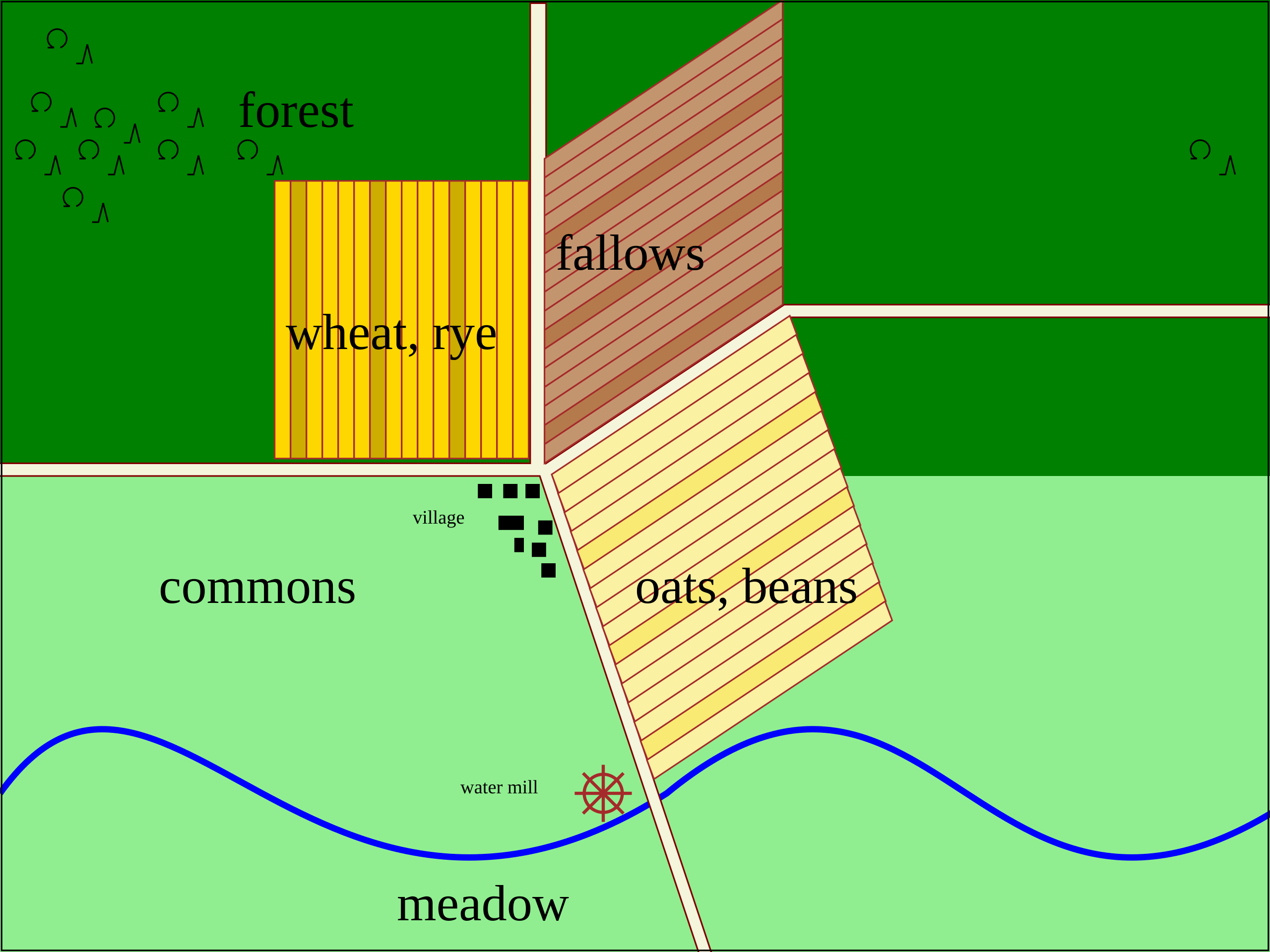
The sixteenth and seventeenth centuries also saw profound changes in the countryside. Enclosure of medieval common grazing fields into privately-owned farms expanded, especially in the Midlands and southeast. This gave landlords more control over land and flocks.
Sheep could now be bred systematically for better wool quality. Pastures could be managed more carefully. By the eighteenth century, breeders like Robert Bakewell pioneered scientific methods of stock improvement. The wool they produced fed directly into the New Draperies, ensuring both volume and quality.

Enclosure was controversial because it displaced small farmers, but it was central to creating a commercial countryside. Land became capital, flocks became specialized, and production was directed toward markets rather than subsistence.
Southeast England as a Commercial society
The New Draperies reinforced the transformation of England’s southeast into a Commercial society. Families who once relied mainly on farming now earned cash by spinning, weaving, or finishing cloth. Entire villages lived by contracts with clothiers. Markets, fairs, and credit expanded, and people became accustomed to earning wages and buying their food.
This resembled the earlier transformation of Northern Italy and Flanders, where agriculture gave way to commerce and manufacturing. England was now firmly part of this tradition. The habits of a commercial people—contract-making, market-dependence, and specialization—spread widely.
Incentives and long-term outcomes
Crown taxation again shaped incentives. By continuing to tax wool exports heavily, the state reinforced the trend toward domestic cloth production. The Cockayne failure showed the limits of state coercion, but the broader pattern was clear: it was more profitable to manufacture cloth in England than to ship raw wool abroad.
By the eighteenth century, England’s textile industry had diversified and modernized. The New Draperies had displaced the Old, and the economy was more commercial than ever. This set the stage for the final phase, when cotton would join wool as the foundation of Britain’s industrial future.
Phase 4: Cotton textile exports
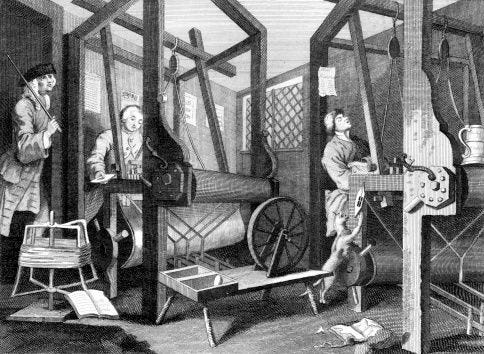
Now we are moving onto the phase that economic historians associate with the Industrial Revolution. This phase was absolutely important, but I think economic historians tend to ignore or downplay to key role of the first three phases that preceded the mechanization of cotton textile exports. It is impossible to fully understand the following British Industrial Revolution without putting it into its proper context of the English wool trade of the preceding 500 years.
The first stirrings of cotton
Cotton textiles began to appear in England in the early seventeenth century. Initially, they were produced alongside woolens and linens in Norfolk, where immigrant workers had brought knowledge of spinning, weaving, and dyeing mixed fibers. These were often fustians—fabrics with linen warps and cotton wefts—that combined strength with softness.
Cotton was not yet dominant, but it was entering the mix.
By the later seventeenth century, production shifted northward to Lancashire, the West Riding of Yorkshire, and southwestern Scotland. These regions had several advantages.
Labor was cheaper than in Norfolk, and
Water supplies were cleaner and faster-flowing, supporting both spinning and finishing.
The damper climate of Lancashire also helped cotton fibers stay workable without breaking.
Wool remained important in these areas, but cotton was beginning to find its footing.
Competition from Indian calicoes
At the same time, Indian cotton textiles were flooding into England, an unintended consequence of the English empire on the subcontient.
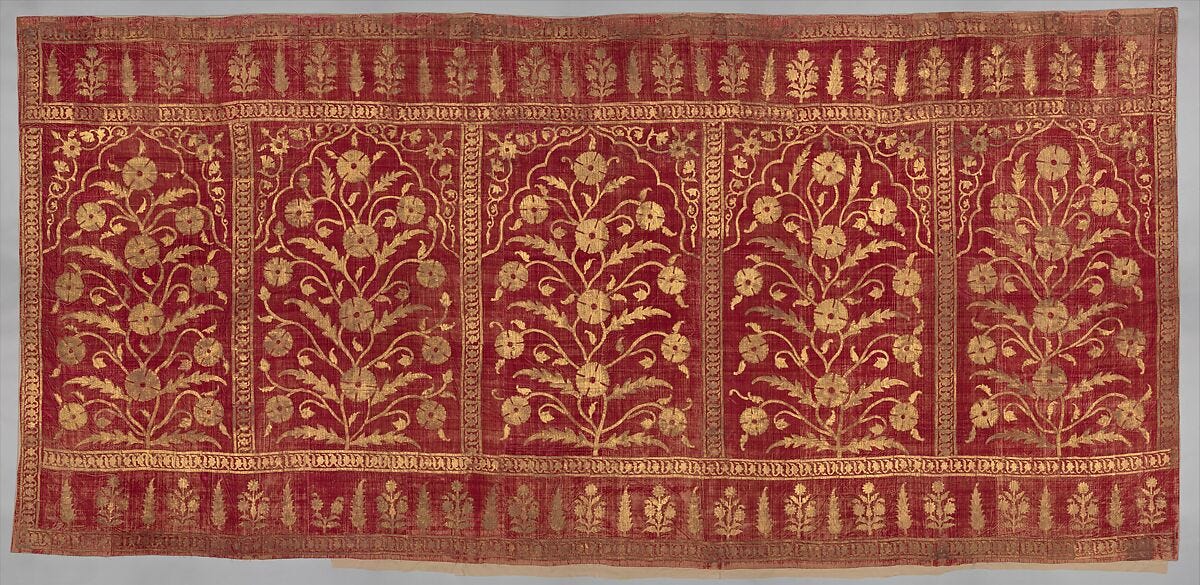
Calicoes—brightly printed, light, and washable—were highly fashionable. They were cheaper than many woolens and quickly became popular with consumers. By the 1670s and 1680s, they were threatening to displace English-made cloth in the domestic market.
Wool interests sounded the alarm. The wool industry remained the foundation of customs revenue and rural employment, and it could not easily compete with cheap Indian imports. This raised a question that echoed earlier centuries: how could the state protect domestic producers while also adapting to changing markets?
The Calico Acts and import substitution
Parliament responded with the Calico Acts. The first, passed in 1700, banned the import of finished Indian cotton textiles. The second, in 1721, went further by forbidding the wearing of printed calicoes in England. Only fustians and domestic printing on imported white cloth were allowed.
These measures had a double effect. They protected wool from direct competition by restricting the most threatening cotton goods. But they also encouraged English printers and dyers to experiment with printing on linens and cotton-linen mixes. By practicing on these fabrics, English craftsmen developed the chemical knowledge, dye recipes, and printing techniques that would later be applied to cotton spinning and weaving.
Thus, an act meant to protect wool indirectly laid the groundwork for the rise of a domestic cotton industry. The Calico Acts were later repealed in 1774, but the intervening 50 years enabled the British cotton industry to operate without foreign competition.
The Calico Acts are a classic example of temporary protective tariffs being imposed to enable to domestic industries to grow into globally-competitive industries (otherwise known as import substitution industrialization). I think that it is an open question how intentional the implementation and repeal was. My guess is that it was more a fortuitous accident of changing coalitions of economic interests than a deliberate industrial policy.
Immigrants
Many of the dyers and printers who experimented with calico printing in the late seventeenth and early eighteenth centuries were descendants of earlier immigrant communities. Flemish and Walloon Protestants who had fled the Low Countries during the sixteenth century had settled permanently in towns across England. By the eighteenth century, their children and grandchildren remained active in the textile trades, applying their inherited expertise in dye chemistry, mordants, and finishing techniques to new fabrics.
These immigrant-descended artisans played an important role in transferring skills from wool to cotton. Their familiarity with color-fast dyes and patterned printing gave English manufacturers an advantage when Parliament’s Calico Acts limited Indian imports.

In this way, the legacy of Flemish and Walloon refugees not only reshaped the wool industry through the New Draperies but also provided crucial capabilities that allowed cotton printing and weaving to take root in England.
The gradual rise of cotton manufacture
Through the early eighteenth century, cotton remained a small but growing part of the English textile trade. Cotton cloth was lighter, cheaper, and more colorful than woolens. It appealed especially to overseas markets in warmer climates.
The skills developed in the New Draperies and in wool finishing carried over directly. Dyers, printers, and merchants who had worked with wool diversified into cotton. Rural putting-out systems already familiar in wool were applied to cotton yarn and weaving. Infrastructure improvements—turnpike roads, canals, and ports—developed for wool also served cotton.
In this sense, cotton piggybacked on the commercial society that wool had created. Without centuries of wool revenues, merchant companies, skilled dyers, and export markets, cotton would have had a far harder time breaking through.
Incentives and the crown’s role
As in earlier phases, the crown’s taxation system influenced incentives. Customs on wool remained high, while cotton, as a newer and smaller trade, was less burdened. Protective tariffs on calicoes kept the domestic market open for English producers to experiment. The crown had not designed an industrial policy for cotton, but its fiscal and protective measures created an environment in which innovation was possible.
The Commercial to Industrial transition
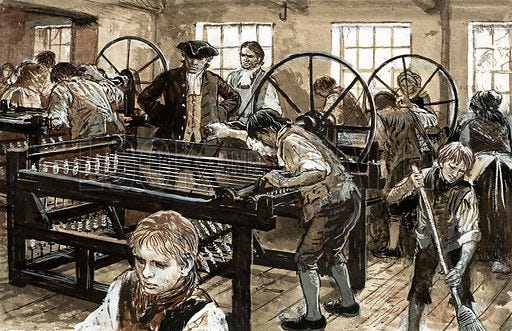
By the mid-eighteenth century, cotton was no longer just a side industry. It was becoming a sector in its own right, centered in Lancashire and Yorkshire. Wool still dominated overall exports, but cotton was climbing rapidly. English entrepreneurs recognized that cotton could complement wool by supplying lighter fabrics to colonial and Mediterranean markets, broadening the country’s trade portfolio.
This was the crucial link in England’s long transformation. In the thirteenth century, England had been an Agrarian exporter of raw wool. By the fifteenth and sixteenth centuries, it had become a Commercial exporter of broadcloth and then New Draperies. In the seventeenth and eighteenth centuries, cotton represented the next step—an industry that began to cross the line into industrial production. The habits of a commercial society—contracts, credit, reinvestment—were now feeding directly into industrialization.


By the end of the eighteenth century, cotton had not yet fully surpassed wool, but it was poised to do so. The decisive moment came in 1805, when cotton textiles became Britain’s leading export. That milestone lay just ahead, but the groundwork had been laid in the seventeenth and eighteenth centuries, when wool and cotton coexisted and cross-fertilized.
Southeast England and the northern counties
The cotton story also reinforced the regional transformation of England. The southeast, long commercialized by the wool trade, retained its role in lighter New Draperies and finishing. But the new centers of cotton manufacture were in the north and west. Lancashire and the West Riding of Yorkshire, already experienced in wool, now adapted those skills to cotton.
This created a more balanced economy. The southeast remained tied to markets, contracts, and exports, resembling the city-states of Italy and Flanders. The north and west, however, were beginning to resemble something new: an industrial landscape where mechanization would soon transform production.
England’s rise up the export value chain
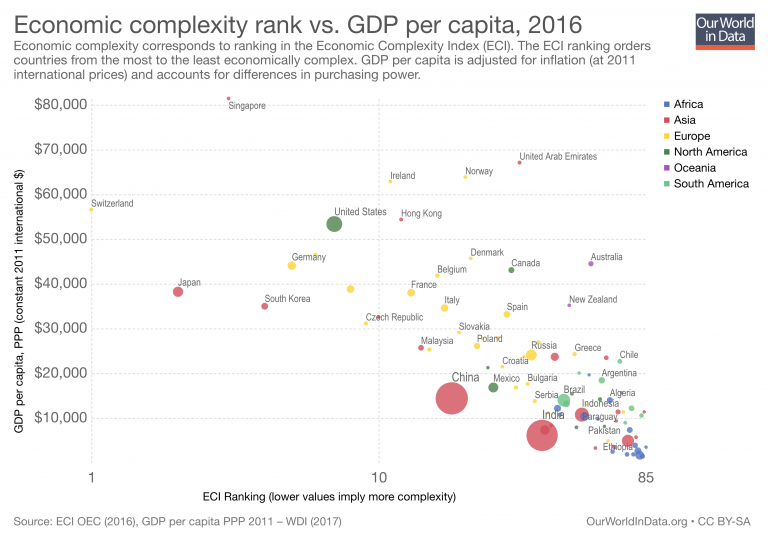
The long history of England’s wool and cotton trades also illustrates what modern economists describe as the theory of Economic Complexity. According to this theory, nations become wealthier and more competitive not by a single leap but by gradually moving up the value chain of export industries. Each step builds on the technologies, skills, organizations, and capital developed in earlier industries, which can then be applied to related products with higher value-added.
England’s history fits this pattern closely.
In Phase 1, England exported raw wool. This required good sheep breeds, skilled shearing, and reliable packing methods, but most of the value was captured abroad in Flanders.
In Phase 2, the rise of the Old Draperies kept the raw material at home and applied English skills in spinning, weaving, fulling, and dyeing. These related capabilities allowed England to retain more value, employ more of its people, and capture larger profits.
In Phase 3, England adapted again. Refugees from the Low Countries—ethnically Flemish and Walloon Protestants—fled Spanish repression in the mid-sixteenth century and settled in towns like Norwich, Colchester, and Sandwich. They brought with them advanced weaving and dyeing techniques, especially for lighter worsteds, bays, and serges. They also carried knowledge of linen and cotton working. Their presence broadened England’s capabilities, allowing it to diversify into the New Draperies. At the same time, enclosure and selective breeding improved the quality of English wool inputs, linking agricultural innovation to manufacturing growth.
Phase 4 saw the first stirrings of cotton manufacturing. Once again, earlier capabilities were transferred. Dyers and printers, some of them descended from the same Flemish and Walloon immigrant communities, adapted their chemical knowledge to new fibers. English merchants, already accustomed to managing complex export markets in wool, now experimented with cotton. Infrastructure first built for the wool trade—turnpikes, canals, warehouses, and financial institutions—served cotton as well.
In this way, England demonstrated how nations grow through related diversification. New industries do not appear from nowhere; they emerge out of the capabilities accumulated in existing sectors. Wool provided the foundation—skills, capital, institutions—on which cotton could rise. By moving step by step from raw exports to finished goods and then into a new but related sector, England grew steadily wealthier and more competitive.
This pattern of gradual ratcheting through economic complexity explains why England’s long engagement with wool was not just about one commodity. It was about building a web of related capabilities that could support new industries. In this sense, the history of the English wool trade is also a case study in how economic complexity drives nations upward along the value chain.
Conclusion
The history of the English wool and cotton trades shows a clear sequence of transformation, a long path from
an Agrarian economy
to a Commercial and
and finally to an industrial society.


The transformation unfolded in four phases.
The story of the English wool trade is best understood in four phases:
Raw wool exports (13th–14th centuries) within an English Agrarian economy
Wool cloth exports, Old Draperies (14th–16th centuries), the beginning of English transformation into a Commercial society, spreading geographically outwards from southeast England to other parts of England.
Wool cloth exports, New Draperies (16th–18th centuries)
Cotton textile exports (18th–19th centuries), the beginning of British transformation from a Commercial society to an Industrial society.
The crown’s role was central throughout. At first, its policies were likely accidental. Monarchs in the thirteenth and fourteenth centuries simply wanted to raise revenue for war. By heavily taxing raw wool exports, they unintentionally encouraged domestic cloth production, since cloth was taxed more lightly. This changed incentives in ways the crown may not have foreseen but which permanently shifted the economy toward manufacturing.
Over time, however, the monarchy became more intentional. It backed monopolies like the Company of the Staple and the Merchant Adventurers, enforced quality through alnagers, and experimented with interventions like the Cockayne Project. These measures tied merchants to the state, stabilized customs revenues, and gradually kept more of the value chain at home. Crown taxation and regulation, beginning as fiscal necessity, evolved into a framework that helped England climb the ladder of economic development.
These phases also mark the rise of a Commercial society in southeast England. What had been an agrarian landscape of subsistence farmers and open fields became a countryside of enclosed pastures, wage-earning spinners, and market-oriented villages. Families no longer lived only by the harvest but by the cash economy, just as in northern Italy and Flanders before them. England’s southeast became a society of contracts, credit, and exports—a transformation that explains why it was able to leap from agriculture to industry.
England’s position in the thirteenth and fourteenth centuries resembled that of many modern developing nations that export raw commodities—oil, copper, or unprocessed crops—without capturing the greater value of finished goods. Like those countries, medieval England depended on demand set abroad and suffered when foreign buyers shifted to alternatives. The long shift from raw wool to finished cloth is a textbook example of “moving up the value chain,” the very problem that modern economies still face.
This process also illustrates the theory of economic complexity. Nations do not leap to wealth all at once; they ratchet upward by applying technologies, skills, organizations, and capital from one industry to related ones with higher value-added. England used its capacity for shearing, spinning, weaving, and dyeing wool to diversify into New Draperies. The immigrant knowledge of Flemish and Walloon weavers expanded the range of fabrics. These same skills, and the financial and logistical infrastructure built around wool, carried over into cotton printing and weaving. Each phase of the wool and cotton trade represented a step up the ladder of complexity, and each step made England wealthier and more competitive.
The Industrial Revolution in Britain, especially the rapid expansion of cotton textiles, would have been impossible—or at least highly unlikely—without this long history. Wool exports trained England in production, organization, and finance. Crown taxation and monopolies created the incentives to retain value at home. The New Draperies demonstrated flexibility and innovation. Immigrant skill enriched the pool of capabilities. Cotton then extended these capabilities into a new sector. The industrial age did not come out of nowhere; it rested on six centuries of cumulative adaptation.

England’s rise to industrial leadership was the outcome of this ratchet:
from raw wool to broadcloth,
from Old Draperies to New Draperies,
from wool cloth to cotton manufacturing.
At each stage, the country captured more value, commercialized its society, and expanded its capabilities. Without that long process—and without the crown’s fiscal pressures that inadvertently but decisively changed incentives—the Industrial Revolution, or at least the participation of cotton in it, would have been improbable. With it, England became the first nation to transform not only its economy but the entire world.
Bibliography
If you are interested in this topic, I would suggest reading the following:
Online lecture notes for John Munrow’s Modern European Economic History 1250-1750 class. His lecture notes are the source of all graphs and maps in this article.
Eileen Power, The Wool Trade in English Medieval History
T. H. Lloyd, The English Wool Trade in the Middle Ages
E. Lipson, The History of the Woollen and Worsted Industries
Herman Van der Wee, The Growth of the Antwerp Market and the European Economy
David Nicholas, Medieval Flanders
Negley B. Harte The New Draperies in the Low Countries and England, 1300–1800
Here are some more articles on English and British history:
How Britain transformed from poverty to progress (the series)

If you’re following me but don’t yet receive these essays by email, you’re missing most of them. Substack doesn’t email followers—only subscribers. You can get every new essay free in your inbox here 👉
If you enjoyed reading this article, you might also be interested in reading my “From Poverty to Progress” book series:
Always learn something from your posts
The most interesting part to me is the bit about taxation redirecting industry into more or less productive activities.