

“Populism” once described a real political movement. Today it lumps together politicians who share little more than anti-elite rhetoric.
If you’re following me but don’t yet receive these essays by email, you’re missing most of them. Substack doesn’t email articles to followers, only to subscribers. You can get every new essay free in your inbox by subscribing 👉:
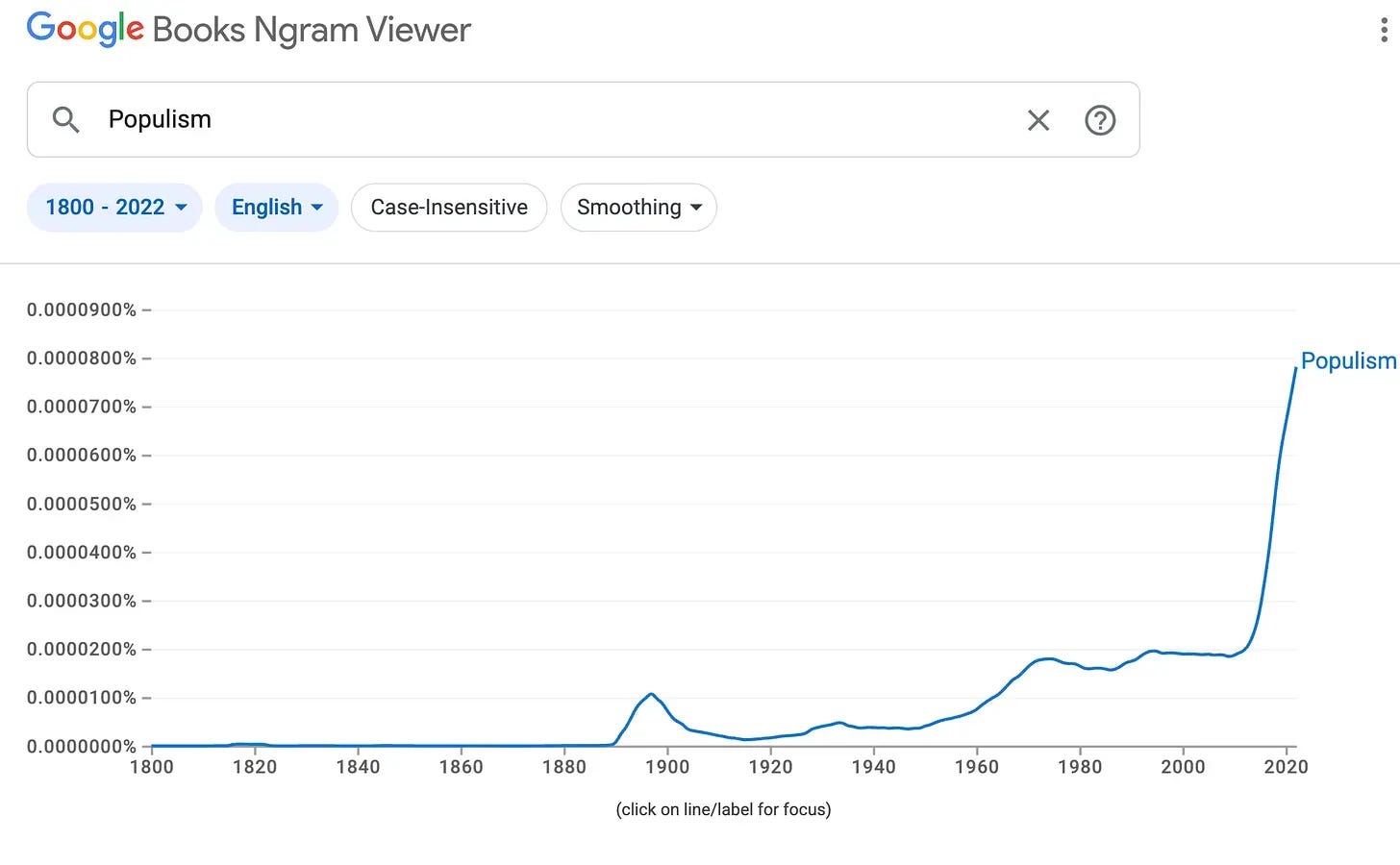
For most of the last century, the word “Populism” was a relatively minor part of our political vocabulary. Then, starting around 2011, something changed.
Use of the term began to soar, and after the Brexit referendum and election of Donald Trump in 2016, “Populism” became one of the most common terms used by intellectuals to describe what was supposedly going wrong with Western democracy.
Look at a Google Ngram graphic for use of the the word “Populism” (at top) and the change is striking. For decades, the term received relatively little attention. Its use rose and fell, but there was no sustained increase. Around 2011, the line suddenly turns upward. After 2016, it rises even faster.
During this period, a group of prominent intellectuals increasingly focused their attention on the concept of Populism and related threats to liberal democracy. The list includes Heather Cox Richardson, Francis Fukuyama, Anne Applebaum, Timothy Snyder, Simon Schama, Ruth Ben-Ghiat, Michael Beschloss, and Robert Kagan. Many of them essentially leveraged their previous academic accomplishments in a different field into being very well-known public intellectuals on television and social media.
A bit later, a new generation of bloggers and Substacks followed the trend: Yascha Mounk, Noah Smith, Nate Silver, Matthew Yglesias, Andrew Sullivan, Jonathan Chait, Tibor Rutar, and Richard Hanania. Many of them are still very active in the public sphere and focus much of their writing on the topic.
These are serious intellectuals with impressive credentials. Fukuyama was famous for his work on the post-Cold War world. Applebaum and Snyder built their reputations studying Communism, Eastern Europe, and the Soviet Union. The others have written interesting books and articles.
Despite a clear background in rigorous thought among these people, their preferred term or “Populism” is actually quite vacuous and uninformative. Its typical use often degenerates into little more than an ideological attack on people whom they disagree with.
It is time to stop using the term “Populism”, and here is why.
To be clear, I have no problem with the use of the adjective “populistic” to describe a political leaders rhetoric or speaking style. The term is often very useful and accurate.
My objection is to using the noun “Populism” as if it were a coherent ideology like Liberalism, Communism, Socialism, Libertarianism or Conservatism. The suffix “-ism” makes that implication very clear. The concept behind it is anything but coherent. But very intelligent people continue to use the term.
If you enjoy this article, you should read my From Poverty to Progress book series.
A brief note
First let me say that this is not a personal attack on any of these people. They are all very intelligent and have written very thoughtful books and articles on other topics. This article is an attack on the usage of the word “Populism.” The writers that I listed above are too smart to keep repeatedly using it, so my hope is that this article will convince them (and others) to stop using the term.
The Problem with the term “Populism”
The term “Populism” has numerous problems.
The first problem with “Populism” is surprisingly basic: there is no generally accepted definition of what the term actually means, even among the thinkers themselves. More importantly, those who use the term do not seem to feel the need to present a clear definition and apply it consistently to all political actors.
Different intellectual use the term to describe quite different things. Sometimes Populism is an ideology. Sometimes it is a style of political rhetoric. Sometimes it describes a charismatic leader who claims a special connection with the people. Sometimes it means hostility toward elites or experts. In other cases, the defining characteristic is opposition to political pluralism or established institutions.
These differences matter. An ideology, a rhetorical style, and a method of exercising political power are three different things. Combining them under one label does not make them the same phenomenon.
The second problem is that “Populism” has acquired an overwhelmingly negative meaning. This is not an accident, as it is deliberately portrayed as such by the authors themselves. And given how almost all these influential writers share this bias, it is obvious that their readers do as well. At this point, the term is little more than intellectually-acceptable name-calling.
The term regularly appears alongside words such as authoritarianism, nationalism, nativism, conspiracy theory, anti-intellectualism, and democratic backsliding. Calling someone a “Populist” rarely sounds like a neutral attempt at political classification.
In many cases, its use is not far off from more intellectually-acceptable means of branding everyone not Left-of-Center as a “Fascist” or “Nazi.”
The third problem is selective application. If “ordinary people versus corrupt elites” is the defining characteristic, then populistic rhetoric can be found across the political spectrum.
Franklin Roosevelt denounced the “economic royalists” and welcomed the hatred of powerful interests that opposed the New Deal
Theodore Roosevelt denounced powerful trusts and the “malefactors of great wealth.”
Lyndon Johnson frequently presented the Great Society as a struggle on behalf of ordinary Americans against entrenched privilege and concentrations of power.
Ronald Reagan frequently contrasted ordinary Americans with an out-of-touch federal government and Washington establishment.
Charles de Gaulle appealed directly to the French people over political parties and parliamentary elites.
Margaret Thatcher attacked an entrenched establishment that included trade-union leaders, bureaucrats, intellectuals, and members of her own Conservative Party.
To the best of my knowledge, none of the intellectuals apply the term “populism” to any of the above political leaders. Writers can be much quicker to recognize Populism when the people attacking elites are on the other side of the political spectrum. This makes Populism an unusually convenient political category. Its definition can expand or contract depending upon who is being described.
These problems become more serious when separate characteristics begin to blend together in a progressive more negative manner. The progression looks something like this:
populistic rhetoric → Populism → authoritarian Populism → authoritarianism → threat to democracy
But every arrow represents a separate claim that needs to be demonstrated. A politician can attack elites without being authoritarian. A politician can distrust a particular institution without opposing democratic government. And an authoritarian leader can use restrained, sophisticated rhetoric while systematically destroying democratic institutions.
There is a much simpler way to describe the original phenomenon. When politicians divide society rhetorically between ordinary people and powerful or corrupt elites, we can call their rhetoric “populistic.” But this is a style of rhetoric, speaking style, or campaign strategy, not an ideology.
The term “populistic” tells us something useful about how they communicate. It tells us very little about what they believe. Two political leaders can have the same political style, but very different policy stands. Two political leaders can have very different political styles, but make similar policy stands.
Those who repeatedly use the term “Populism” in their work repeatedly concatenate communication style and rhetoric with policy stands.
Worse, their own followers can add in the next step:
→ threat to democracy → moral justification for repression
So repeated use of the vacuous term “Populism” with obviously negative connotations is actually undermining the very democracy that that many of these writers claim that they want to protect.
I have no idea how many of these intellectuals believe that we need to use repression to stop Populism. I do know that some of them were publicly advocated for censorship to fight what they call “disinformation.”
And these repressive tendencies are not restricted to political rhetoric and social media. It has become the de factor campaign strategy for the Center-Left over the last 10 years. And if anything, it is much stronger in Europe than in the United States.
Is this really how you "Save Democracy?"

Make someone’s day: Gift a subscription to your friends and family!
A Real Populism
Having established the problem with repeatedly using the term “Populism”, let goes through its actual use in American history (I can’t speak to its use in other nations).
The Original Populist Party
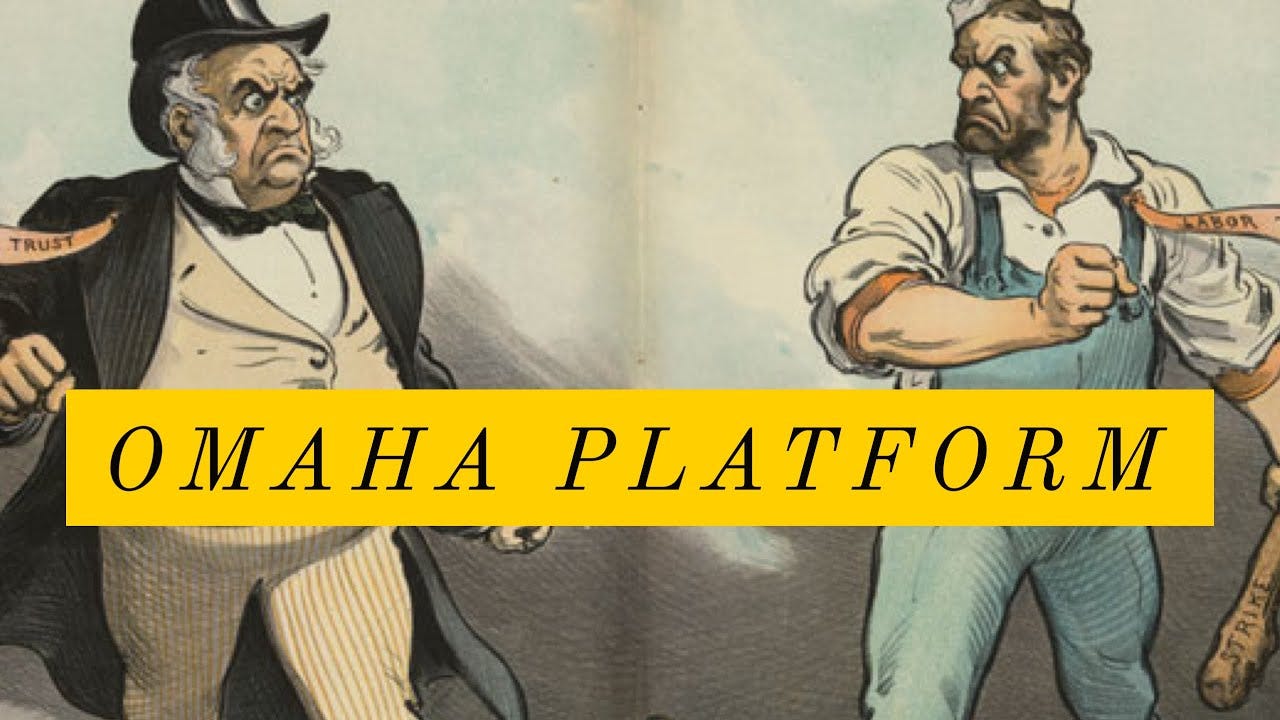
The word “Populism” originally described something much more concrete than it does today. In the United States of the 1890s, it referred primarily to the People’s Party, commonly called the Populist Party. This was not a vague collection of attitudes about elites. It was an organized political movement with identifiable leaders, supporters, and policies.
The Populists drew much of their support from farmers in the South and Great Plains who believed that the economic system was working against them. Many were deeply in debt. They depended upon railroads to transport their crops and banks to provide credit. Falling agricultural prices made their debts harder to repay. They believed that railroads, banks, and large corporations had gained too much economic and political power.
Their 1892 Omaha Platform offered specific solutions. The Populists supported:
expanding the money supply through the free coinage of silver,
government ownership or greater control of railroads and communications,
a graduated income tax,
direct election of senators and other political reforms.
In the 1892 Presidential election, the party nominated James Weaver. Weaver won 8.6% of the national popular vote and the states of Colorado, Idaho, Kansas, Nevada, and North Dakota.
Whatever one thinks of these proposals, they constituted a substantive political program.
Populism takes over the Democratic party
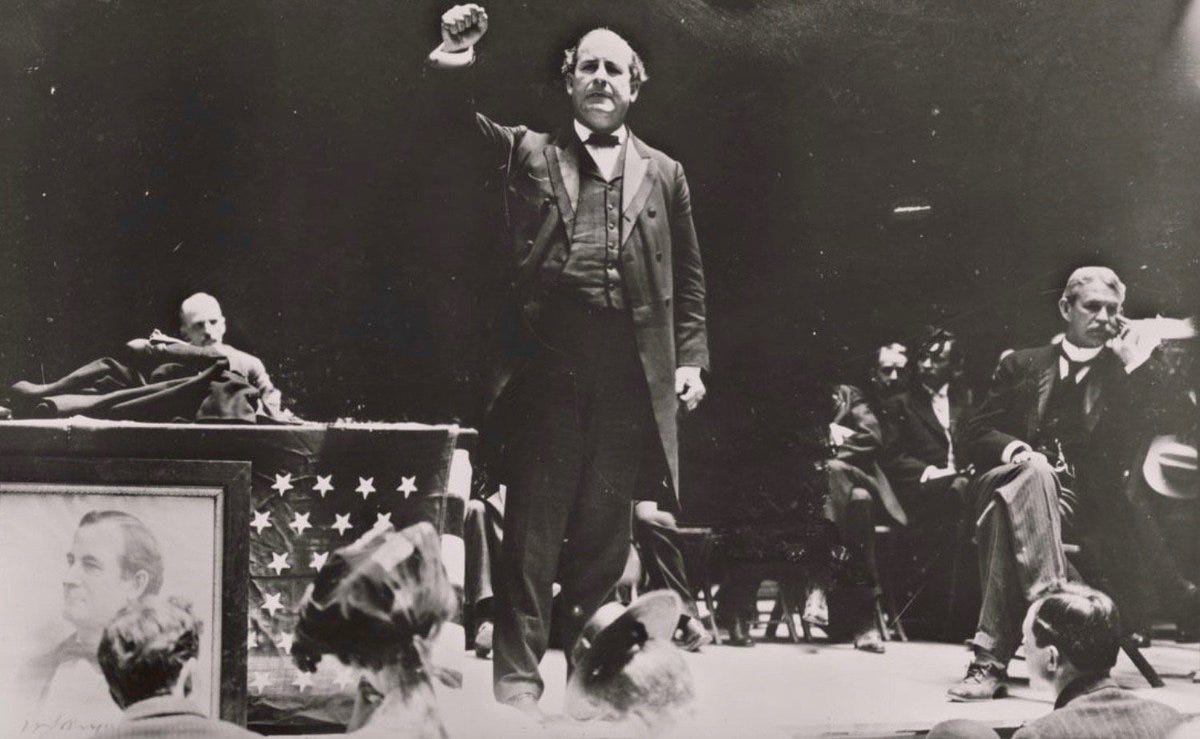
William Jennings Bryan brought many of these themes into the national spotlight during the presidential election of 1896. Bryan was a Democrat, not a member of the People’s Party, but the Populists also nominated him for president.
William Jennings Bryan was not some fringe wacko. He was one of the most important American political leaders for over two decades. He was the principle opposition to the Grover Cleveland wing of the Democratic party, know as the Bourbon Democrats.
William Jennings Bryan was:
Member of the US House (1891-95)
The Democratic presidential nominee in 1896 (losing to William McKinley)
The Democratic presidential nominee in 1900 (ditto)
The Democratic presidential nominee in 1908 (losing to William Howard Taft)
As payback for his public endorsement Woodrow Wilson appointed him Secretary of State from 1913 to 1915
Remained an extraordinarily influential public speaker and political campaigner for roughly three decades.
Was the famous lawyer in the Scopes Monkey Trial of 1925 (made even more famous by the book, play, and movie Inherit the Wind.
Bryan’s “Cross of Gold” speech (one of the most famous political speeches in American history) attacked the financial interests that supported the gold standard and portrayed the monetary debate as a struggle between ordinary producers and powerful economic interests.
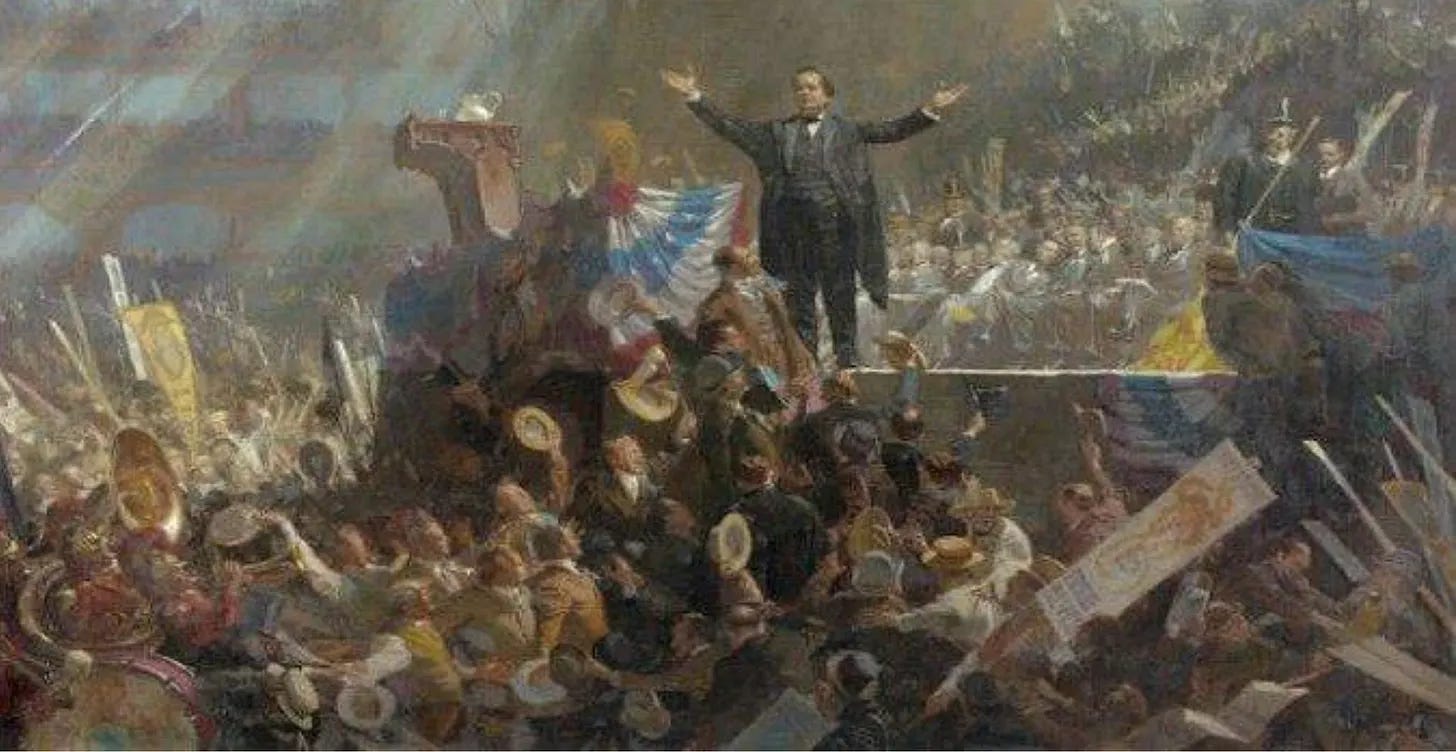
This was certainly populistic rhetoric. But it was also attached to specific economic arguments and policy proposals. A voter in 1896 who said he supported the Populists communicated considerably more information about his political beliefs than someone today who says a politician is a Populist.
That is the first great irony in the history of the term. Populism began as the name of a real political movement with a substantive political program. Over time, intellectuals would make the term more universal (and less useful) by making it less specific.
From Movement to Style
In the Google N-Gram graphic at the top, you can clearly see a second era in the use of the term “Populism”. For want of a better term, I will call it the Richard Hofstadter era.
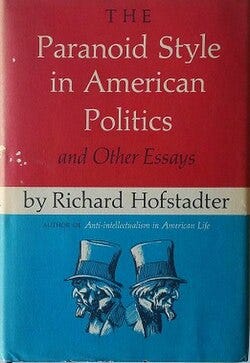
In the 1950s and 1960s, historian Richard Hofstadter helped give Populism a new meaning. Writing in the shadow of Joseph McCarthy, Hofstadter connected earlier Populist politics with resentment, status anxiety, conspiracy theories, and anti-intellectualism. His influential books included:
The Age of Reform (1955); one of the most paradigm-setting books in the post-WW2 era
his famous 1964 essay “The Paranoid Style in American Politics.”
Richard Hofstadter was twice awarded the Pulitzer Prize, and was the iconic historian of what one might call “the post-war liberal consensus.” In many ways, 21st Century intellectuals are just rehashing Hofstadter’s claims.
Yet Hofstadter made an important distinction that is often lost today. For Hofstadter, Populism was a style of politics, not an ideology. He recognized that similar rhetoric and habits of thought could appear on both the Left and Right. This distinction allowed him to criticize the way people practiced politics without pretending that they therefore shared the same political beliefs.
Inventing an Ideology
Over the following decades, scholars increasingly detached “Populism” from the American People’s Party and tried to turn it into a general category that could be applied across countries and political systems. Margaret Canovan’s 1981 book Populism demonstrated the difficulty. Movements called populist differed so greatly that finding a common ideology among them was remarkably difficult.
Cas Mudde offered what became one of the most influential solutions. In 2004, he defined Populism as a “thin-centered ideology” that divides society into two opposing groups,
“the pure people” and
“the corrupt elite,” and
argues that politics should express the general will of the people.
Mudde deserves credit for applying his definition more consistently than many later users of the term. Populism could be Left or Right. He even identified populist elements in the New Left of the 1960s and 1970s. Nor did his definition require nationalism, nativism, or authoritarianism.
But it is clear that Cas Mudde was far more concerned about the Populist Right than the Populist Left. He was one of the leading scholars of the contemporary European far right, and he systematized the study of the postwar and contemporary European radical right. Part of his concern was that his younger brother was very active on the Dutch Right.
But calling Populism a “thin-centered ideology” creates another problems. Liberalism, socialism, communism, and other ideologies tell us a great deal about how their adherents think society should be organized. Mudde’s Populism tells us almost nothing about taxes, property, trade, immigration, welfare, individual rights, religion, foreign policy, or the proper size of government.
If two political movements disagree about nearly every important question of public policy but both complain about corrupt elites, in what meaningful sense do they share an ideology?
At some point, an ideology can become so thin that a simpler description works better. It is a rhetorical style.

The Explosion
For decades, “Populism” remained a relatively specialized term. Then its use began rising rapidly around 2011. The timing is important because it predates both Brexit and Donald Trump.
The Financial Crisis of 2008 had badly damaged confidence in established institutions. In the United States, the Tea Party attacked Washington, taxes, government spending, and the political establishment from the Right. Occupy Wall Street attacked banks, corporations, billionaires, and economic inequality from the Left. Its slogan, “We are the 99%,” was almost a perfect example of ordinary-people-versus-elite rhetoric.
Europe experienced an even greater political upheaval during the Eurozone crisis. Syriza emerged on the Left in Greece, Podemos in Spain, and the Five Star Movement in Italy. UKIP attacked Britain’s political establishment and the European Union from the Right. These movements disagreed about many fundamental political questions, but they shared hostility toward established political parties and institutions.
“Populism” offered intellectuals a convenient way to place these very different movements into a common category.
Then came 2016. Britain voted to leave the European Union and Donald Trump won the American presidency. Suddenly Populism was no longer a specialized subject for political scientists. It became a common explanation for political upheaval throughout the Western world.
The Google Ngram chart captures this change in language. It does not demonstrate that an ideology called Populism suddenly swept across the world. It demonstrates something we can say with much greater confidence: intellectuals and other writers suddenly became much more interested in describing politics through the concept of “Populism.”
Post-Cold War Liberals
The intellectuals who made Populism a major subject of public debate after 2011 were not a random group. Many belonged to a generation of highly educated liberals and Center-Left intellectuals who built successful careers during the post-Cold War era.
Francis Fukuyama became famous in 1989 for arguing that liberal democracy had defeated its major ideological competitors.
Anne Applebaum built her reputation writing about Communism and the Soviet world.
Timothy Snyder became a prominent historian of Eastern Europe.
Pippa Norris and Ronald Inglehart spent decades studying democracy, political culture, and social change.
Others built careers in political science, history, journalism, and public policy.
There were important exceptions to the Center-Left pattern. Applebaum came from a more conservative, anti-Communist tradition, while Fukuyama had roots in neoconservatism. But both remained strongly committed to the basic institutions of the post-Cold War liberal order.
This generation had good reason for valuing those institutions.
The collapse of Soviet Communism appeared to vindicate liberal democracy.
European integration advanced rapidly.
International trade expanded.
Universities grew.
Professional journalism remained influential.
Economists, scientists, and other experts gained important roles in public policy.
Independent courts, central banks, international organizations, and professional bureaucracies became increasingly important parts of government.
These intellectuals also prospered within this world. By the 2000s, many held prestigious positions at universities, newspapers, think tanks, foundations, and other influential institutions. They were not outsiders demanding admission to the Establishment. They had become important members of it.
After 2008, many of these institutions suffered a dramatic loss of public confidence. The Financial Crisis discredited financial and economic elites. The Iraq War had already damaged confidence in foreign-policy experts. Political parties lost loyal voters. Newspapers lost their old control over political information. Social media allowed politicians to communicate with millions of people without going through traditional journalists or other gatekeepers.
The institutions that had appeared increasingly secure during the 1990s were suddenly being challenged from many directions.
For the post-Cold War liberal generation, “Populism” provided a useful way to understand these challenges. It grouped together political movements that differed greatly in their actual policies but shared one important characteristic: they challenged established elites and institutions.
Two Revolts
The older Center-Left did not face a revolt from only one direction. At almost exactly the same time that anti-establishment movements were attacking it from the Right, a new generation of Leftists began attacking it from the Left.
There was an obvious historical precedent. In the late 1960s, young Baby Boomers rebelled against what they called “The Establishment.” Ironically, much of that Establishment consisted of the New Deal and postwar liberals who had created the institutions the young activists were attacking. The New Left considered the older Center-Left too cautious, too bureaucratic, too accepting of hierarchy, and too willing to compromise.
What caused the Youth Revolt of the late 1960s?

If you’re following me but don’t yet receive these essays by email, you’re missing most of them. Substack doesn’t email followers—only subscribers. You can get every new essay free in your inbox here:
By the early 1970s, politics settled down somewhat, and young Baby Boomers were disillusioned by their inability to transform society in their favored direction. A sub-section got a four-year college degree and went into a relatively high-paying profession. Over the decades, they gradually worked their way up their institutions until a few of them were now in control of the very Establishment that they had criticized decades ago.

Ironically, the Youth Revolt of the late 1960s somewhat repeated itself in the 2010s, but this time with Baby Boomers in the Establisment and a younger generations criticizing them. Millennials were the first generation of college-educated Americans to grow up in institutions where Center-Left values were already widespread. As they entered universities and professional careers, some concluded that the older generation had not gone nearly far enough. Racial inequality persisted. Gender differences persisted. Economic inequality persisted.
To these young activists, the failure to achieve Equality suggested that the institutions themselves were part of the problem.

Critical Social Justice offered an explanation. Inequality could be understood as the result of systems of power embedded within institutions and society. The solution was not merely to reform those institutions. They needed to be transformed.
This put the older Center-Left in an uncomfortable position. From one direction came younger Leftists arguing that liberal institutions perpetuated inequality and oppression. From the other came anti-establishment voters arguing that universities, government bureaucracies, journalists, experts, and other institutions had become dominated by self-serving elites.
These two revolts were not the same movement. In fact, they were often bitterly hostile to each other. But they emerged during roughly the same period and challenged many of the same institutions for completely different reasons.
Category Creep
As “Populism” became more popular, its meaning also expanded. A term originally centered on conflict between ordinary people and elites gradually became associated with a much larger collection of political characteristics.
A Populist might now be described as anti-elite, anti-expert, nationalist, nativist, conspiratorial, anti-pluralist, authoritarian, or hostile to democratic institutions. The problem is that these characteristics are not the same thing, nor does one necessarily lead to another.
Consider nationalism. A politician can believe strongly in national sovereignty without attacking elites. An anti-elite politician can favor intenationalism. A politician can distrust economists without distrusting doctors. A conspiracy theorist can favor democracy, while an authoritarian ruler can surround himself with highly trained experts. Combining these characteristics under “Populism” sacrifices useful distinctions.
The same problem appears with anti-pluralism. Jan-Werner Müller makes this central to his definition of Populism. For Müller, merely criticizing elites is not enough. Populists claim that they, and they alone, represent the real people. That is an important political characteristic. But if the characteristic we are worried about is anti-pluralism, why not simply call it anti-pluralism?
Authoritarianism creates an even larger problem. History provides plenty of authoritarian leaders who had little need for populistic politics. Francisco Franco ruled Spain through the military, Catholic Church, bureaucracy, and other established institutions. Leonid Brezhnev sat at the top of an enormous Communist Party bureaucracy. Neither fits comfortably into an ordinary-people-versus-corrupt-elites model.
Meanwhile, democratic politicians have frequently attacked elites without becoming dictators. Franklin Roosevelt denounced “economic royalists” while winning four presidential elections. Ronald Reagan attacked Washington bureaucrats and the political establishment while operating within constitutional limits. Bernie Sanders has spent decades attacking billionaires and corporations without advocating the abolition of competitive elections.
Using more precise words would make these differences clearer.
If a politician is nationalist, call him nationalist.
If a politician is for want to increase taxes on the wealthy, then say so.
If he wants expanded social insurance programs, then say so.
If he opposes all immigration, say he is “anti-immigration.”
If he opposes all immigration, say he is “pro-tariff.”
If a politician is opposed to international agreements, then say he is opposed to X, Y, and Z agreements.
If he wants stronger anti-trust regulations against large corporations, then say so.
If he concentrates power and destroys institutional restraints, say so.
“Populism” becomes less informative as more of these characteristics are packed inside it.
The Putin Problem
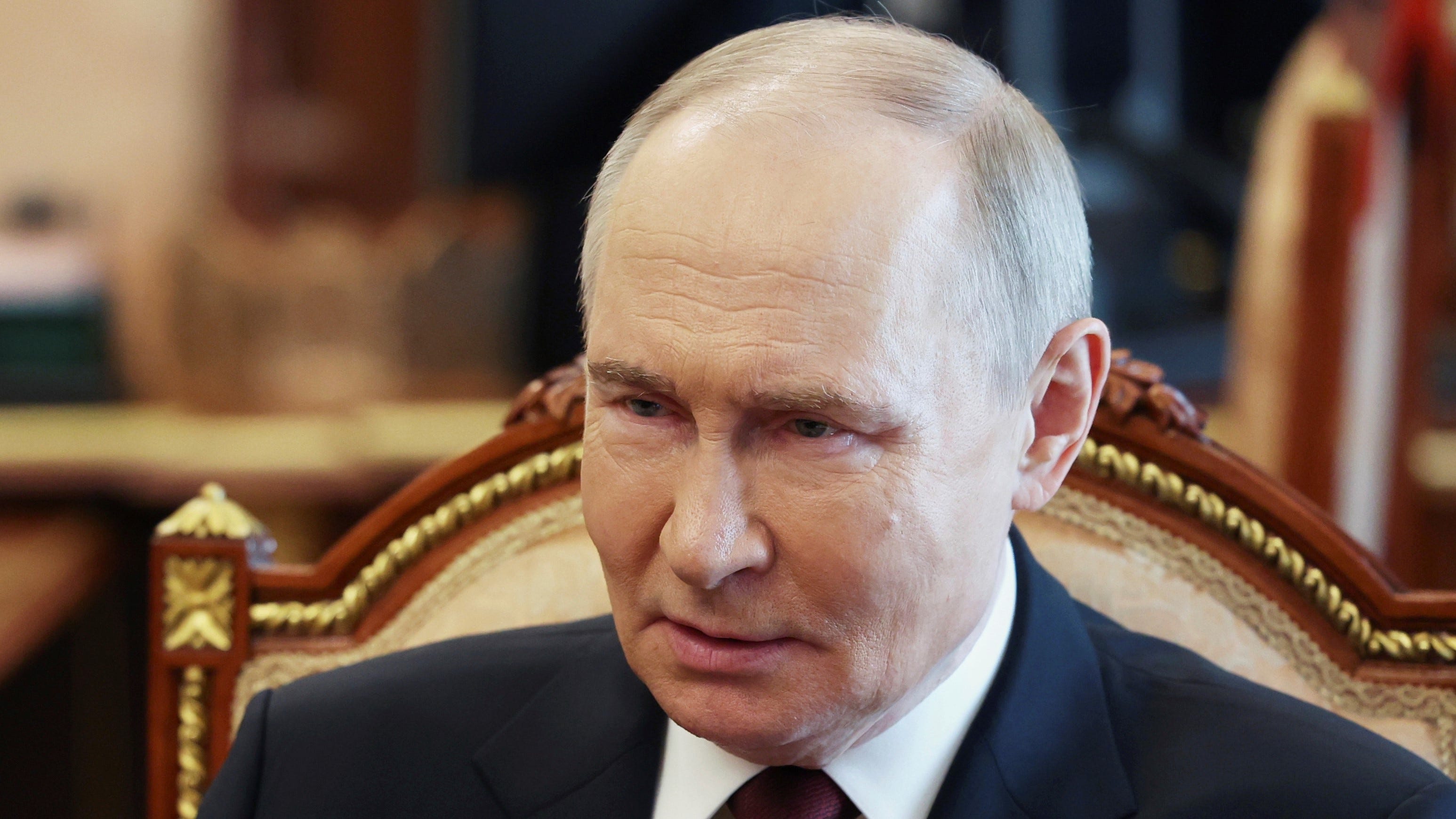
The concept-stretching becomes particularly disconcerting when the term is applied to Vladimir Putin and anyone who does not explicitly criticize him.
Vladimir Putin exposes the weakness of the category particularly well. He certainly uses populistic rhetoric. He presents himself as the defender of ordinary Russians against corrupt oligarchs, decadent Western elites, hostile foreign powers, and domestic enemies who supposedly do not represent the real Russian people.
But Putin has controlled Russia for more than two decades. He sits at the center of a powerful network of government officials, security agencies, state corporations, wealthy businessmen, and political allies.
If anyone represents the Russian political Establishment, it is Vladimir Putin.
Calling Putin an authoritarian is informative. He has restricted political competition, weakened independent media, repressed opponents, and concentrated political power. Calling his government nationalist is also informative. Calling some of his rhetoric populistic can be useful.
Calling Putin a “Populist” adds surprisingly little.
It can also create confusion. If a ruler who has controlled the state for decades remains a Populist because he attacks some other group of elites, almost any political leader can qualify. An established ruler can always find another elite to blame: bankers, intellectuals, foreigners, journalists, bureaucrats, international organizations, or wealthy opponents.
Putin demonstrates why political style should be separated from political power. An authoritarian can use populistic rhetoric. That does not make Populism the cause of his authoritarianism.
The Dangerous Chain
The problems with “Populism” become more serious when the word begins doing more than describing a political style. Characteristics that should be examined separately can turn into a chain of assumptions:
populistic rhetoric → Populism → authoritarian Populism → authoritarianism → threat to democracy
Each arrow represents a separate claim. Yet repeated use of these terms can make the progression seem almost automatic.
The first jump converts rhetoric into ideology. A politician attacks corrupt elites and claims to represent ordinary people. That is enough to describe the rhetoric as populistic. It does not tell us whether the politician favors free markets or socialism, free trade or protectionism, more immigration or less immigration, a larger welfare state or a smaller one.
The next jump is more consequential. Once the politician has been classified as a Populist, other characteristics commonly associated with Populism can begin to follow him around. Distrust of experts becomes distrust of institutions. Distrust of institutions becomes anti-pluralism. Anti-pluralism becomes authoritarianism.
The final jump is from authoritarianism to a threat to democracy. Sometimes that description is entirely justified. A leader who cancels elections, imprisons political opponents, suppresses independent media, or prevents opposition parties from competing is attacking democracy. We do not need the concept of Populism to recognize any of these actions.
The danger is circular reasoning. If authoritarian characteristics help us decide who counts as a Populist, and those same leaders are then presented as evidence that Populism leads to authoritarianism, part of the conclusion was contained in the original classification.
Authoritarian behavior should be demonstrated by what political leaders actually do, not inferred from what we have decided to call them.
Defending Democracy
Democracies can face genuine enemies. Adolf Hitler came to power through a political system that still contained competitive elections and then systematically destroyed that system. The experience helped produce the idea of “militant democracy,” in which a democracy may sometimes need to defend itself against political movements seeking to abolish democratic competition.
But defending democracy is not the same thing as defending existing institutions from democratic challenge.
Voters must be allowed to replace political parties, change immigration laws, reject trade agreements, reduce the authority of government agencies, alter regulations, criticize judges, challenge experts, and withdraw from international organizations. They can make wise choices or foolish ones. The ability to remove existing leaders and change existing policies is one of the purposes of democracy.
This distinction became increasingly blurred during the years following the rise of “Populism” as a political category. Parts of the Liberal and Center-Left world became more receptive to exceptional measures justified as necessary to protect democracy. These are not hypothetical examples.
Over the past decades there have have many instances of Center-Left governments:
restricting political speech on social media,
excluding candidates from ballots,
disqualifying political movements,
expanding the role of unelected institutions, and
limiting the spread of what they call “disinformation” considered dangerous or misleading.
If a Right-wing government did the above, few of these thinkers would hesitate to call it a clear example of “authoritarianism” and a “threat to democracy.”
This does not mean that the intellectuals discussed earlier advocated all or even most of these measures. Nor does the rise of anti-Populist writing prove that it caused greater support for them. Many people sincerely believed that extraordinary political events created extraordinary dangers.
But language affects how we understand those dangers. If a political opponent is a conservative, socialist, nationalist, protectionist, or immigration restrictionist, we can argue with his policies. If he is instead classified as part of an international ideology called Populism, and Populism is understood as inherently connected to authoritarianism, then his electoral success can itself begin to look like a threat to democracy.
There is an important difference between:
preventing someone from destroying democratic competition, and
preventing voters from using democratic competition to challenge the existing political order.
And too many thinkers who repeatedly use the term “Populist” seem willing to ignore obvious Center-Left attempts to do the latter, even if it undermines democratic competition.
Social Media
Social media did not invent the term “Populism,” but it made an already broad concept even less precise.
The original academic definitions come with qualifications. Cas Mudde calls Populism a “thin-centered ideology,” carefully distinguishes it from nationalism and the radical Right, and applies his definition to movements on both the Left and Right. Jan-Werner Müller adds the more demanding requirement of anti-pluralism. These distinctions matter in academic writing.
They do not survive very well on social media.
Twitter, which launched in 2006 and became an important arena for political debate during the 2010s, originally limited posts to 140 characters. Its format rewarded brevity, provocative claims, and easily understood labels. A complicated description such as “this politician frequently uses populistic rhetoric while also displaying nationalist and anti-pluralist tendencies” becomes much easier to communicate as “this politician is a Populist.”
The noun also does something the adjective does not. Saying that a politician made a populistic argument describes one aspect of what he said. Calling him a Populist classifies the politician himself. Once that classification is accepted, all the other associations accumulated around Populism can come along with it.
The compression can proceed remarkably quickly:
populistic rhetoric → Populist → authoritarian Populist → threat to democracy → support for politica'l repression of Populists to save democracy
This is especially attractive in the highly polarized environment of social media. Labels identify allies and enemies quickly. They also allow specialized academic language to acquire the appearance of analytical precision after much of the original precision has disappeared.
The result is an odd combination. “Populism” retains the authority of a concept developed by serious scholars while increasingly functioning in public debate as a vague political label.
So let’s stop using the term “Populism” and “Populist”
I understand the very powerful incentives of the media and social media to make intellectual careers. I understand that simple, catchy phrases help build a following. I understand that words change meaning over time. I also understand that some activists have enthusiastically embraced calling themselves “Populists,” but…
Let me put it bluntly: Populism is simply not a thing.
Everyone in the intellectual sphere has a certain responsibility to choose their words carefully and understand the negative consequences of not doing so. The people listed in this article do not occassionally use the term “Populism” incorrectly. It is a key part of their public persona. And it is hard to not see it as deliberate. In some cases, it might even be deliberate career-enhancement decisions. Riding social media algorithms is a smart career decision for many.
Regardless of the reason, let’s collectively stop using the terms “Populism” and “Populist” and only occassionally refer to a political leaders rhetoric or speaking style as “populistic.” You cannot control the terms that other people use, but you are all intelligent and articulate enough to express yourself more clearly.
If you refuse to do so, then at least define the term clearly and use it consistently across the entire ideological spectrum.
If you’ve been enjoying these essays but only follow me here, you’re not getting them by email. Followers see Notes; subscribers receive every new piece on the history and future of progress.
Subscribe free here 👉:
If you enjoyed this article, you should read my From Poverty to Progress book series.
The term “populist” is often used by representatives of so-called governing parties / center-left / far-center to mean “demagogue.” In other words, considering it as a threat to democracy that exploits the supposed naivety (or even stupidity) of the common people.
But more and more often, those labeled as populists by their opponents accept and even embrace the term as a synonym for “democrats,” considering themselves to be the true voice of the people.
PS : Emmanuel Todd made an interesting distinction between illiberal democracies and liberal plutocracies... The later calling the former populist.