

Britain did not industrialize by accident or invention alone. The railroad emerged in the 1830s and 1840s only after a specific set of industries and skills assembled, completing a two-stage economic transition from Commercial society to fossil-fuel-powered Industrial growth.
If you’re following me but don’t yet receive these essays by email, you’re missing most of them. Substack doesn’t email articles to followers, only to subscribers. You can get every new essay free in your inbox by subscribing 👉:
In previous essays in this series on the British Industrial Revolution, I:
Explained why different schools of thought had very different conceptions of what the British Industrial Revolution, particularly its definition, proper metric, timing, and the effect of material standard of living
Overviewed the competing theories on the causes.
Explained key weaknesses in all the competing theories.
Offered a multi-causal synthesis that explains the causes of the British Industrial Revolution better than any other competing theories. I argue that the British Industrial Revolution was actually a two-stage transition with:
The first stage being a centuries-long transition from an Agrarian society to a Commercial society and
The second stage was a far more rapid economic transition occurring in the 1830s and 1840s. I think that this second stage deserves the term “Industrial Revolution.”
So what enabled this transition in the 1830s and 1840s?
The British Industrial Revolution (the series)

The British Industrial Revolution is one of the great transformations in the material standard of living for the masses in world history. We cannot understand material progress without coming to grips with its importance.
One key factor is pretty obvious: this is the exact timing of the Railroad Boom, which is widely credited as transformative. But then this just pushed back the question to:
What enabled the railroad boom of the 1830s and 1840s? and
Why did the railroad boom not happen earlier or in other societies?
In this article, I will focus more specifically on how Britain accidentally assembled all the necessary industries and skills for the invention and rapid scaling of the railroad. This led to the “railroad boom” in the 1830s and 1840s, likely the largest capital investment boom in world history.
It was this railroad boom and other applications of the awesome energy density of fossil fuels into the domains of transportation, communication, materials, agriculture, urban infrastructure and military that truly transformed the British (and later the world’s) economy.

If you enjoy this article, you should read my From Poverty to Progress book series.

Industries That Enabled the Railroad Boom
The transition from Commercial society to a fossil-fuel economy capable of sustained, economy-wide growth required a small but specific set of industries. These industries mattered not because they raised living standards on their own, but because together they made it technically and economically possible to construct and scale a national railroad system.
Railroads were the first technology that could apply fossil fuels across transport, materials, and production simultaneously. Only industries that directly enabled that outcome are relevant here.
Coal mining was indispensable because railroads depended on an energy source unconstrained by land, climate, or biological regeneration. Organic energy systems, such as wood, food, fodder, wind, and water, imposed hard ceilings on transport speed, carrying capacity, and distance. Coal removed those ceilings, but only potentially. Without industries capable of converting coal into motion, materials, and machines, coal alone could not transform the economy.
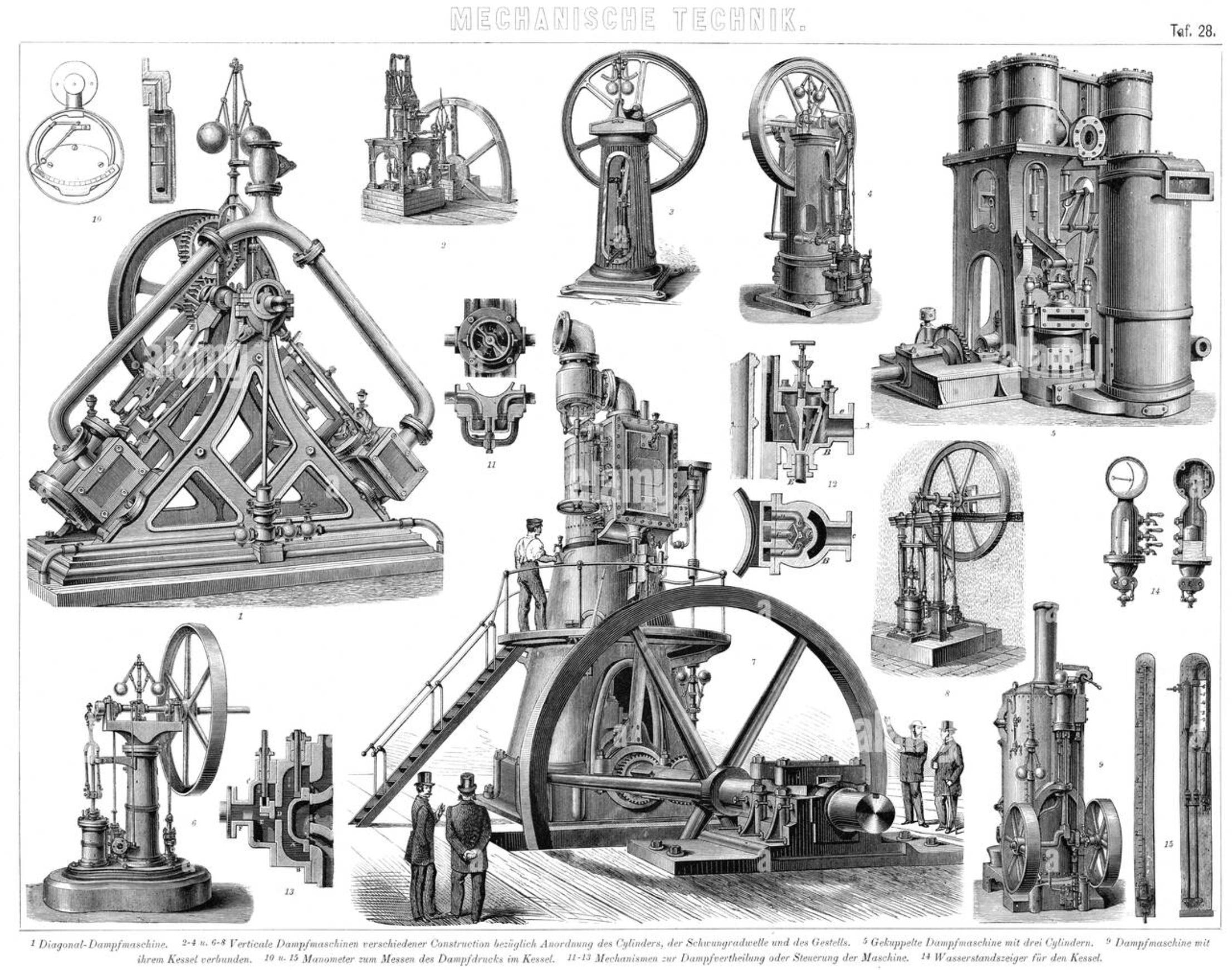
Steam power provided that conversion. Steam engines transformed coal into continuous, controllable mechanical work independent of geography. For railroads, this was decisive. Locomotives required a compact, mobile power source capable of sustained output over long distances. No alternative energy system available to Commercial societies could meet this requirement. Steam power was therefore not merely helpful but essential to fossil-fuel-based transport.
Coke-based iron production removed a second binding constraint. Railroads required vast quantities of standardized iron: rails, wheels, axles, bridges, engines, and structural components. Charcoal ironmaking, even at its most advanced, was limited by forest availability and could not scale to meet this demand at acceptable cost. Coke iron, produced using coal rather than wood, allowed iron output to expand in parallel with energy supply. Without cheap, abundant iron, railroads could not be built beyond experimental or local lines.
Precision Machine tools were the industrial foundation that made mechanical engineering actionable. Precision boring, turning, milling, and fitting were required to manufacture interchangeable parts, seal steam cylinders, align axles, and maintain engines under heavy use. Artisanal craftsmanship alone could not support the tolerances or volumes required. A dedicated machine-tool industry allowed complex mechanical designs to be reproduced reliably, repaired quickly, and improved incrementally. These conditions were essential for a national rail network.
Finance was the final indispensable industry. Railroads were unprecedented capital sinks. They required massive upfront investment in land, earthworks, iron, machinery, and labor, long before revenues could be realized. No prior private industry demanded comparable capital mobilization over such long horizons. Railroads therefore depended on:
joint-stock corporations,
transferable shares,
liquid secondary markets,
long-term debt instruments, and
credible legal enforcement.
Without these financial structures, the material and engineering capabilities would have remained unused.
Taken together, these industries formed a tightly interdependent system.
Coal supplied energy;
Steam converted it into motion;
Coke iron embodied it in durable materials;
Precision machine tools made those materials workable at scale; and
Financial institutions mobilized the resources necessary to deploy them across an entire country.
The absence of any one of these industries would have prevented railroads from becoming a national system, and thus would have blocked the transition from Commercial society to fossil-fuel growth.
What distinguishes Britain is not that it possessed advanced commerce, skilled labor, or competitive exports, but that it assembled this entire industrial suite before the railroad era. Railroads did not create these industries. They activated them. And once activated, they marked the transition from a Commercial society operating within a non–fossil-fuel ceiling to an economy reorganized around fossil-fuel growth.
Skills That Enabled The Railroad Boom
The industries that enabled the transition to fossil-fuel growth could not function without a parallel set of skills and organizational capabilities. These were not abstract forms of knowledge or scientific theory. They were practical, system-level competencies that allowed complex, capital-intensive technologies to be designed, coordinated, and operated at national scale. As with the enabling industries, their importance lay not in isolation but in combination.
Mechanical engineering was the central integrating skill. Railroads were not merely collections of iron and steam engines; they were tightly coupled mechanical systems in which power generation, transmission, motion, braking, and structural integrity had to work together reliably under heavy load. Mechanical engineering unified knowledge of materials, forces, tolerances, and motion into repeatable designs. It allowed locomotives to be powerful yet durable, rails to bear sustained stress, and entire systems to operate safely at speed.
Closely related to this was railroad-specific civil engineering, which extended mechanical principles into the landscape. Large-scale earthworks, bridges, tunnels, drainage systems, and stable track beds were essential for maintaining low gradients and long-term reliability. Without this combination, railroads could not extend beyond short, experimental lines.
Surveying and geodesy were indispensable for transforming railroads from local projects into national networks. Steam locomotives were highly sensitive to gradients and curvature, making route optimization a central technical problem. Surveyors had to evaluate terrain over hundreds of miles, balance construction costs against operating efficiency, and integrate routes with land acquisition and capital planning. While surveying existed in many societies, railroad-scale surveying required continuous coordination between engineers, financiers, and legal institutions. This was a scaling constraint rather than an invention constraint, but it was no less binding.
Metallurgical quality control was a necessary competence once railroads moved beyond novelty. Early rail systems suffered frequent failures caused by brittle rails, poorly rolled iron, and inconsistent materials. Because rail failure was catastrophic (endangering lives, destroying capital, and undermining public confidence) railroads forced rapid improvements in testing, inspection, and standardization of iron output. This capability connected directly to coke-based iron production, mechanical engineering, and machine tools. Without reliable metallurgical control, railroads could not operate safely or economically.
Standardization and time discipline represented a critical organizational technology. Railroads required standardized track gauges, rail profiles, wheel dimensions, couplings, signaling systems, and operating rules. Unlike earlier commercial activities, which depended primarily on exchange, railroads depended on synchronization. Trains had to share tracks, meet schedules, and coordinate movements over long distances. Over time, this led to standardized timetables and, eventually, standardized time itself. These were not cultural preferences but functional necessities imposed by system operation.
Large-scale project management was the final enabling skill. Railroads required the coordination of thousands of workers, multi-year construction schedules, uncertain geological conditions, staged financing, and continuous material supply. No previous private enterprise had demanded this degree of sustained coordination under competitive conditions. Project management emerged as a practical capability: sequencing tasks, managing risk, controlling costs, and adapting plans as conditions changed. Without it, even societies with the right materials and energy sources would have failed to build coherent rail networks.
Together, these skills transformed industrial potential into operational reality. They linked materials to machines, machines to landscapes, and landscapes to markets. Like the enabling industries, they did not by themselves constitute fossil-fuel growth. But without them, the railroad could not have been built.
Which Societies Had These Industries And Skills
Once the industries and skills required for a railroad-centered fossil-fuel transition are specified, comparison becomes much clearer if the evidence is presented systematically. What matters is not general sophistication, but which specific industries and system-level skills each society actually possessed before 1830.
Britain
Before 1830, only Britain possessed the full set of industries and skills required to design, finance, build, and operate railroads at national scale.
Industries present
Coal mining: large-scale, geographically widespread, central to the energy economy
Steam power: widely deployed, continuously improved, and domestically manufactured
Coke-based iron production: cheap, abundant, increasingly standardized output
Precision machine tools: boring, turning, milling, fitting at industrial tolerances
Finance: joint-stock corporations, liquid secondary markets, long-term capital mobilization
Skills present
Mechanical engineering: integrated understanding of power, motion, materials, and tolerances
Railroad-relevant civil engineering: large earthworks, bridges, tunnels, drainage, long-lived structures
Surveying and geodesy: route optimization tied to land markets, gradients, and capital planning
Metallurgical quality control: testing, inspection, rolling techniques, iterative improvement
Standardization and time discipline: gauges, components, operating rules, synchronized scheduling
Large-scale project management: coordination of labor, materials, finance, and risk over many years
Crucially, these industries and skills already interacted through shared labor markets, firms, and capital flows. Railroads did not create this system; they activated it.
Netherlands
A fully developed Commercial society, but lacking the key industries that enabled railroads and other fossil-fuel powered technologies.
Industries/skills present
Advanced finance and legal institutions
Sophisticated trade and shipping
World-leading hydraulic and water-management engineering
High-quality surveying and cartography
Key absences
No national coal industry
No steam-power ecosystem
No coke-based iron production
No machine-tool sector
Limited mechanical engineering tied to heavy systems
The Dutch economy was highly efficient within a non–fossil-fuel ceiling, but its capabilities could not be recombined into a railroad system.
Northern Italy
An early and sophisticated Commercial society with long urban traditions, but its dynamism was stifled by foreign conquest after 1494.
Industries/skills present
Dense urban networks
Skilled artisanal manufacturing
Established construction and surveying traditions
Commercial finance at regional scale
Key absences
No domestic coal supply
No steam-power ecosystem
No coke-based iron industry
No machine-tool sector
Engineering skills remained local and architectural, not mechanical-system-oriented
Northern Italy’s capabilities were real but structurally incompatible with fossil-fuel transport systems.
Flanders
A dense, advanced Commercial society at smaller scale, but its dynamism was stifled by Spanish conquest in the 16th Century.
Industries/skills present
Competitive textile production
Skilled artisanal labor
Dense local markets
Key absences
No domestic coal base
No steam power or coke iron
No machine tools
Weak capital mobilization for large projects
Limited system-level engineering
Flanders possessed commercial depth but lacked every heavy industrial and engineering component required for railroads.
German States
Agrarian societies with a blend of small Commercial cities. Technically skilled but fragmented.
Industries/skills present
Strong craft traditions
Local iron production (mostly charcoal-based)
Some mining and surveying competence
Key absences
No integrated coal–steam–iron system
No national machine-tool industry
Fragmented markets and jurisdictions
Underdeveloped capital mobilization
Weak large-scale project coordination
Capabilities existed in isolation, not as a recombinable system.
Sweden and Russia
Resource-rich but commercially and industrially constrained.
Industries/skills present
High-quality iron production (charcoal-based)
State-directed mining and metallurgy
Key absences
No scalable coal–steam integration
No machine-tool sector
Weak private capital markets
Limited system-level engineering and project management
Material resources alone proved insufficient.
India
An Agrarian society where vast majority of people were farmers, but it did have a highly competitive textile industry based on household production.
Industries/skills present
World-leading textile production
Extensive regional trade networks
Skilled artisanal labor
Key absences
No coal-based industrial energy system
No steam, coke iron, or machine tools
No railroad-capable engineering or capital institutions
Commercial sophistication did not translate into heavy industrial capability.
China
An Agrarian society where vast majority of people were farmers, but with large markets, particularly for rice.
Industries/skills present
Extensive internal commerce
Administrative surveying and infrastructure experience
Historical coal use in limited contexts
Key absences
No steam-power ecosystem
No coke-based iron industry
No precision machine tools
No private capital mobilization for infrastructure
No integrated mechanical engineering tradition
Market and Scale alone did not produce railroad capability.
Japan
An Agrarian society where vast majority of people were farmers, that was highly organized but energy-constrained.
Industries/skills present
Dense internal markets
Skilled artisanal production
Strong administrative coordination
Key absences
No domestic coal–steam–iron system
No machine tools or mechanical engineering
No infrastructure finance at scale
Japan would later assemble these capabilities rapidly, but only after external transfer.
As we can see in our brief comparative tour of the most complex societies in 1830, many societies possessed commerce, skill, or even advanced engineering in specific domains. Only Britain possessed the full, integrated set of industries and skills required to build railroads before 1830. Railroads therefore reveal, rather than explain, Britain’s singular position at the threshold of fossil-fuel growth.
Railroads As The Second-Stage Transition
Railroads were not simply another industry layered onto an already Commercial Britain. They were the first technology capable of applying fossil fuels across an entire economic system simultaneously.
In doing so, they marked the transition:
from a Commercial society operating within a non–fossil-fuel ceiling
to an Industrial society reorganized around fossil-fuel-powered growth.
What made railroads categorically different from earlier transport improvements was not speed alone, but systemic integration.
Railroads collapsed transport costs over land,
Unified regional markets, and
Connected coal, iron, machinery, food, and labor into a single national network.
Transported fuel, that had previously been consumed near its point of extraction, cheaply and reliably across long distance
Transported key material inputs across the entire nation rather than just within a specific locality
Transported finished goods to cities across Britain creating a much tighter national market
Funneled massive amounts of capital in what was likely the largest capital investment boom in world history.
This transformation depended directly on the industries and skills already described.
Coal powered locomotives and supplied ironworks.
Steam engines converted fossil energy into mobile traction.
Coke-based iron embodied that energy in rails, engines, and bridges.
Machine tools and mechanical engineering made locomotives and rolling stock reproducible and maintainable.
Civil engineering reshaped landscapes to accommodate low gradients and durable track beds.
Surveying optimized routes, while standardization and time discipline allowed trains to share infrastructure safely.
Finance and project management mobilized capital and coordinated construction on an unprecedented scale.
The economic effects followed quickly. Railroads dramatically reduced the cost of moving bulk goods, especially coal and food. They expanded labor markets, supported urban growth away from waterways, and enabled firms to operate at scales that had been impossible under the constraints of organic energy and high transport costs. For the first time, fossil fuels were not merely inputs into isolated industries, but the organizing energy source of the entire economy.
It is in this sense that railroads represent the second stage of economic transformation: from Commercial societies to Industrial societies.
Commercial societies had already achieved a profound break from Agrarian subsistence, creating market dependence, specialization, and sustained growth. Railroads did not negate that achievement; they built upon it. But they also shattered its limits. By integrating fossil fuels into transport, materials, and coordination at national scale, railroads initiated a new growth regime characterized by faster expansion, rising material consumption, and sustained improvements in living standards for the mass of the population.
Beyond Railroads
Railroads were the first and most important nineteenth-century technology to reorganize an entire economy around fossil fuels, but they were not the only one. They should be understood as the opening system transformation, not the sole driver of the new society that followed.
Once railroads demonstrated that fossil fuels could be applied across transport, materials, coordination, and markets at national scale, similar principles were extended into other domains. Together, these technologies completed the transition to a new type of society.
Railroads mattered most because they solved the core coordination problem of a fossil-fuel economy: how to move energy, materials, goods, and people cheaply and reliably over land. But once that constraint was broken, fossil fuels could be applied systematically to production, construction, communication, and daily life.
The result was not a single technological revolution, but a cascade of applications of the awesome energy density of fossil fuels to an entire suite of sectors, each building on the same underlying industrial and organizational capabilities.
Key nineteenth-century innovations that applied fossil fuels to additional domains included:
Steam-powered industrial machinery: The widespread replacement of human, animal, and water power with steam-driven machinery in manufacturing allowed production to scale independently of geography. Factories could concentrate labor, capital, and machines wherever markets and transport allowed, rather than where rivers flowed.
Coal-powered metallurgy and materials processing: Fossil fuels were applied not only to iron, but increasingly to steel, glass, chemicals, and cement. These materials reshaped construction, machinery, and infrastructure, embedding fossil energy into the physical fabric of society.
Steamships: Steam propulsion freed maritime transport from wind patterns and seasonal constraints. Combined with coal fueling stations and iron shipbuilding, steamships extended fossil-fuel transport to global trade routes, integrating national railroad systems into a world economy.
Urban gas networks: Coal gas transformed lighting, heating, and public space in cities. Gas networks represented one of the first examples of continuous fossil-fuel energy delivered directly into homes and businesses through fixed infrastructure.
Fossil-fuel-based urban infrastructure: Pumps, engines, and later electric generators powered water supply, sewage systems, and construction machinery. These systems allowed cities to grow far beyond the limits imposed by organic energy and local sanitation.
Electric power generation: Although electricity emerged later, it depended fundamentally on fossil fuels for generation. Electric motors, lighting, and communications extended the fossil-fuel system into precision manufacturing, information flow, and everyday domestic life.
Each of these innovations applied the same underlying logic revealed first by railroads: fossil fuels could be converted into reliable, scalable power and embodied in durable systems that reorganized entire domains of economic activity. None of them would have been possible without the prior integration of coal, steam, iron, mechanical engineering, machine tools, finance, and large-scale organization.
Railroads therefore mark the beginning of the second-stage transition, not its completion. They demonstrated that a Commercial society could be transformed into a fossil-fuel society. The technologies that followed filled out that new social type, extending fossil energy from transport into production, cities, and daily life. What emerged was not an economy with better machines, but a fundamentally different structure: one in which energy, materials, and coordination were no longer bound by the constraints that had defined all previous societies.
Implications
Reframing the British Industrial Revolution around the application of fossil-fuel systems to an entire suite of technologies rather than isolated inventions clarifies several long-standing confusions about industrialization.
It explains why Commercial societies could be rich, urban, and technologically sophisticated for centuries without triggering industrialization and why Britain’s breakthrough occurred when it did. Industrialization was not:
the gradual intensification of commerce,
nor the accumulation of clever machines.
It was the moment when fossil fuels were applied systematically across multiple domains, beginning with transport and rapidly extending into materials, production, cities, and coordination.
This perspective also explains why Britain’s pre-1830 experience looks deceptively unremarkable in aggregate data. Commercial societies were already a major historical advance. They generated market dependence, specialization, and steady improvements in material life relative to agrarian societies. Britain belonged fully to this group. Britain’s economy before railroads differed from the Netherlands in degree, not in kind. The absence of a sharp growth discontinuity before the nineteenth century is therefore not a puzzle to be explained away, but evidence that Britain had not yet crossed the decisive threshold.
The railroad-centered transition further clarifies why industrialization was so rare. Many societies had commerce, skilled labor, impressive engineering traditions, or abundant resources.
What they lacked was not ingenuity, but a specific configuration of industries, skills, and institutions that could be recombined into a fossil-fuel system.
Railroads functioned as a stringent integration test. Passing it required coal, steam, iron, machine tools, finance, mechanical engineering, surveying, standardization, project management, and legal coordination to exist simultaneously at national scale. Before 1830, only Britain met that standard.
Finally, this framework helps distinguish between stages of material progress without collapsing them into a single story.
Commercial society was itself a take-off relative to all earlier forms of human organization.
Fossil-fuel-based Industrial society was a second-stage transformation built on top of it.
Like a two-stage booster rocket, both stages were essential, and the first-stage rocket had to come first. Only later could the second stage fire. Treating these stages as analytically distinct avoids both the tendency to minimize preindustrial achievement and the tendency to read modern growth backward into the eighteenth century.
The early nineteenth century did not simply bring better machines. It brought a new way of organizing energy, materials, and coordination.
Railroads were the first clear expression of that shift.
Everything that followed, including industrial production, urban infrastructure, global transport, and eventually electrification, extended the same logic into new domains. Seen this way, Britain’s role in the nineteenth century was not to invent modernity, but to assemble and deploy the first fossil-fuel-based Industrial society capable of sustaining it.
The British Industrial Revolution (the series)
The British Industrial Revolution is one of the great transformations in the material standard of living for the masses in world history. We cannot understand material progress without coming to grips with its importance.
Bibliography
Angus Maddison; The World Economy: A Millennial Perspective
Stephen Broadberry et al.; British Economic Growth, 1270–1870
E. A. Wrigley; Energy and the English Industrial Revolution
Vaclav Smil; Energy and Civilization: A History
R. W. Fogel; Railroads and American Economic Growth
Christine MacLeod; Heroes of Invention: Technology, Liberalism and British Identity, 1750–1914
Joel Mokyr; The Enlightened Economy
If you’ve been enjoying these essays but only follow me here, you’re not getting them by email. Followers see Notes; subscribers receive every new piece on the history and future of progress.
Subscribe free here 👉:
See also my other articles on:
If you enjoyed this article, you should read my From Poverty to Progress book series.
I always learn from your posts! Appreciate your perspectives.