

Economics explains how modern economies grow, but not how they came to exist in the first place. Progress Studies provides an answer to this deeper question.
If you’re following me but don’t yet receive these essays by email, you’re missing most of them. Substack doesn’t email followers, only subscribers. You can get every new essay free in your inbox here:
👉 Start Here
Economics has a huge blind spot. Its leading theories explain how modern economies grow, but largely skip the more fundamental question of how those economies came into existence in the first place. It is a little like trying to understand biology without explaining evolution.
Economists have become very good at explaining how modern economies grow. But they are much less successful at explaining where those economies came from in the first place. Most economic growth models begin after the technologies, institutions, freedoms, food systems, and energy systems that make modern prosperity possible already exist.
I have a love-hate relationship with economics for this very reason.
On the one hand, economics is by far the most rigorous of the social sciences. Economists develop testable theories, collect enormous amounts of data, and use that evidence to understand how economies function. Economics is also the academic discipline closest to Progress Studies, particularly its branch of economic history. In fact, you could almost define Progress Studies as Applied Economic History.
On the other hand, economics rarely addresses the historical question that interests me most: How did humanity create the conditions for sustained material progress in the first place?
To me, economics is a little like biology before Darwin. It can describe how a complex system functions but struggles to explain how that system evolved. Economists have developed sophisticated models of modern economic growth without fully explaining how the modern market-based industrial economy originated.
Now, I should make something clear. I am not a trained economist. My understanding of economics is probably no better than that of an educated layman. A professional economist could easily run rings around me in a debate about how a modern economy functions today. But when it comes to explaining how that economy originated, I suspect I could give the typical economist a serious challenge.
My goal is not to criticize economics for its own sake. I want to extend its theories by adding the deeper historical and civilizational foundations that made modern economic growth possible.
Recently, three economists earned the Nobel Prize in Economics for 2025: Philippe Aghion, Peter Howitt, and Joel Mokyr. I already wrote about Joel Mokyr in a previous article. In this article, I want to shift to the other two Nobel Prize winners.
I do not claim to have a deep understanding of Aghion–Howitt’s theory. I had heard of them before they earned the Nobel Prize, but I cannot claim to know that much about their work, so I decided to do a little research on their theory and see if Progress Studies can learn anything from it.
As I see it, Aghion–Howitt is one more baby step towards the field of economics trying to explain the why of modern economic growth. Aghion–Howitt were essentially trying to fill in the gap left behind by older economic theories. To put it into perspective, we need to go over a few other economic models.
This article explains the Aghion-Howitt economic growth model and what the Progress Studies movement can learn from it.
Read on…

If you enjoy this article, you should read my From Poverty to Progress book series.
Three main economic growth models
Modern economic growth theory has developed through three major models, each building on the previous one:
The Solow model (1950s): Economic growth depends on labor, capital, and technological progress, but technological change comes from outside the economy.
The Romer model (1980s): Technological progress comes from within the economy through knowledge accumulation and spillovers, as people invest in research, education, and new ideas.
The Aghion–Howitt model (1990s): Economic growth comes from innovation through creative destruction, as new technologies and companies replace older ones.
Each model explained something the previous one could not. Solow measured the contribution of technological progress. Romer explained how an economy generates new knowledge. Aghion and Howitt showed how competition and creative destruction turn innovation into a continuing process.
But I think all three models leave out a crucial part of the story. They explain how economic growth works once certain conditions exist, but not how those conditions developed in the first place. That is the gap Progress Studies seeks to fill.
Solow growth model: Growth from “Outside”
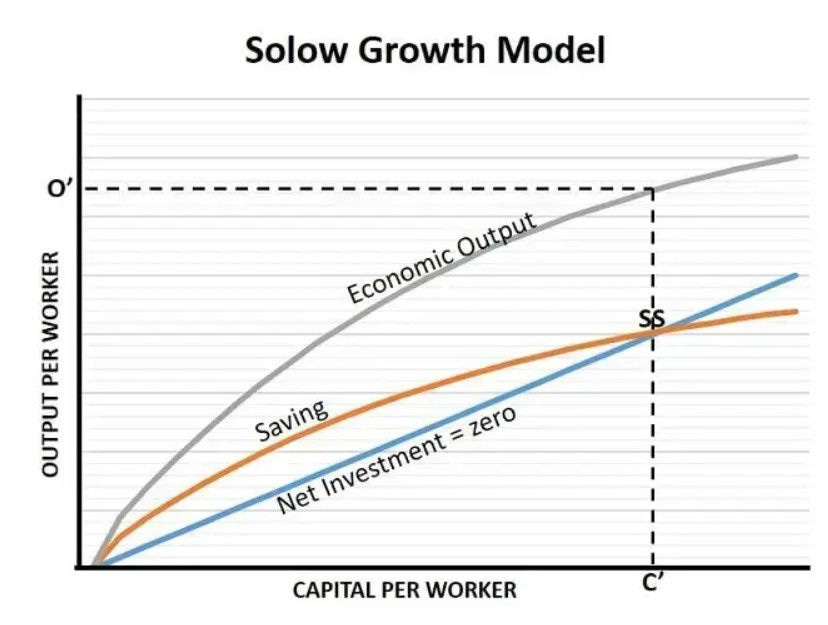
For much of the 20th century, economists could measure economic growth, but they struggled to explain what caused it. In the 1950s, economist Robert Solow developed the first major mathematical model of long-term economic growth.
The Solow growth model identified three main sources of economic growth:
Labor: More workers producing goods and services.
Capital: More machines, equipment, and other productive assets.
Total factor productivity (TFP): The increase in output that could not be explained by adding more labor or capital. Economists generally associate this with technological progress.
The third factor was especially important. Solow showed that adding more workers and machines could not, by itself, explain sustained increases in living standards. Something else had to make those workers and machines more productive.
But there was a problem. Total factor productivity was essentially a mathematical leftover. Economists calculated it by subtracting the contributions of labor and capital from economic growth. They could measure its effects without explaining what caused it.
Policy Implications of the Solow model
Solow’s model had an important implication for economic policy. Governments could help their economies reach higher levels of wealth by encouraging investment and capital accumulation. But those policies could not permanently increase the rate of economic growth.
That was because long-term growth ultimately depended on technological progress, which the model treated as an external force beyond the government’s control.
Solow himself was developing a theoretical equilibrium model, not prescribing a government policy program. But later economists drew several policy recommendations from his framework:
Encourage saving and investment. Promote private saving, secure property rights, and efficient financial markets so businesses can invest in more capital. More capital per worker raises productivity, although diminishing returns eventually limit the benefits.
Maintain macroeconomic stability. Avoid inflation, fiscal crises, and wars that destroy capital or discourage saving and investment.
Establish good institutions. Protect property rights and enforce contracts so people and businesses have the confidence to accumulate capital.
Avoid interfering with technological progress. Since the model treats innovation as something that happens outside the economy, government policy should focus on removing obstacles rather than trying to generate innovation directly.
The dominant theory for promoting economic growth in developing nations rests on these policy prescriptions. Build the right institutions and economic growth will just happen.

Weakness of the Solow model
Solow’s great achievement was showing just how important technological progress was to long-term economic growth. His great weakness was failing to explain where that technological progress came from.
In his model, new technologies simply appeared. The economy benefited from them, but the process that produced them remained unexplained.
Why do people invent new technologies?
Why do some societies produce far more innovations than others?
Solow’s model could not answer these questions because it treated technological progress as something that happened to the economy rather than something the economy produced.
Economists could measure the contribution of technological progress to economic growth. But they still could not explain the process of innovation itself.
The Romer model: Knowledge from Within
Thirty years after Solow, economist Paul Romer tackled the biggest weakness in his model. Technological progress does not just happen. People create it by investing in new ideas.
In the 1980s, Romer developed a model that explained how economies generate technological progress from within. His theory rested on three important ideas:
Knowledge is like a recipe book. Once someone invents a new recipe, other people can use it.
Unlike physical resources, ideas can be reused indefinitely. That means economic growth can continue even when land and natural resources are limited.
The creation of new knowledge depends on investments in:
human capital,
research,
education.
Romer helped establish what became known as endogenous growth theory. “Endogenous” simply means that growth comes from within the economy rather than from some outside force.
This was a major advance. If people and organizations create technological progress, then government policies that encourage education, research, and innovation can increase the long-term rate of economic growth.
Policy implications of the Romer model
Paul Romer fundamentally changed the role of government in economic growth theory. In Solow’s model, technological progress was largely beyond the government’s control. In Romer’s model, governments could encourage the creation and spread of new knowledge.
The key was that knowledge produces increasing returns. Once an idea is discovered, it can be used again and again without being consumed. And because new ideas often build on existing ones, investments in knowledge can produce benefits far beyond the original investment.
Paul Romer’s model pointed toward five major policy recommendations:
Invest in education and human capital. A better-educated population can create new ideas and put existing knowledge to more productive uses.
Support research and development (R&D). Private companies cannot capture all the benefits of their discoveries because others can copy or build on them. Without public support, businesses tend to invest less in R&D than would benefit society as a whole.
Protect intellectual property. Patents and copyrights give innovators an incentive to develop new ideas. But those protections must be balanced against the danger of creating monopolies that restrict further innovation.
Encourage openness and trade. Exposure to foreign ideas helps knowledge spread across borders, allowing societies to benefit from discoveries made elsewhere.
Avoid relying on redistribution and short-term economic stimulus. Policies that temporarily increase demand or consumption cannot substitute for the knowledge accumulation needed to sustain long-term growth.
Romer’s model gave policymakers a much more active role in generating growth. Education, R&D, and openness were no longer simply desirable policies. They became potential drivers of permanent increases in the economic growth rate.
This also represented an important shift in emphasis. Solow’s model encouraged governments to establish good institutions that supported investment and capital accumulation. Romer’s model focused more directly on the policies those institutions produced, especially policies that encouraged the creation and spread of knowledge.
Weaknesses of the Romer model
Romer explained where new ideas came from, but his model still missed an important part of how innovation actually works.
In particular:
Innovation appeared too smooth and cooperative. Companies and individuals contributed new knowledge to a growing pool of ideas, and everyone benefited from that expanding knowledge.
The model largely ignored creative destruction. In the real economy, innovations do not simply add to existing knowledge. New technologies can destroy entire industries, drive established companies out of business, and replace older ways of producing goods and services.
Romer captured the creation and spread of knowledge, but not the competitive struggle that drives much of technological progress. His model had plenty of winners, but almost no losers.
The Aghion–Howitt model
Innovation is not a peaceful process in which everyone benefits. New technologies destroy old industries, successful companies lose their markets, and new competitors replace established businesses. This constant struggle is one of the main forces driving economic growth.
In the 1990s, Philippe Aghion and Peter Howitt built an economic growth model around this process. They showed how innovation, competition, and creative destruction can produce sustained economic growth, and how institutions and government policies can either encourage or suppress it.
Their model built on the ideas of economist Joseph Schumpeter, who argued that capitalism advances through creative destruction. New products, technologies, and businesses continually replace older ones. Aghion and Howitt combined this insight with Romer’s endogenous growth theory, which explained how innovation comes from within the economy.
Some economists call their approach Schumpeterian Growth Theory because Aghion and Howitt turned Schumpeter’s ideas into a theory that was:
Precise enough to model mathematically.
Testable against real-world evidence.
Useful for evaluating economic policies.
As one popular description puts it, “Schumpeter made the poetry; Aghion and Howitt did the math.”
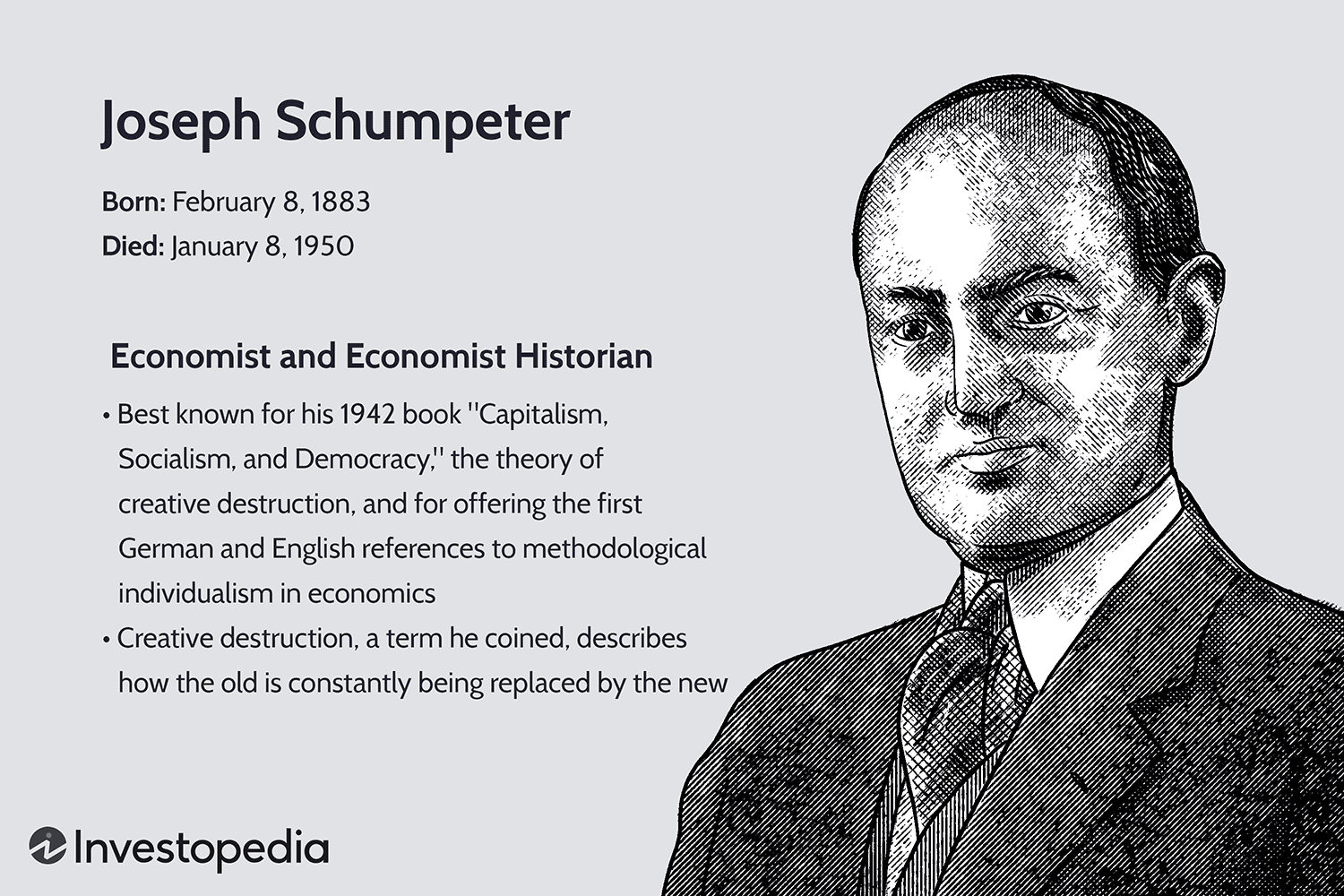
Together with Paul Romer, Aghion and Howitt became pioneers of endogenous growth theory. But while Romer focused on the creation of knowledge, Aghion and Howitt explained how competition turns innovation into a continuing process of economic growth.
Their model works roughly like this:
People and companies want to get rich. One of the best ways to do that is to invent a new product or develop a better way of doing something. The goal is to earn monopoly rents, meaning profits above the normal competitive level.
Innovation creates temporary monopoly power. A company that invents a better engine, a new phone, or some other valuable technology can earn unusually high profits because competitors cannot immediately match it. Patents and the advantages of being first to market help protect those profits. The prospect of these temporary monopoly rents gives companies a powerful incentive to invest in research and development.
Success never lasts forever. Eventually, another entrepreneur or company develops something better. The older technology becomes obsolete, the established company loses its advantage, and the new competitor takes its place. This is what Schumpeter called creative destruction.
The cycle keeps repeating. Every company wants to become the next successful innovator or protect its position against competitors. That creates constant pressure to improve products and production methods. Each successful round of innovation raises productivity and living standards.
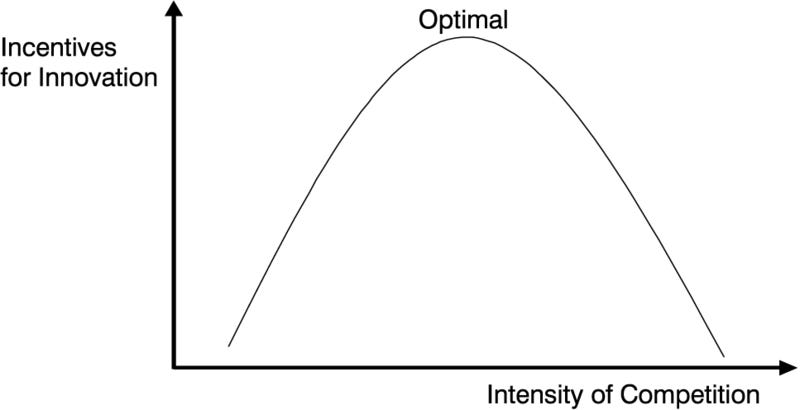
The key is finding the right level of competition. Every economic sector needs a balance between two conditions:
New entrepreneurs must be able to enter the market and challenge established companies.
Existing companies must be able to earn enough temporary monopoly profits to justify investing in innovation.
Too much competition can discourage innovation. If competitors can immediately eliminate the profits from a new invention, established companies have less incentive to spend money developing it. They need some opportunity to recover their investments and earn a suitable return.
Too little competition also discourages innovation. If established companies can prevent new competitors from entering the market, they have little reason to improve. Without the threat of being replaced, they can continue earning profits without investing in new technologies.
The important insight is that competition and temporary monopoly profits are not necessarily opposites. Both can be necessary for innovation. Companies need the prospect of unusually high profits to justify taking risks, but they also need the threat of competition to keep improving.
Aghion and Howitt’s model connected innovation, competition, institutions, and government policy within a single theory of long-term economic growth.
In particular, it helped explain:
Why some capitalist economies keep improving while others stagnate.
How innovation can create wealth while temporarily increasing inequality.
How policies involving education, patents, and antitrust regulation influence long-term economic growth.
Policy implications of the Aghion–Howitt model
Aghion and Howitt showed that governments can influence economic growth by changing the incentives to innovate. Governments cannot simply order businesses to invent better technologies. But they can establish conditions that encourage businesses and entrepreneurs to take the risks that make innovation possible.
Their model treats innovation as a continuing competitive struggle. Companies invest in R&D because they hope to earn temporary monopoly profits from new technologies. But they will only make those investments if two conditions exist:
They expect to keep enough of the profits from successful innovations to justify the investment.
New entrepreneurs can enter the market and challenge established companies, but competition does not eliminate the rewards of innovation too quickly.
Government policy can strengthen or weaken both conditions. This makes innovation policy a central part of economic growth policy.
Under the Aghion–Howitt model, governments should encourage:
Free entry for new entrepreneurs. New companies must be able to enter established industries and challenge existing businesses. This is perhaps the most important condition.
Regulations that prevent established companies from blocking new ideas. Incumbents should not be able to use their economic or political power to prevent potential competitors from entering the market.
Competition among established companies. Existing businesses need competitive pressure to justify continued investment in R&D.
Secure but time-limited intellectual property rights. Patents should allow innovators to earn temporary monopoly profits without protecting them from competition indefinitely.
Education systems that produce innovators. This goes beyond Romer’s emphasis on general human capital. The goal is to develop people capable of creating new technologies and businesses.
Financial systems that support risk-taking. Entrepreneurs need access to investment capital, particularly venture capital, to develop and commercialize new technologies.
The government’s role is not to plan innovation or decide which technologies should succeed. It is to create an economic environment where entrepreneurs can challenge established businesses, innovators can earn rewards, and competition continually pushes companies to improve.
Strengths of the Aghion–Howitt model
Aghion and Howitt made an important advance over earlier economic growth models. Solow had established the importance of technological progress, but treated it as something that happened outside the economy. Romer explained how investments in knowledge and research generated new ideas from within the economy.
Aghion and Howitt added something both models were missing: the competitive struggle through which new technologies replace old ones.
This made their model a more realistic description of how capitalism works. Innovation does not simply expand society’s collective knowledge. It also destroys the value of existing technologies, threatens established businesses, and creates new opportunities for entrepreneurs.
Their model captured the economic consequences of these struggles, including the temporary monopoly profits that reward successful innovators and the competitive pressures that eventually eliminate those profits.
It also explained why government policies must balance two competing goals. Innovators need enough protection to justify investing in new technologies, but established companies must never become so protected that they can prevent new competitors from challenging them.
Aghion and Howitt’s greatest contribution was turning creative destruction from a broad explanation of capitalism into a quantitative theory of economic growth. Economists could now model the incentives that drive innovation, test the theory against evidence, and evaluate the consequences of different policies.
Weaknesses of the Aghion–Howitt model
Despite these advances, I think the Aghion–Howitt model suffers from the same fundamental weakness as earlier economic growth theories. The Aghion–Howitt model begins halfway through the story.
The model assumes that a modern industrial economy already exists. Entrepreneurs can start businesses and compete with established companies. Property rights are secure. Capital is available for investment. And the economy has enough energy and productive capacity to support industrial development.
But where did these conditions come from?
The model cannot explain:
Why the conditions that support innovation and creative destruction arose in the first place.
Why only a handful of societies developed these conditions.
Why some societies lost these conditions after centuries of prosperity.
These are not minor historical details. They determine whether the economic mechanisms described by Aghion and Howitt can operate at all.
Aghion and Howitt explain how innovation drives economic growth once the necessary conditions already exist. But their model does not explain how societies acquired those conditions, why most societies never developed them, or why some societies eventually lose them.

The next iteration in economic theory: Progress Studies
I believe Progress Studies can provide the missing first chapter of economics. Instead of beginning with a modern industrial economy and explaining how it grows, we need to explain how that economy came into existence in the first place. Why did humanity endure thousands of years of stagnation before a few societies finally achieved sustained material progress?
My research offers an explanation. The Five Keys to Progress identify five necessay preconditions that make sustained material progress possible:
Efficient food production and distribution systems,
Trade-based cities,
Decentralized power,
High-value export industries, and
Widespread usage of fossil-fuel energy.
Together, these five preconditions allow a society to function as a vast, decentralized problem-solving network. Millions of people and organizations can experiment, innovate, compete, cooperate, and improve existing technologies. These activities reinforce one another, creating a continuous process of material progress.
I call this process How Progress Works


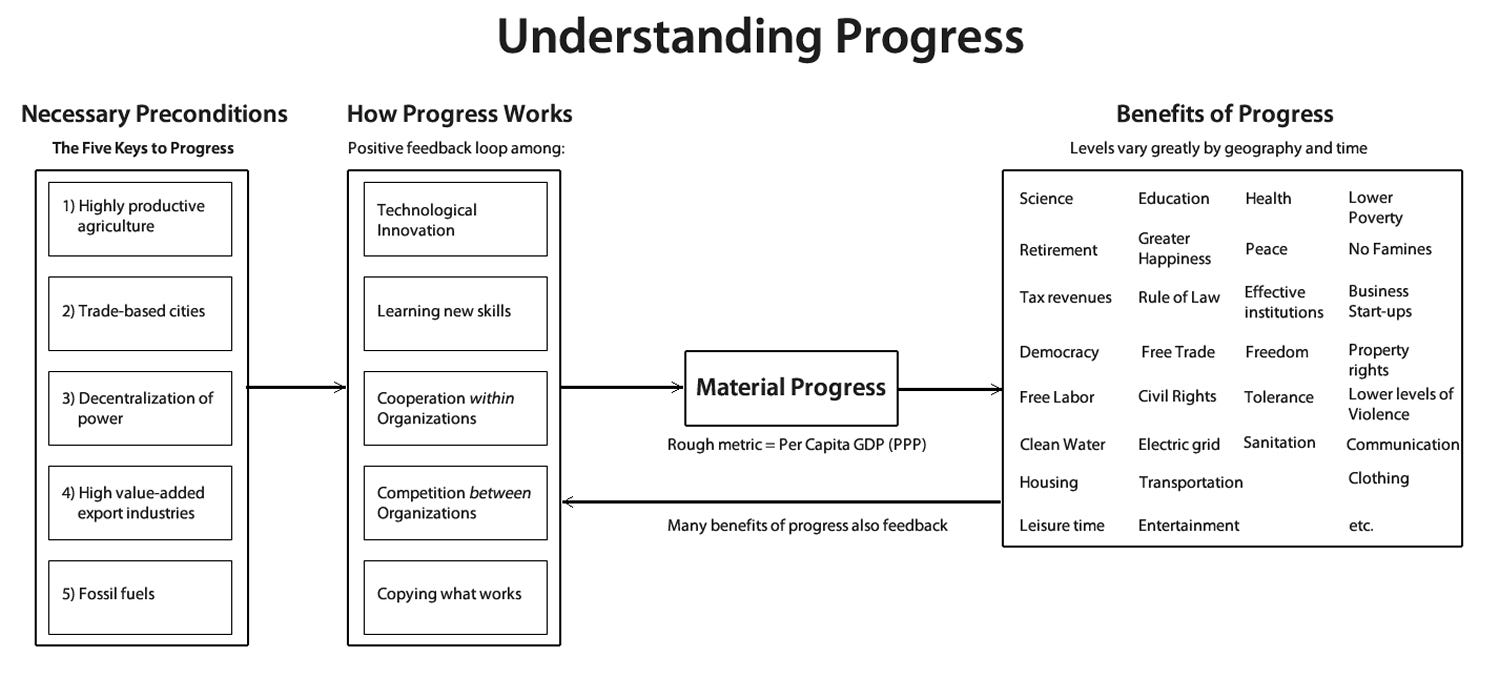
Aghion and Howitt explain how innovation, competition, and creative destruction drive economic growth. My framework explains how societies develop the conditions that allow those mechanisms to operate and sustain themselves over generations.
Without a theory of these origins, economics risks mistaking the middle of the story for the whole story. It can explain the mechanics of innovation without explaining the civilization that makes innovation possible.
Progress Studies offers a broader explanation by connecting economic growth to geography, energy, institutions, and human evolution. I believe my framework is the first to bring these factors together into a single causal theory that explains:
How societies acquire the Five Keys to Progress.
How those conditions transform societies into self-reinforcing engines of material progress through How Progress Works.
How societies can lose those conditions when political power becomes centralized, energy supplies falter, or ideologies undermine the foundations of progress.
Just as Aghion and Howitt extended Solow and Romer by explaining the economic forces that produce innovation, Progress Studies can extend Aghion and Howitt by explaining the deeper origins of those forces.
That would give us a more complete theory of material progress. We could understand not only how to accelerate innovation within modern economies, but also how societies develop the capacity for sustained progress and why they sometimes lose it.
So how to we connect the two theories?
While researching this article, I was struck by how closely Aghion and Howitt’s model resembles my How Progress Works theory. I developed my theory around 2020, almost 30 years after they developed theirs, without having read their work or studied economics. I am certainly not claiming that I invented their theory.
I think this is a case of “simultaneous invention,” also called “multiple discovery,” where different people independently develop similar ideas without knowing about each other’s work. Aghion and Howitt got there decades before I did, and they deserve the credit.
But there are also some substantial differences between our theories. Aghion and Howitt explain the proximate mechanics of progress, particularly how innovation and competition drive economic growth.
My How Progress Works theory explains the deeper social conditions that make those mechanisms possible and sustainable. And my complementary theory, the Five Keys to Progress, pushes the explanation back even further, identifying how those conditions arose in the first place.
Shared idea: Decentralized Problem-solving
Both theories see material progress as the result of countless individuals and organizations competing and cooperating to solve problems. Progress emerges from their combined activities, not from any central authority directing them.
Aghion–Howitt: Firms and entrepreneurs compete to earn profits by developing new technologies that replace older ones. The economy becomes a self-organizing discovery process, with innovation and creative destruction driving economic growth.
My theories: Once a society acquires the Five Keys to Progress, it becomes a vast decentralized problem-solving network. Individuals and organizations experiment, copy, compete, cooperate, and improve existing technologies. These are the same behaviors that Aghion and Howitt describe mathematically.
The difference is what each theory explains. Aghion and Howitt show how decentralized problem-solving generates economic growth. My theories explain why only certain societies develop the conditions that allow decentralized problem-solving to flourish.

Different Levels of Explanation
Our theories explain progress at two very different levels:
Aghion–Howitt: The microeconomic mechanisms that sustain economic growth, particularly the incentives to innovate, the entry and exit of firms, and creative destruction.
My theories: The societal mechanisms that produce the institutions, energy systems, and organizational freedom needed for those economic processes to operate.
Aghion and Howitt start with societies that already have the conditions needed for sustained economic growth. My theories explain how those societies developed and why others remained stagnant.
The Five Keys to Progress identify the necessary preconditions for sustained material progress:
Efficient food system
Trade-based cities of free citizens
Decentralized power
High-value-added export industry
Fossil fuel energy
Each key provides something essential for creative destruction to operate on a large scale. Without them:
Key 1: There is no surplus labor available for experimentation.
Key 2: There are no dense networks of innovators and merchants.
Key 3: There is insufficient freedom for new businesses to enter markets and compete.
Key 4: There is no injection of wealth to fund research and development.
Key 5: There is no abundant energy to scale up innovations.
These conditions help explain why innovation and creative destruction became powerful engines of economic growth in some societies but not others.
Aghion and Howitt assume these conditions already exist. My theories explain where they come from.
Integrating the two models
I see Aghion and Howitt’s model as part of my broader theory of material progress, not as a competing explanation. Their work adds something valuable to my framework: a way to explain contemporary economic growth and evaluate the effects of government policies.
The two theories fit together in several important ways:
Creative destruction is part of the process I describe in How Progress Works. Technological innovation, learning new skills, cooperation, competition, and copying are all behaviors that drive material progress.
Sustained economic growth occurs when these behaviors are supported by abundant fossil-fuel energy and institutions that allow decentralized trade, freedom, and specialization.
In other words, the Aghion–Howitt model describes one part of How Progress Works in mathematical terms. It provides a quantitative explanation for an important mechanism within my broader qualitative theory.
And that is something I cannot do myself. I am not a trained economist, and I lack the mathematical skills needed to build and test sophisticated quantitative models. Aghion and Howitt provide the kind of mathematical analysis that my theories lack.
Missing components from my theories
Aghion and Howitt address several important aspects of economic growth that my theories of the Five Keys to Progress and How Progress Works do not explicitly cover. I see no fundamental contradictions between our approaches, but their work has exposed some gaps in my thinking.
Four differences stand out.
Quantitative modeling
My theories are qualitative. I try to use measurable evidence, such as per capita GDP, wherever possible, but I do not express the mechanisms of progress through mathematical equations.
Aghion and Howitt take a very different approach. They turned Schumpeter’s theory of creative destruction into a quantitative model that explains how incentives to innovate translate into measurable economic growth.
Their model uses concepts such as:
Expected R&D returns.
Innovation arrival rates.
Creative destruction probabilities.
Endogenous growth, in which economic growth results from decisions made by people and businesses within the economy rather than external technological shocks.
My theories describe the social conditions and human behaviors that produce innovation, but they cannot calculate the rate of innovation or predict its contribution to economic growth mathematically.
This is a real limitation. Unfortunately, I lack both the mathematical skills and the desire to spend years acquiring them. My strengths lie in building and testing qualitative theories, not constructing sophisticated economic models.
I would love to see a qualified economist do for my theories what Aghion and Howitt did for Schumpeter’s theory of creative destruction. Any volunteers?
Role of monopolies
Aghion and Howitt have forced me to reconsider one of my long-held views: that monopolies are almost always bad for progress.
My theories generally treat monopolies as tools that political, economic, military, and religious elites use to extract surplus grain or money from the rest of society. I recognize that certain monopolies, such as those involving military power, may be necessary. But my historical research has led me to view monopolies as something societies should avoid whenever possible.
There is a good reason for that bias. Throughout most of human history, too little competition has been a far greater obstacle to progress than too much competition.

Aghion and Howitt show why certain economic monopolies, or quasi-monopolies, can actually encourage technological innovation.
Companies invest in R&D because they hope to earn unusually high profits from their discoveries. Temporary monopoly power allows successful innovators to recover their investments and enjoy those profits. Without that reward, many innovations would never be developed.
But those monopolies must remain temporary. New entrepreneurs need the freedom to enter markets, challenge established companies, and eventually replace their technologies with something better.
Aghion and Howitt explicitly model the tradeoff between monopoly profits and future competition:
Innovators earn temporary monopoly rents.
New competitors eventually destroy those rents by introducing better technologies.
The replacement effect, or the threat of being replaced by competitors, influences companies’ incentives to innovate.
My How Progress Works theory recognizes competition and copying as essential drivers of progress. But it does not formally distinguish between innovation motivated by profit and innovation motivated by survival. Nor does it model monopoly rents or intellectual property rights as quantitative influences on innovation.
I now think Aghion and Howitt are right that patents granting companies temporary monopolies can be beneficial. The difficult question is how long those monopolies should last. I suspect the answer varies considerably between industries and technologies, but I do not yet have a clear position.
One point I agree with wholeheartedly is the importance of allowing new entrepreneurs to enter markets. Temporary monopolies can encourage innovation, but easy market entry is essential to keeping them temporary.
Business Cycle and Growth Interaction
Aghion and Howitt also explain something my theories largely ignore: how innovation affects short-term economic fluctuations.
Creative destruction can disrupt established industries, displace workers, and produce temporary slowdowns or recessions. Their model connects these fluctuations to the longer-term process of economic growth.
My theories take a different perspective. I treat progress as a long-run evolutionary process, not as an economy fluctuating around a short-term equilibrium.
As a result, I focus on the historical conditions that allow progress to continue over decades and centuries rather than the shorter-term economic cycles that occur along the way.

Innovation Frontiers
Aghion and Howitt distinguish between economies operating at the technological frontier and those trying to catch up.
Economies at the frontier must develop new technologies to keep growing. Economies behind the frontier can often advance by adopting and adapting technologies that already exist elsewhere.
My How Progress Works theory recognizes this distinction through the importance I place on copying and modifying successful technologies. Societies do not have to invent every technology themselves. They can make enormous progress by learning from others.
But my framework does not mathematically distinguish between frontier and catch-up economies or explicitly model how their innovation incentives differ.
Aghion and Howitt’s work provides a more precise explanation of how innovation and imitation contribute to growth under different economic conditions.


Missing components from Aghion and Howitt’s model
Aghion and Howitt made important contributions to our understanding of economic growth. Their work also exposed some weaknesses in my own theories, particularly my treatment of monopolies and my inability to model economic growth mathematically.
But I think their model leaves out several factors that are essential to understanding material progress. Just as Aghion and Howitt built on Solow and Romer, I hope future economists will use the Five Keys to Progress and How Progress Works to address these weaknesses in their model.
Civilizational Preconditions for Innovation
Aghion and Howitt explain how innovation works within a modern industrial economy. But their model assumes that the conditions needed for innovation already exist.
My Five Keys to Progress framework identifies the deeper historical and geographic conditions that make innovation and creative destruction possible:
Efficient food systems that free workers from food production so they can pursue other occupations, including innovation.
Trade-based urban networks that allow people to exchange skills and knowledge.
Decentralized political and ideological power that allows entrepreneurs to compete with established businesses.
High-value export industries that bring wealth into a society.
Fossil fuels that provide the abundant energy needed for sustained experimentation and innovation.
These are not simply favorable conditions for economic growth. They are the foundations that allow the economic processes described by Aghion and Howitt to operate on a large scale.
Their model takes these conditions for granted. My framework tries to explain how societies acquire them.
Food and Energy as foundations of growth
I think one of the biggest weaknesses of modern economics is that it underestimates the importance of food and energy. Because economists generally study modern industrial economies, they tend to treat food and energy as readily available. They are more concerned with changes in prices, particularly oil prices, than with the underlying supplies that make economic activity possible.
Aghion and Howitt’s model follows this pattern. It does not explicitly account for the food and energy required to support innovation. Yet real technological revolutions depend on enormous surpluses of both.
Throughout most of human history, food and energy were among the greatest constraints on material progress. Societies could not simply invent their way to prosperity without the physical resources needed to support their inventions.
That is why I think economists should expand the three main factors of economic growth into five:
Food: Added from my Five Keys to Progress framework.
Energy: Added from my Five Keys to Progress framework.
Labor: Already included in the Solow model.
Capital: Already included in the Solow model.
Technological innovation: Treated as a residual in the Solow model and later explained through innovation and creative destruction in the Aghion–Howitt model.
Food and energy are not secondary considerations. They are physical inputs that make the other factors productive. Without sufficient food to support specialized workers and enough energy to power production, technological innovations cannot transform an economy on a large scale.


Labor is too vague
Economists also need to rethink what they mean by labor. Counting the number of workers tells us very little about a society’s capacity for technological innovation.
Economists have partly addressed this problem through the concept of human capital. But I think we need more specific categories to understand the civilizational foundations of progress.
At a minimum, labor should be divided into different occupations and skill levels:
Entrepreneurs who create and build new businesses.
Engineers who develop and improve technologies.
Skilled blue-collar workers who build prototypes of physical inventions and maintain the infrastructure that entrepreneurs and engineers depend on, including energy systems, ports, highways, railroads, sanitation, and electricity.
Unskilled and low-skilled workers.
Many other occupations that contribute to economic production.
The important distinction is not simply how many workers a society has, but what those workers know how to do.
Technology is useless without the skills needed to develop, operate, and maintain it. Labor contributes to material progress because workers possess skills associated with particular technologies, not simply because they exist.

Capital is also too vague
Capital suffers from a similar problem. Economists often treat it as a single factor of production, even though different kinds of capital serve very different purposes.
Economists have started making these distinctions in their models of innovation finance, but I do not think they have gone far enough to explain the civilizational foundations of progress.
I plan to write a separate essay on this subject, so I will focus on one particularly important category: venture capital.
Venture capital deserves its own place in economic growth theory because it enables entrepreneurs to create and expand businesses that compete with established corporations.
This is particularly important in the Aghion–Howitt model. Creative destruction depends on new companies challenging existing businesses. Without access to financing, many entrepreneurs cannot turn their inventions into competitive businesses.
Venture capital therefore helps ensure that the temporary monopolies described by Aghion and Howitt actually remain temporary.
Ties to human biological evolution
My theory of How Progress Works also connects economic growth to human biological evolution. Humans did not suddenly develop the ability to cooperate, imitate, and compete when modern capitalism appeared. These behaviors evolved over millions of years because they helped our ancestors survive and reproduce.
How Progress Works treats these behaviors as ancient evolutionary adaptations. Material progress accelerates when societies develop institutions that allow people to use these instincts productively.
Aghion and Howitt take a different approach. Their model treats individuals and companies as rational economic actors responding to incentives. It does not explain those behaviors in terms of human biological evolution.
My framework connects the economic mechanisms they describe to the much older evolutionary processes that produced human problem-solving behavior.

Diffusion and Global Spread of Progress
Material progress does not develop independently in every society. Once a society acquires the Five Keys to Progress, its innovations can spread to other societies.
My research examines how this geographic diffusion occurs and why certain regions, particularly Northwest Europe and North America, became leaders in material progress while others followed.
Aghion and Howitt’s core model largely treats the economy as a single, closed system. It does not explicitly explain the geographic spread of progress through international diffusion, geopolitics, or imitation between societies.
My framework places these processes within the larger history of how progress spreads from one society to another.

Limits and Collapse Dynamics
Economic growth is not guaranteed to continue forever. Societies can lose the conditions that made material progress possible in the first place.
My theories explicitly recognize this danger. Progress can reverse when decentralized power collapses or when political, economic, and ideological elites recentralize power and undermine the institutions that support innovation.
Aghion and Howitt’s core model largely assumes that the institutional environment remains stable. It explains how innovation operates within a competitive economy, but not why a society might lose the capacity for sustained innovation.
To be fair, their later empirical research does examine institutions and politics. But I have not found an explanation in their core model for how the institutions that support innovation originally arise or why they sometimes collapse.
This is an important distinction between our approaches. Aghion and Howitt explain how economic growth can continue under favorable institutional conditions. My theories also seek to explain how societies can lose those conditions and experience a reversal of material progress.


Conclusion
Economists have made enormous progress in explaining how modern economies grow. But explaining how economic growth works after the necessary conditions already exist is not the same as explaining how those conditions arose, why only certain societies developed them, or why they sometimes disappear.
I believe Progress Studies can help fill that gap. My Five Keys to Progress and How Progress Works theories explain how efficient food systems, trade-based cities, decentralized power, high-value export industries, and fossil fuels create the conditions for sustained material progress. Aghion and Howitt explain how innovation, competition, and creative destruction drive economic growth once those conditions exist.
What we need now is to combine these approaches. Economists can bring their mathematical models and empirical methods to bear on the deeper causes of progress. They can measure the Five Keys, test their importance against historical evidence, and incorporate them into quantitative models of economic growth and decline. Progress Studies can contribute the broader historical, geographic, and evolutionary explanations that existing growth models largely overlook.
The goal is not to replace economics, but to extend it. Just as Romer built on Solow, and Aghion and Howitt built on Romer, Progress Studies can help economics take another step toward a more complete theory of material progress.
We need an economics that explains not just how wealthy societies become wealthier, but how poor societies become wealthy in the first place, how progress spreads, and why it sometimes reverses.
That is the missing first chapter of economics. And I believe Progress Studies can help write it.
If you’ve been enjoying these essays but only follow me here, you’re not getting them by email.
Followers see Notes; subscribers receive every new piece on the history and future of progress.
Subscribe free to get each essay in your inbox:
👉 Start Here
If you enjoyed this article, you should read my From Poverty to Progress book series.
My second comment is that I have always been extremely disappointed in how economists have explained economic growth, or more accurately, how they haven’t even tried.
To me this is like medical doctors who don’t understand health, and worse, don’t bother to try to understand it. The idea that Solow basically built models of economic growth that explained away most of growth as coming outside the model, was a travesty. He might as well have said, “don’t ask us”. Romer’s model was much better, but I agree completely with you on its inadequacies.
Two other things that have always bothered me about economics. The first is how they are excessively dominated by mathematicians. I worked with teams of mathematicians and actuaries in my past life, and greatly value them. However, my experience is that there are great entrepreneurial/innovative thinkers and there are great mathematicians. Each is one person out of a thousand. But for someone to have both skills is probably one in a million.
Luckily the solution to this is to combine creative/innovator types with mathematician types.
Economics seems to have been captured by the mathematicians and they screen out non mathematicians. I worry they also screen out most of the big picture thinkers. It takes both, and both don’t have to be the same person.
My final criticism with economists is that they don’t seem to value the underlying structure or framework of their own discipline. Economists study markets, and markets work via the interplay of secure property rights, freedom of action, prices, mutually beneficial interactions, and open competition. Yet most modern economists don’t seem to even care about these foundations. It seems to me that if you take these things away you no longer have an economy that is worth modeling, yet many economists just don’t seem to care.
This is a really important area that you are exploring – the civilization groundwork for economic growth. Have you read Why Nations Fail? (https://en.wikipedia.org/wiki/Why_Nations_Fail) by the winners of the 2024 Nobel Prize in economics? Their work covers this topic in ways that complement your ideas.