

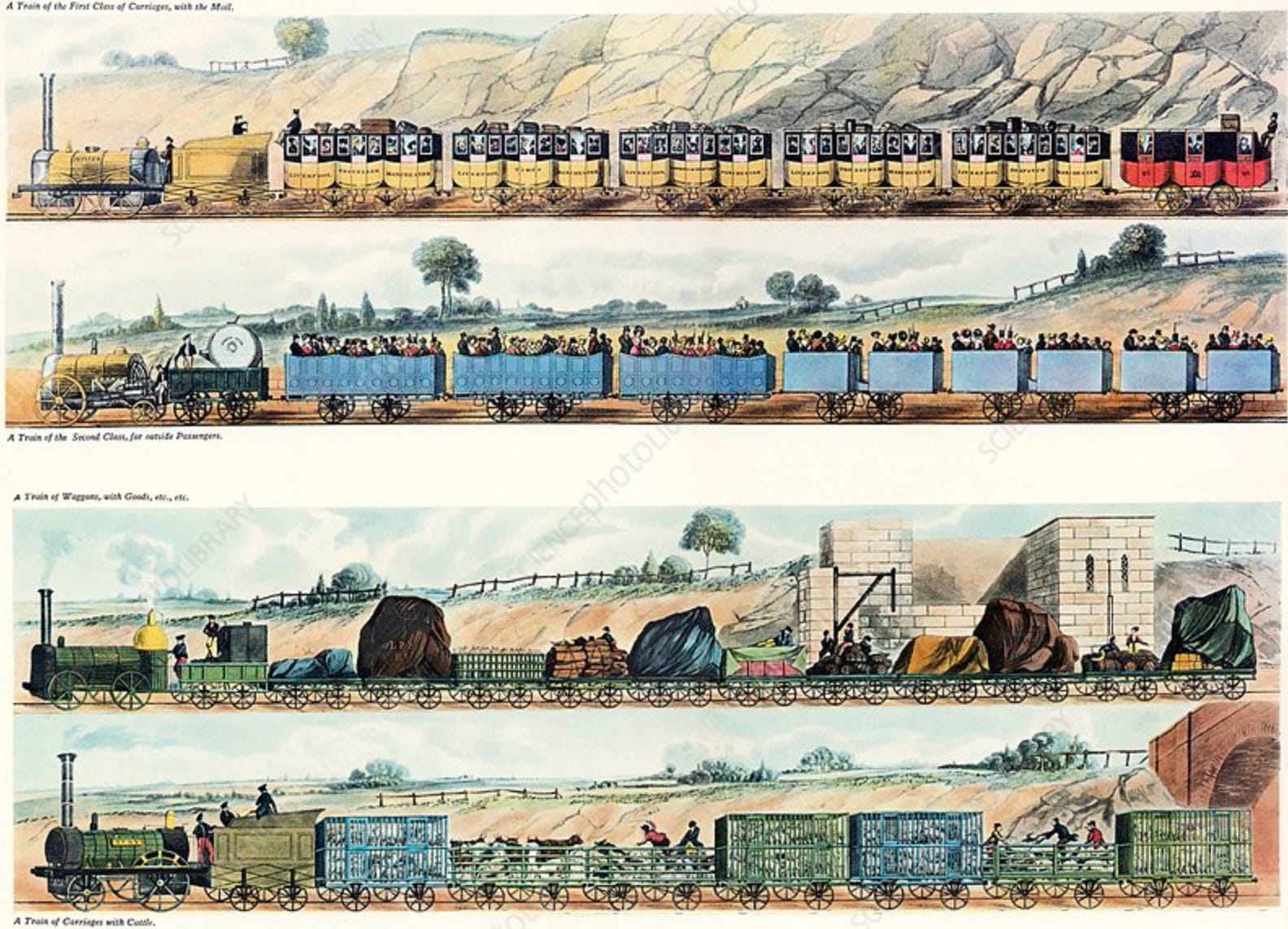
Britain’s Industrial Revolution was a two-stage transition: Commercial first, fossil-fuel–powered technological innovation second. This framework explains why no single theory has been enough.
If you’re following me but don’t yet receive these essays by email, you’re missing most of them. Substack doesn’t email articles to followers, only to subscribers. You can get every new essay free in your inbox by subscribing 👉:
In previous essays in this series on the British Industrial Revolution, I:
Explained why different schools of thought had very different conceptions of what the British Industrial Revolution was, particularly its definition, proper metric, timing, and the effect of material standard of living
Explained key weaknesses in all the competing theories, particularly:
Overwhelmingly focusing on just one cause or set of related causes, largely because they make quantitative measurement easier. This is despite the unlikelihood that only one thing caused such a transformative event.
(with a few exceptions) Failure to compare Britain to other Commercial societies at the time: Northern Italy, Flanders and the Dutch Republic.
(largely because of the above) Still after 200 years, there is no consensus on the causes of the British Industrial Revolution.
In this article, I will present a multi-causal theory that explains the causes of the British Industrial Revolution far better than competing theories.
Read on…

If you enjoy this article, you should read my From Poverty to Progress book series.

Pre-industrial England was a Commercial society
Any attempt to explain why Britain industrialized first must begin with the correct comparison set. Most existing theories implicitly compare Britain either to:
its own pre-industrial past or
Agrarian societies elsewhere in Eurasia.
This article instead compares Britain to other Commercial societies that shared similar levels of market dependence, urbanization, specialization, and institutional sophistication. Only this comparison allows us to distinguish prerequisites for industrialization from the forces that actually triggered it.
For centuries, the most advanced economies in the world were Commercial societies. England (and later Britain) belonged fully to this group until the nineteenth century, sharing more structural similarities with the Netherlands than with any later industrial economy. In the 16th, 17th, and 18th Century England/Britain (and perhaps earlier) was a Commercial society: which I define as having:
the majority of food calories are purchased in the marketplace rather than acquired directly (this makes Commercial societies very different from all preceding Society Types)
yet without the widespread use of fossil fuels (this distinguishes them from contemporary Industrial societies).

Only four regions clearly reached this condition before the nineteenth century:
Medieval city/states of Northern Italy (Venice, Florence, Genoa, Milan, and many more)
Late Medieval city/states of Flanders (Ghent, Bruges, Ypres, and Antwerp in modern-day Belgium)
The Dutch Republic (1579-1795)
Pre-industrial England, particularly in the southeast (roughly 1500-1800)
These societies shared a common structural profile.
Most households depended on markets for food, which required widespread wage labor, monetization, and specialization.
Urbanization rates were high by premodern standards,
Trade networks were dense,
Political and economic decision-making was widely spread across individuals institutions
Commercial institutions were sophisticated.
Manufacturing was common
Export industries were competitive, often world-leading, and
Capital accumulation was substantial.

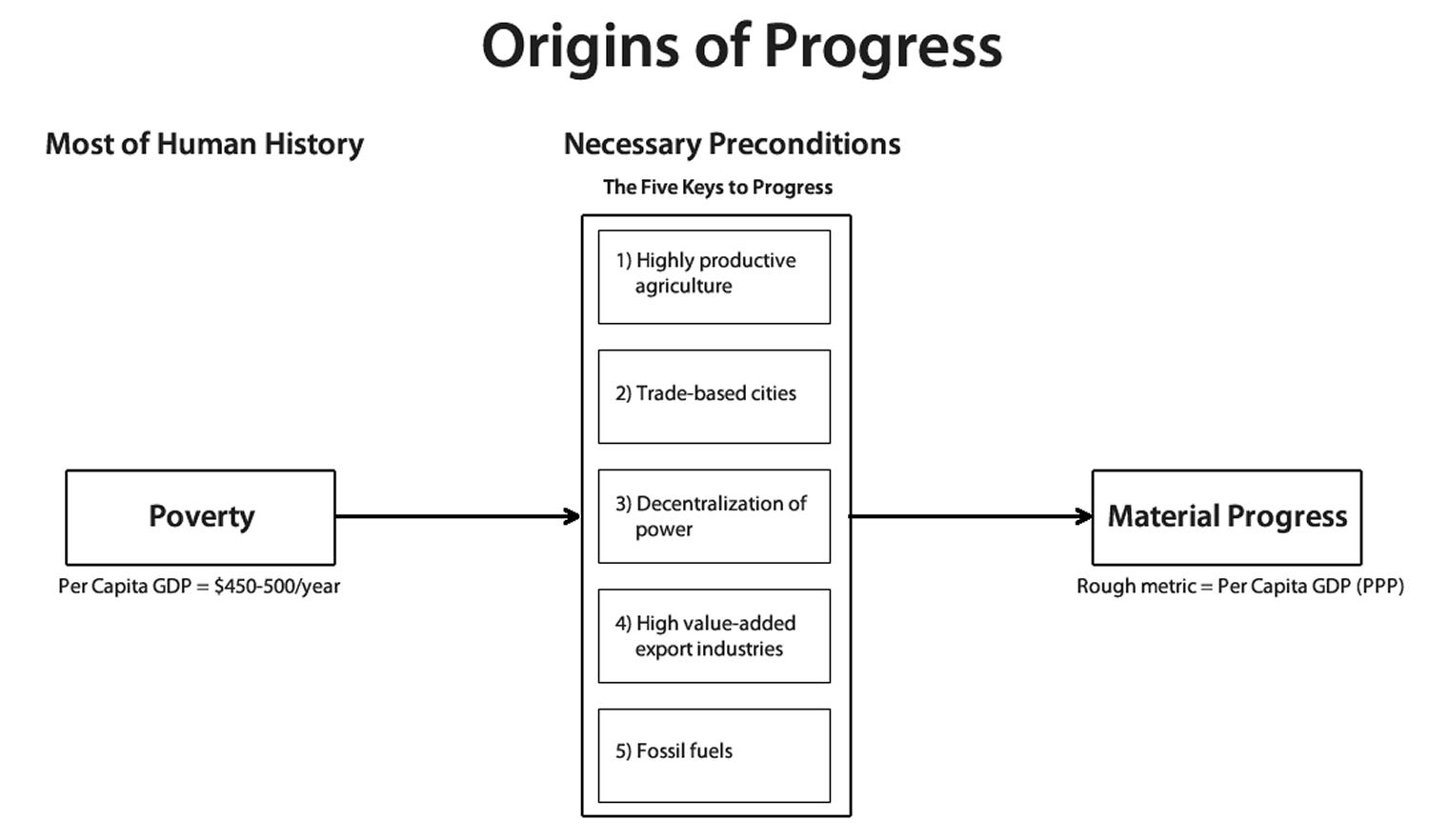
By the standards of earlier history, these were extraordinarily advanced economies. Using my Five Keys to Progress theory, these nations had achieved the first Four Keys.
A highly efficient food production and distribution system. This enables societies to overcome geographical constraints to food production so that large numbers of people can focus on solving problems other than getting enough food to eat.
Trade-based cities packed with a large number of free citizens possessing a wide variety of skills. These people innovate new technologies, skills, and social organizations and copy the innovations made by others.
Decentralized political, economic, religious, and ideological power. It is of particular importance that elites are forced into transparent, non-violent competition that undermines their ability to forcibly extract wealth from the masses. This also allows citizens to freely choose among institutions based upon how much they have to offer to each individual and society in general.
At least one high-value-added industry that exports to the rest of the world. This injects wealth into the city or region, accelerates economic growth and creates markets for smaller local industries and services.
This enabled an increased standard of living for the masses, but nothing like what was to come.
The Shared Energy Ceiling of Commercial societies
Yet all Commercial societies faced the same hard ceiling: they lacked the Fifth Key to Progress: widespread use of fossil fuels. The incredible energy density of fossil fuels injects vast amounts of useful energy into society enabling it to solve a wide variety of problems. The London area used coal for home heating and some industries combusted coal for heat, but nothing approaching the widespread application of fossil fuels that are common in contemporary Industrial societies.

Without fossil fuels:
Energy supplies were limited by land, forests, and human or animal labor.
Transport costs, particularly land transport costs, remained high,
Leading to fragmentation of markets, and
Sharply constraining scale.
Economic growth existed, but it was smooth, incremental, and bounded compared to today.
Crucially, England before the 1830s differed in degree, not in kind, from the Netherlands. Markets were deep, wages were relatively high, and exports were competitive, but the underlying structure was still that of a Commercial society.
The limits faced by Dutch merchants and Italian manufacturers were the same limits faced by British ones. No Commercial society, including Britain, had yet escaped the constraints imposed by organic energy, costly transport, and fragmented production.
The remainder of this essay explains why Britain alone ultimately shattered the constraints of Commercial societies, and why that break did not occur until fossil fuels were applied across an entire economic system in the nineteenth century.


Industrial Growth Without Industrialization
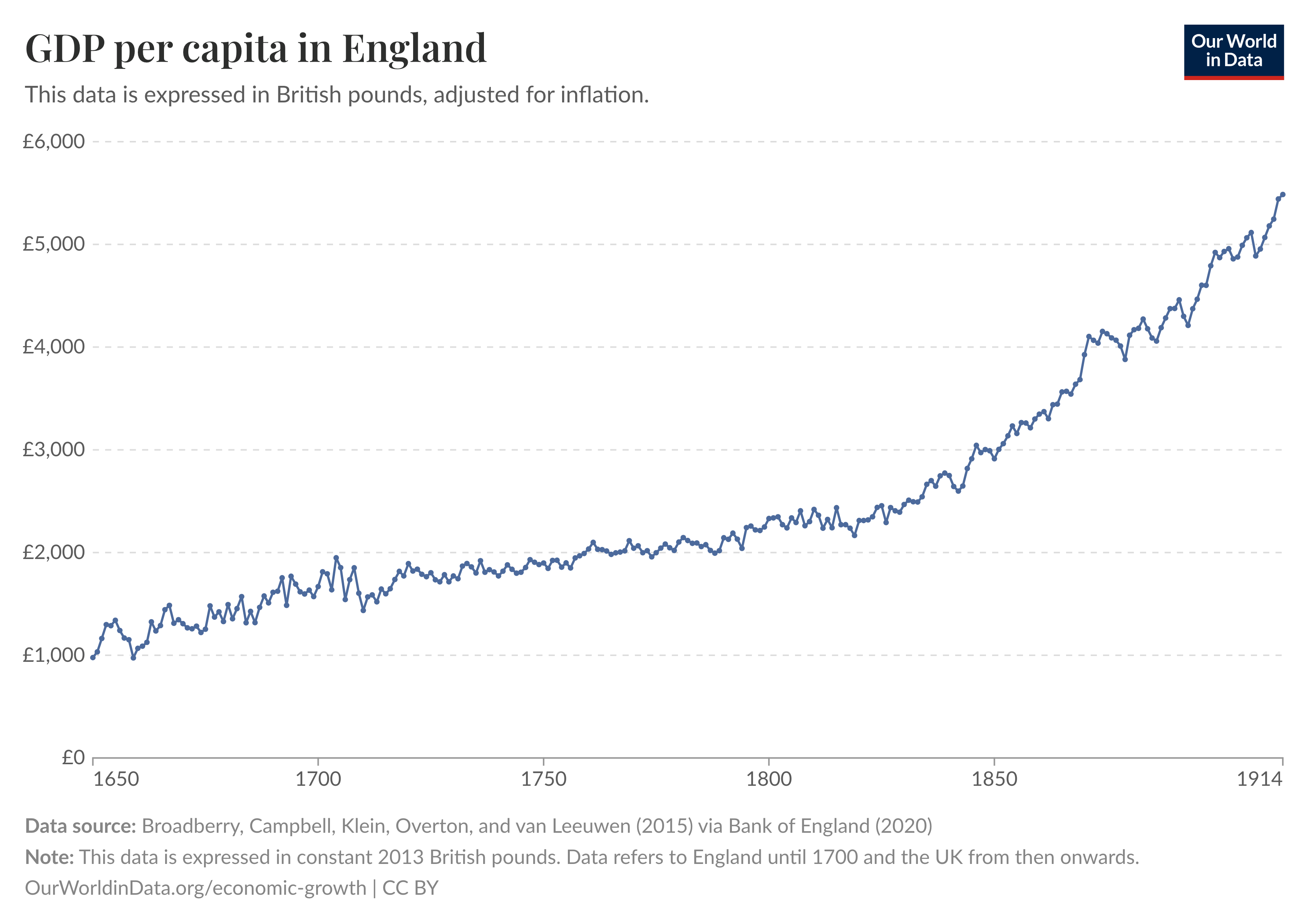
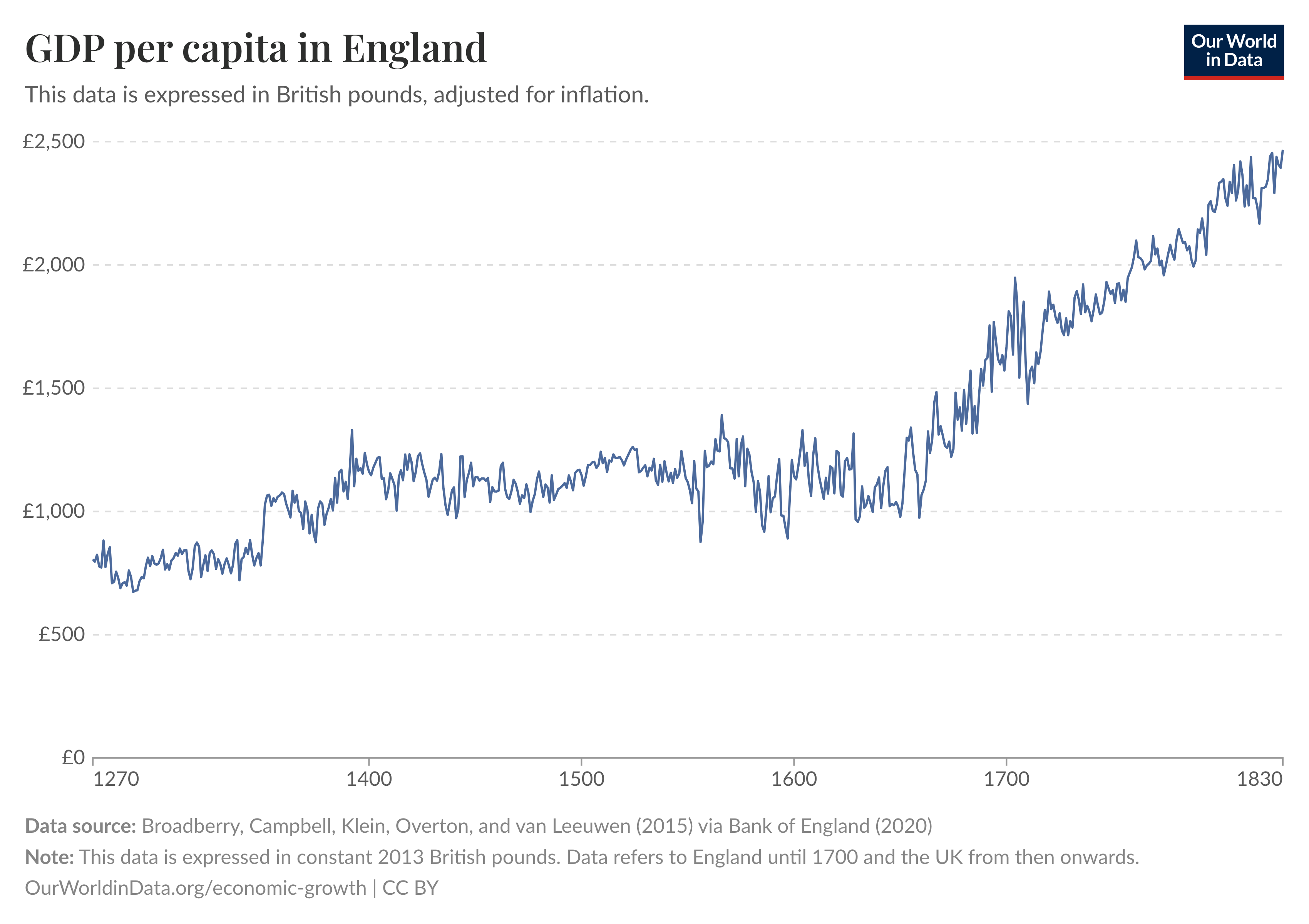
Measured economic growth before the nineteenth century shows no sharp British break from other Commercial societies. It is best understood as gradual economic growth within a non–fossil-fuel economy, bounded by the constraints shared by all Commercial societies.
What is most striking in these data is the absence of any major changes in the per capita growth rate prior to the 1830s. There is no moment at which England decisively pulls away from other Commercial societies in growth rates or living standards.
Wage series tell the same story. English real wages were high by European standards, but so were Dutch wages, and both fluctuated within a constrained range for generations. Consumption patterns improved slowly, but without the dramatic broadening that would later characterize Industrial society. To understand why this long period of growth did not yet constitute an Industrial Revolution, we must also examine changes in production structure.
Manufacturing Expansion before Industrialization
When we shift the focus on manufacturing employment, the transition was much earlier than most economic historians claim.

One can see clearly that the Secondary sector (mining, manufacture, and construction):
Experienced a long, slow increase from less than 20% of all employment before 1400 to less than 30% in 1600
Then increased rapidly from 1600 to over 40% in 1700
Then hovered at 42-47% between 1700 and World War II.

This quantitative smoothness matters because it falsifies a common intuition. If industrialization were already underway in eighteenth-century Britain, it should be visible in the aggregate data on per capita GDP or in increased manufacturing employment.
It is not.
The Two-Stage Transition
The implication is clear. Whatever made Britain distinctive before the 1830s does not qualify as an Industrial Revolution. This quantitative continuity matters because it clarifies what Commercial societies actually represented.
I believe that my Society Type and Five Keys to Progress frameworks can help to synthesize the debate. Once Britain is correctly understood as a late Commercial society that had already acquired four of the Five Keys to Progress, we see Britain went through two major transitions, not one. Since previous economic historians largely assumed only one transition with only one cause, they are constantly talking past each other.
A good analogy of these transitions is a two-stage rocket that transformed England from an Agrarian society > Commercial society > the world’s first Industrial society. Sometime in the 17th Century (the exact timing is very unclear), England fired its first-stage rocket which propelled to high rates of economic growth than any previous nation. This led to almost two centuries of strong real per capita GDP growth of roughly 0.5% per year.
The long-slow transition of England from an Agrarian society to a Commercial society:
A long-slow transition of southeast and eastern England from an Agrarian society that was previously quite similar to other Eurasian Agrarian societies into a Commercial society. Southeast England did so by acquiring (and to a large extent copying from the Low countries) four of the Five Keys to Progress:
Highly productive agriculture
Trade-based cities
Decentralization of power
High value-added export industries (A big part of this transition was the growth of manufacturing in the 17th Century that researchers traditionally associate with Industrial societies.)
What was missing was the Fifth: Widespread usage of fossil fuels.
The gradual spread of that Commercial society geographically north and west to the rest of England and parts of Scotland and the transformation of political and economic institutions that this expansion forces. I will write more on this in future articles.
By borrowing technologies, skills and organizations from other Commercial societies and specializing in industries that were essential to the invention and mass production of railroads, pre-industrial Britain accidentally assembled all the necessary preconditions for the Industrial Revolution. I will write more on this in future articles.
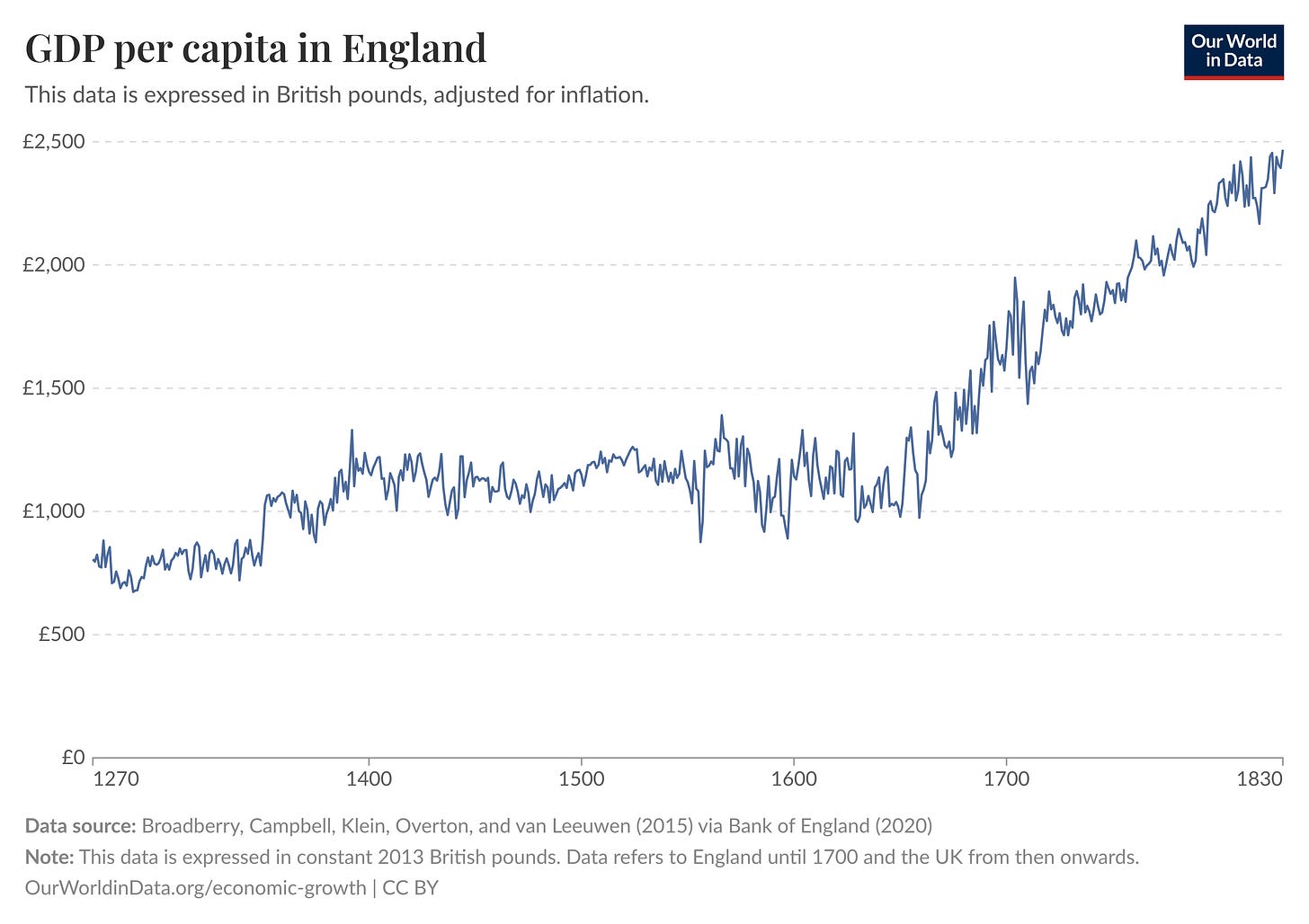
During the 1830s and 1840s, the second-stage booster fired. Given the profound changes in the material standard of living of the masses and its spread to many other regions of the world, I think that this second transition can be accurately characterized as an Industrial Revolution.
This economic transition to an Industrial society that came with the specific application of the awesome energy density of fossil fuels to land transportation: the railroad in the 1830s and 1840s. This led to a massive expansion in the use of fossil fuels (i.e the Fifth Key to Progress). It was this technological innovation (along with the application of fossil fuels to other domains such as ocean transportation, agriculture, materials, communication, urban infrastructure, and the military) that truly transformed Britain into the first Industrial society.
Just as importantly, it was this period that had the biggest positive impact on the material standard of living of the masses. Real per capita GDP growth more than doubled to roughly 1.2–1.4% per year and stay there for the rest of the 19th Century.


Synthesizing the Competing Theories
I believe that my theory synthesizes what is useful about the vast majority of the competing theories while integrating them onto one useful framework.
First Stage Booster Causes
The cause of the first-stage booster is the coming together of the first Four Keys to Progress in Commercial societies. Almost all the other theories describe one characteristic or set of related characteristics that were common among all four Commercial societies.
I have no doubt that Britain was more advanced on a number of these metrics than other Commercial societies, but all four Commercial societies were far superior to other Agrarian societies at the same time period. All of the theories describe characteristics of Commercial societies, but none of them alone can explain either:
the emergence of Commercial societies in England and other societies, or
the later Industrial Revolution.
Both of those transitioned are better explained by the Five Keys to Progress, where Commercial societies needed to acquire the First Four Keys to Progress but none of them were sufficient without all four. The nature of Commercial drove them to innovate or copy the First Four Keys to Progress in ways that previous society types could not.
Second Stage Booster Causes
The cause of the second-stage booster (i.e. the Industrial Revolution) is most closely approximated by the Coal theory proposed E. A. Wrigley and Robert Allen. Coal was critical because it was:
Far more energy dense than wood, wind, water, or muscle power
The most easily accessible and refined of all fossil fuels. Petroleum and natural gas were far too difficult for pre-industrial societies to discover, extract, refine, and distribute compared to coal.
But coal had been on Earth and Britain for millennia. Proximity to easily-accessible coal was very helpful, but it is not sufficient.
The key causal trigger of the British Industrial Revolution was the key technological innovations of the early and mid-19th Century that were powered by coal and later other fossil fuels (i.e. activating the Fifth Key to Progress at a system-wide scale).
The first and most important coal-powered technological innovation was the railroad, which transformed land transportation…
but this energy revolution was later extended to the steamship, steel production, telegraphy, tractors, internal combustion engines, turbines, and electricity.
Coal made these technologies possible, but far from inevitable.
In a future article, I will explain why Britain was able to innovate those critical coal-based technologies.
How the Five Keys to Progress Integrate the Competing Theories
One advantage of viewing the British Industrial Revolution through the lens of the Five Keys to Progress is that it reveals why so many competing explanations appear plausible, yet incomplete. Almost all major theories in the literature correctly identify an important causal factor, but most isolate only one part of a much larger system.
In retrospect, nearly all of the leading explanations can be mapped onto one of the Five Keys.
The first key, a highly efficient system of food production and distribution, encompasses theories emphasizing agricultural productivity and demographic change. Explanations centered on rising agricultural yields, enclosure, improved farming techniques, and population dynamics, advanced by scholars such as Wrigley, Clark, Overton, and the Cambridge Group, correctly identify how Britain freed labor from subsistence agriculture and sustained dense populations. These factors were indispensable preconditions for urbanization, specialization, and non-agricultural employment, but they could not by themselves generate industrial takeoff.
The second key, dense trade-based cities populated by free workers with diverse skills, integrates theories focused on high wages, human capital, artisan capabilities, invention networks, and the so-called Industrial Enlightenment.
High-wage explanations (Allen, Humphries),
Skills-based accounts (Mokyr, Wallis), and
Studies of artisan and inventor networks (MacLeod, Fox, Edgerton)
all describe different facets of the same underlying reality: a commercial urban society in which skilled workers, mechanics, engineers, and entrepreneurs were numerous, mobile, and incentivized to experiment and innovate. These conditions explain Britain’s unusual capacity for incremental technological improvement, but not the timing or scale of industrialization.
The third key, decentralized political, economic, and ideological power, incorporates institutional, political, and cultural explanations. Theories emphasizing:
Theories emphasizing property rights, constitutional constraints, financial institutions, and limits on arbitrary state extraction (North, Weingast, Acemoglu) fit naturally here, as do accounts stressing
Political fragmentation and interstate competition in Europe (Jones, Goldstone, Greif).
These features shaped incentives and reduced barriers to innovation, but they were shared by multiple Commercial societies.
The fourth key, the presence of at least one high–value-added export industry, integrates theories of proto-industrialization, commercial expansion, consumer demand, and overseas trade. Accounts emphasizing:
Rural manufacturing networks (Mendels, Kriedte, Ogilvie),
the growth of Atlantic trade and colonial commerce (O’Brien, Williams, Inikori), and
the “consumer revolution” (de Vries, McKendrick)
all describe mechanisms by which Commercial societies deepened markets, accumulated capital, and supported increasingly complex production systems. These industries accelerated growth and innovation, but similar patterns existed in Northern Italy, Flanders, and the Dutch Republic without producing an Industrial Revolution.
The fifth key, the widespread usage of fossil fuels, integrates coal-based explanations of the Industrial Revolution. Theories associated with Wrigley and Allen correctly identify coal as the binding constraint on all Commercial societies and the decisive factor distinguishing industrial from pre-industrial economies.
What matters in this framework is not the mere presence of coal, but its application through transformative technologies, most notably railroads, and later steamships, steel production, mechanized agriculture, internal combustion engines, and electricity. These technologies allowed fossil-fuel energy to be deployed across transportation, manufacturing, and infrastructure at scale.
Seen in this light, the persistence of monocausal theories is understandable. Each identifies a real prerequisite for industrialization. The problem is not that these theories are wrong, but that they mistake a necessary condition for a sufficient cause. Commercial societies required all four of the initial keys to emerge and thrive, and Industrial societies required all five. No single key, taken in isolation, could produce the transformation.
This framework also helps explain why Britain industrialized first without implying inevitability. Britain did not uniquely possess most of the commonly cited advantages; other Commercial societies shared many of them. What Britain achieved, slowly, unevenly, and largely unintentionally, was the sequential accumulation of all five keys, culminating in the large-scale application of fossil fuels through coal-powered technologies in the nineteenth century.
The Five Keys to Progress do not replace the existing literature; they organize it into a coherent framework that can be globally and across time. They clarify:
which factors mattered,
why they mattered, and
why none of them alone was decisive.
Most importantly, they connect the British Industrial Revolution to a broader theory of material progress that applies across regions and eras, rather than treating it as an isolated historical anomaly.
Theories That Do Not Fit Cleanly
A small number of prominent explanations do not map neatly onto the Five Keys to Progress. These include arguments centered on:
Historical contingency or luck,
Strong cultural determinism,
Genetic selection, and
some versions of the Atlantic slavery or imperial profits thesis.
What these theories have in common is they tend to emphasize either idiosyncratic events, long-run behavioral traits, or redistributional effects rather than on the basic economic capabilities a society must already possess in order to industrialize at all. As a result, they are difficult to incorporate into a framework that is meant to explain why some societies were capable of sustaining an industrial transition while others were not.
This poor fit is not a weakness of the Five Keys; it clarifies what the framework is and is not trying to explain. The Five Keys to Progress is not a theory designed to explain the causes of the British Industrial Revolution. It is instead a theory designed to explain the cause of all nations experiencing a sudden transition to long-term widely shared economic growth.
The British Industrial Revolution is just one test of the theory. Notably, the theories that fit least well with the Five Keys are also the ones that struggle most to explain why industrialization later occurred in many other countries, often with very different cultures, histories, and social norms.
Contingency and luck may influence timing at the margin, but they cannot explain why entire regions were capable of responding to opportunities while others were not.
Purely cultural or genetic explanations struggle to account for rapid change, geographic clustering, and the repeated emergence of similar economic structures in different cultural settings.
Slavery and imperial profits clearly shaped commercial expansion and distributional outcomes, but they do not explain why only one Commercial society crossed the fossil-fuel threshold first.
The Five Keys framework is not meant to deny the relevance of these factors; it places them where they belong, as modifiers, accelerants, or background conditions rather than as primary causal engines. By doing so, it helps distinguish between explanations that describe why Britain’s path differed in detail and those that explain why an industrial transition was structurally possible in the first place.
The British Industrial Revolution (the series)

The British Industrial Revolution is one of the great transformations in the material standard of living for the masses in world history. We cannot understand material progress without coming to grips with its importance.
Why a General Theory of Industrialization is needed
In the sciences, it is common to distinguish between general theories and special theories.
A special theory is designed to explain a single case or a narrow class of phenomena, often in great detail.
A general theory, by contrast, aims to explain a broad pattern that recurs across many contexts, even if it cannot account for every historical detail of each individual case.
Most existing explanations of the British Industrial Revolution function as special theories. They were developed to explain why Britain industrialized first, and they do so by emphasizing factors that were distinctive to Britain or unusually strong there. This makes them insightful for understanding British history, but far less useful for explaining why industrialization later occurred in very different societies, often under very different cultural, political, and geographic conditions.
The Five Keys to Progress theory is intended to operate as a General Theory of Industrialization. It is not designed to explain Britain alone, but to explain why any society is capable of making a sudden transition to long-term, widely shared material growth.
From this perspective, the British Industrial Revolution is not an exceptional case requiring a bespoke explanation, but one early instance of a broader and repeatable process. The same framework can be applied to Germany, the United States, Japan, South Korea, and China. The same framework can also explain why many societies that shared some apparent advantages nonetheless failed to industrialize.
This does not make special theories useless; on the contrary, they help explain how the Five Keys were acquired, combined, or delayed in specific historical settings. But without a general theory, the literature is left with:
a growing collection of case-specific explanations and
no clear way to distinguish between factors that shaped unique national paths and those that determine whether industrialization is possible at all.
That is why I am writing a series of articles, which I call “National Profiles of Progress” to apply the Five Keys to Progress theory to a large number of nations who suddenly transformed from millennia of stagnant poverty to widely-shared material progress.
National Profiles of Progress (the series)

How nations escaped millennia of poverty in a single generation—and what those transformations reveal about the true causes of long-term economic growth.
If you’ve been enjoying these essays but only follow me here, you’re not getting them by email. Followers see Notes; subscribers receive every new piece on the history and future of progress.
Subscribe free here 👉:
See also my other articles on “English/British history” series:
How Britain transformed from poverty to progress (the series)

If you’re following me but don’t yet receive these essays by email, you’re missing most of them. Substack doesn’t email followers—only subscribers. You can get every new essay free in your inbox here 👉
If you enjoyed this article, you should read my From Poverty to Progress book series.
The multi-causal explanation in this essay is very similar to the mini-revolutions described in my latest piece (https://exchangism.substack.com/p/the-industrial-revolution-as-the). We should examine the revolution as a whole instead of relying on simple factors such as the Industrial Revolution or institutional differences. However, I admit that my explanation relies heavily on large demand as the main cause.