

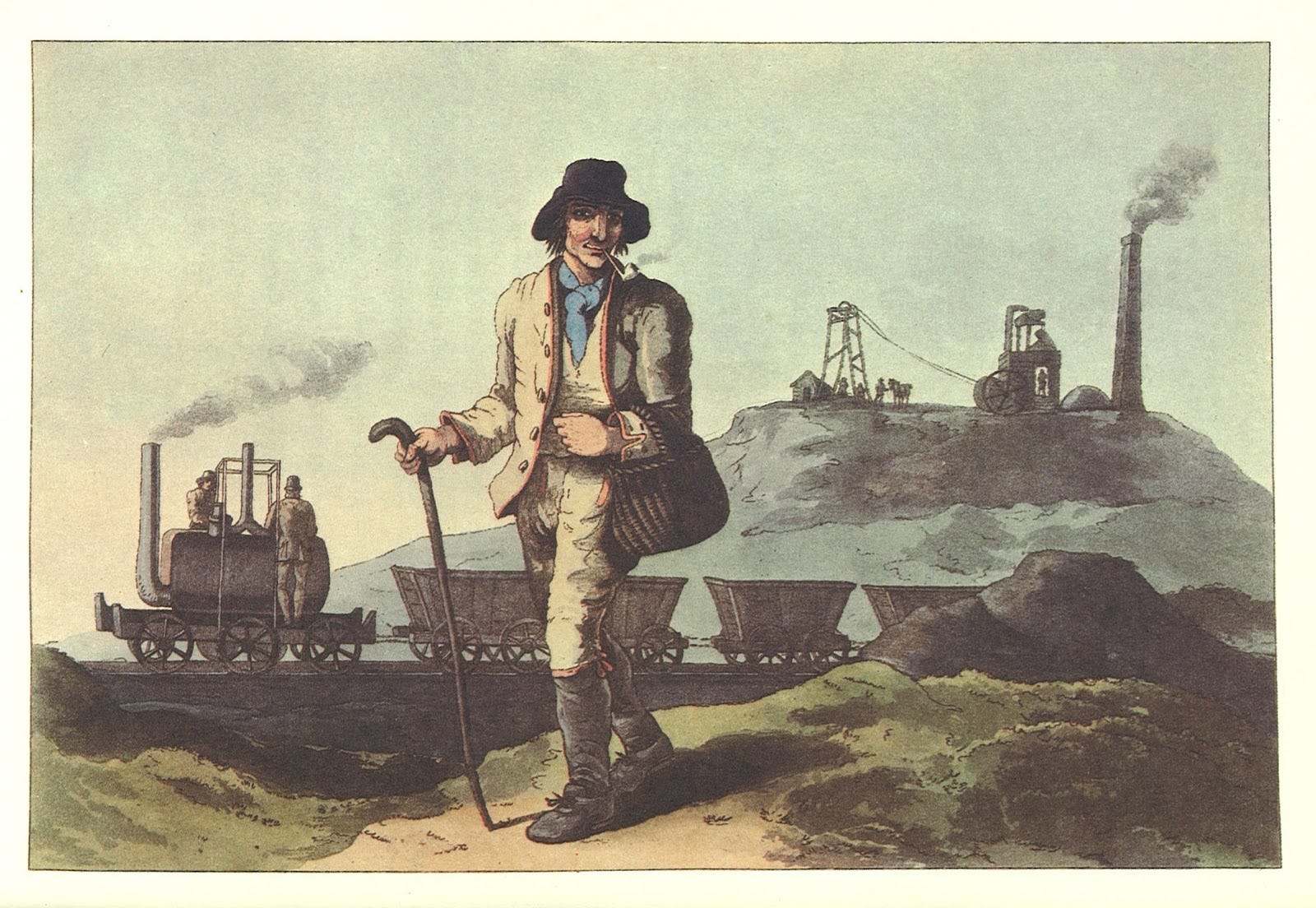
Long before railroads, England expanded coal and iron at low margins. Geography and commerce made the Industrial Revolution possible.
If you’re following me but don’t yet receive these essays by email, you’re missing most of them. Substack doesn’t email articles to followers, only to subscribers. You can get every new essay free in your inbox by subscribing 👉:
Why did the Industrial Revolution take place in Britain? This is one of the most enduring questions in economic history.
This is an article in my series on the British Industrial Revolution. In previous articles in this series, we learned that:
Previous theories on the origins misunderstand the British Industrial Revolution, because they miss that it is actually a two-step economic transition.
Following the model of the city/states of Northern Italy, Flanders, and the Dutch Republic, England evolved into a Commercial society over the course of centuries. This made pre-industrial England resemble those four societies far more than the Agrarian societies that dominated the rest of Eurasia.
This was an essential first step towards the Industrial Revolution, but it was not sufficient unto itself. Commercial societies were exceptional because they reached a critical mass of four of the Five Keys to Progress:Highly productive agriculture
Autonomous trade-based cities
Decentralized political, economic, and religious power
High-value-added export industries.
Because markets played a powerful role in decision-making, Commercial societies naturally specialized in most profitable industries, and they left less profitable raw materials to less developed nations. Trade, finance, luxury manufactures and textiles offered higher returns with lower material risk. Coal and iron were bulky, capital-intensive, volatile, and constrained by the economics of pre-industrial energy. Avoiding them was not a mistake. It was good business.
This is very similar to today, where wealthy nations specialize in the most profitable industries and developing nations specialize in agricultural and mineral inputs for those industries.Unlike the other Commercial societies, England also specialized in coal and iron. Without any foreknowledge or planning, England accidentally specialized in two industries that would later prove essential to the Industrial Revolution that came later.
Being the only Commercial society that specialized in these key industries, Britain was able to invent and scale up the railroad in the 1830s and 1840s. It was the railroad that truly transformed Britain into a new type of society based on the widespread application of awesome energy density of fossil fuels.
This was the second, and most dramatic step, in Britain’s economic transformation. For this reason, it deserves the title of “Industrial Revolution,” but it could not have happened if England had not transformed into a Commercial society in previous centuries.
The railroad enabled the Fifth and final of the Five Keys to Progress: widespread usage of fossil fuels.Later in the 19th Century, Britain invented a host of other technologies that applied the awesome energy density of fossil fuels to transportation, communication, manufacturing, materials agriculture, consumer products, and the military. These technological innovations kept the rapid economic growth going throughout the 19th and 20th century and, most importantly, enabled much of the rest of the world to transform their economies by copying Britain.
So this leaves an important question: Why did England specialize in coal and iron while no other Commercial societies did? Why not just let other nations specialize in these very low profit industries and just import those material like other Commercial societies did?
England was not uniquely backward. It was not uniquely desperate. It did not face a national wood crisis. It did not possess a grand industrial strategy. And yet, over the course of the seventeenth and eighteenth centuries, it expanded coal mining, iron production, large-scale casting, and precision metalworking to a degree unmatched by any other Commercial society. Those industries remained modest in profitability for decades. But they grew steadily enough to accumulate skills, infrastructure, and organizational routines.
This essay argues that England’s path was neither foresight nor accident in the simplistic sense. It was the result of a particular combination of local fossil resources, incremental demand, institutional tolerance for mediocre returns, and commercial depth. Coal and iron did not need to be highly profitable to expand in England. They needed only to be locally useful and economically survivable. That survivability allowed capabilities to compound quietly.
When the technical breakthroughs that made railroads viable finally arrived, England already possessed the full stack of prerequisites: cheap coke iron, precision boring, mature steam engines, scalable civil engineering. What looked like a collection of unimpressive, low-margin industries turned out to be the foundation of the first large-scale fossil-fuel transportation system.
To understand why the railroad emerged first in Britain, we must therefore look not at the moment of invention, but at the decades of accumulation that preceded it. We must look at the reasons England, unlike any other Commercial society, allowed that accumulation to occur.
See my other articles in this series:
The British Industrial Revolution (the series)

The British Industrial Revolution is one of the great transformations in the material standard of living for the masses in world history. We cannot understand material progress without coming to grips with its importance.
If you enjoy this article, you should read my From Poverty to Progress book series.

England’s Strange Specialization
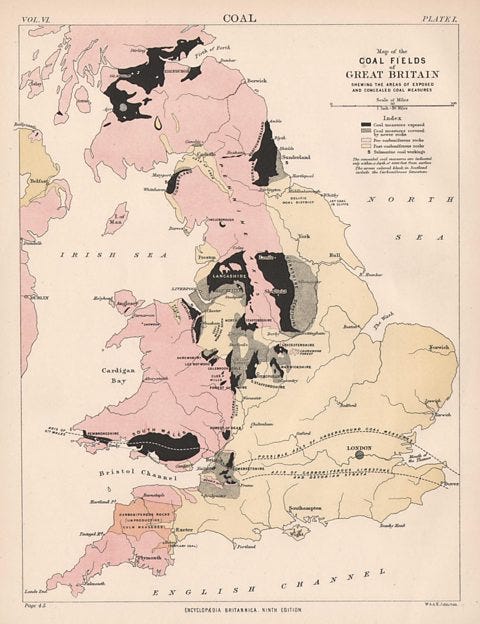
England’s expansion into coal and iron did not begin as a grand industrial project. It emerged gradually, almost quietly, from local geography interacting with a Commercial society that could tolerate low returns. To understand why England did what no other Commercial society did, we must begin with geography, but we cannot end there.
Geography Lowered the Risk Floor
England possessed unusually favorable coal geography. Much of its early coal lay:
Relatively near the surface
Close to navigable rivers
Within reach of coastal shipping
Near large urban markets, especially London
This mattered enormously.
Coal is bulky and cheap per unit of value. It becomes viable only when transport costs are low. England’s coastline, short internal distances, and river access allowed coal to move cheaply from mine to city. By the seventeenth century, London had become a massive coal consumer, drawing shipments from northeast England in volumes unmatched elsewhere in Europe.
Geography therefore lowered the risk floor of coal production. Mines could expand incrementally despite low demand and low profits. Transport was reliable. Demand was steady. Failure was survivable.
But geography alone does not explain industrialization. Other regions possessed coal. Some possessed it in large quantities. Coal in itself does not create transformation. What mattered was how geography interacted with England’s commercial structure.
English Coal Did Not Need to Be Highly Profitable
Coal was not a glamorous industry. Margins were modest. Mines flooded. Shafts collapsed. Output fluctuated. Yet coal continued to expand.
Why?
Because coal did not need to deliver spectacular profits. It needed only to solve practical problems at tolerable cost.
Coal fueled:
Urban heating (by far the biggest market)
Brewing
Salt boiling
Brick and lime production
Glassworks
Later, pumping engines in mines
Each of these uses created steady, incremental demand. No single sector drove explosive growth. Instead, many small users justified gradual expansion. Coal’s importance lay not in its profitability, but in its utility.
The same logic applied to iron.
Iron Followed Coal
England’s iron industry before 1750 was not dominant in Europe. Swedish iron remained superior in many markets. Output grew, but slowly. Profit margins were rarely spectacular.
Yet iron production persisted and expanded modestly, especially where it could draw upon local coal.
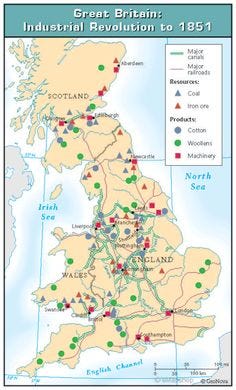
Here again geography mattered. Coalfields lay near ore deposits in several English regions. Transport distances were short. Supply chains were compressed. Even before coke-smelting matured, the proximity of coal and ore encouraged experimentation.
Iron was bulky, volatile, and often disappointing as an investment. But like coal, it could expand incrementally. Tools, hardware, anchors, agricultural implements, and construction materials created continuous baseline demand.
Cannon-making added a technical accelerator. Its volume was limited, but its requirements for controlled casting and precision boring forced advances in furnace management and metalworking accuracy. The effect was not to make iron highly profitable, but to deepen metallurgical capability.
Institutional Tolerance for Mediocrity
Geography made coal and iron possible. Commercial society made them survivable.
Like other Commercial societies at the time, England possessed:
A unified internal market
Deep capital markets
Decentralized investment
Parliamentary tolerance for infrastructure experiments
Profitable sectors (textiles, trade, shipping) that stabilized the broader economy.
These conditions mattered because coal and iron were unimpressive industries. They did not deliver the spectacular margins of colonial trade or fine manufactures. In many Commercial societies, capital flowed toward the highest-return sectors and away from heavy, uncertain ones.
In England, low-margin industries were allowed to persist. Investors could tolerate moderate returns. Failure did not trigger systemic collapse. Experimentation could continue between breakthroughs.
This is the crucial interaction: geography lowered costs; institutions lowered fear.
Who Financed England’s Coal and Iron Expansion?
Coal and iron did not expand because London’s highest-return capital sought them out. They expanded because regional capital, local landowners, and industrial operators were willing to sustain them at modest returns.
Coal was geographically fixed. Mineral rights usually belonged to the surface landowner. In regions such as Newcastle and Durham, aristocratic families and landed gentry controlled access to coal seams. Some operated mines directly. More often, they leased rights to pit operators in exchange for rents or royalties.
The actual development of mines was frequently undertaken by:
Leaseholding entrepreneurs
Multi-generational mining families
Regional merchants tied to the coal trade
Partnerships pooling local capital
These were not globally mobile financiers choosing between coal and colonial trade. They were regionally embedded investors deciding how to use land, labor, and local capital.
Iron followed a similar pattern.
Furnace masters and ironmasters were typically local industrial figures rather than national financiers. In the charcoal era, ironworks were often tied to estates with woodland. In the coal era, iron production clustered near coalfields, again drawing on regional capital networks. Many ironmasters were hybrid figures, part metallurgist, part merchant, part engineer, deeply embedded in local manufacturing culture.
This structure mattered.
In Amsterdam, capital was liquid and globally mobile. It flowed toward shipping, finance, and high-return trade. In England’s coal districts, capital was far more geographically anchored. Investors were often choosing between mining, agriculture, estate improvements, or modest local commerce, not between coal and the East India trade.
Coal and iron did not need to outperform the most profitable sectors of the global economy. They needed only to generate steady, acceptable returns within their regional context. That was enough to sustain incremental expansion.
Over decades, that regionally financed persistence created capabilities that later proved transformative.
Coal and Iron in other kingdoms
It would be a mistake to suggest that England alone financed coal and iron through local or regional capital. In most of Europe’s early mining and metallurgical regions, investment was geographically anchored.
In Sweden, iron production was supported by estate-based ironmasters, noble families, and the Crown. In Russia, heavy industry expanded through state-directed projects tied to military needs. In parts of Belgium and the early Ruhr, coal mining relied on local landowners and regional entrepreneurs.
England was not unique in having regional investors. What distinguished it was how those investors operated inside a broader Commercial society and an integrated materials and energy system.
In Sweden, iron remained charcoal-based and export-oriented. It did not connect to a domestic fossil transition. In Russia, ironworks were often large, administratively directed, and military-centered rather than embedded in decentralized commercial networks. In continental coal regions, political fragmentation, smaller urban markets, and weaker integration limited the compounding of industrial capabilities before 1800.
England combined:
Local and regional capital
A unified internal market
Large urban coal demand
Early steam-pump adoption in mines
Increasing integration between coal and iron
The structure of investment was not radically different. The environment in which that investment operated was.
Coal and iron did not merely exist in England. They were embedded inside a commercially dynamic economy that allowed incremental experimentation, competition, and reinvestment over generations.
Other regions possessed pieces of this system. England assembled the full set earlier than anyone else.
Geography Was Necessary, Not Sufficient
It would be tempting to conclude that England industrialized because it had coal. That explanation is incomplete.
Coal existed elsewhere:
In parts of France
In the Ruhr
In Belgium
In China
But coal alone did not guarantee early transformation. In some places it was deeper, more expensive to access, or poorly connected to markets. In others, political or institutional structures prevented incremental private experimentation. In still others, alternative fuels reduced pressure to reorganize production around fossil energy.
England’s geography made coal and iron expansion economically survivable. Its commercial structure allowed that survivability to translate into decades of capability accumulation.
Neither factor alone was enough. Together, they created a path that no other Commercial society followed.
By the late eighteenth century, England had not yet built railroads. But it had built something equally important: a dense, interlocking set of skills, supply chains, engineering practices, and organizational routines embedded in industries that had once seemed dull and low-return.
When the profitability of coal and iron finally flipped, the groundwork had already been laid. No other nations was able to create the Industrial Revolution or so quickly take advantage of it anywhere near as quickly as Britain.

Coal and Iron Began to Reinforce Each Other
England did not merely expand coal and iron in parallel. Over time, the two industries began to reinforce each other in ways that transformed their economic significance.
This interaction is critical. A nation could possess coal alone, or iron alone, and remain pre-industrial. England accumulated both, and the interaction between them created compounding capability.
How Coal Accelerated Iron
Before the widespread adoption of coke, iron production relied heavily on the combustion of charcoal to produce heat. Charcoal is created by burning wood with minimal oxygen to remove moisture and volatile compounds. The resulting fuel is high in carbon and burns at higher, more controllable temperatures than raw wood.
But charcoal production consumed large quantities of timber. Ironmaking was therefore tied to nearby woodland, and expanding output required drawing wood from increasingly distant sources. This imposed a scaling constraint. Transport costs rose as forests were used more intensively, and charcoal’s bulk made long-distance shipment expensive.
The issue was not that England ran out of trees, but that charcoal-based iron faced rising marginal fuel costs as production expanded. In an industry already characterized by modest profit margins, this constrained growth long before national woodland was exhausted.
Coal altered that equation and freed iron-production from forests. Coke did not make iron profitable overnight. It changed the fuel cost curve from land-constrained to mineral-constrained, allowing scale to increase without driving fuel prices upward.
Coal offered:
Greater fuel density
More stable supply near industrial regions
The possibility of larger furnaces
Reduced dependence on agricultural land
This did not immediately make iron highly profitable. But it changed its scaling curve. Iron could now expand without driving up fuel costs in the same way charcoal had.
Coal did not just supply heat. It removed the primary constraint on metallurgical growth.
How Iron Accelerated Coal
The reinforcement worked in the other direction as well. Coal mines flood. Shafts collapse. Depth increases risk. Without durable tools and drainage systems, coal output plateaus quickly.
Iron enabled:
Stronger pithead gear
More reliable chains and hoists
Improved pumping machinery
Eventually, iron cylinders for steam engines
The introduction of steam-powered pumping, beginning with Newcomen engines in the early eighteenth century, was decisive. These engines consumed coal to extract coal. They required iron components. Deeper mines demanded better metalwork. Better metalwork demanded more fuel.
Coal and iron were no longer independent sectors. They were locked in a feedback loop.
Coal made larger-scale iron possible.
Iron made deeper coal mining possible.
Steam power linked them both.
The Necessity of the Pair
This interaction explains why coal alone was insufficient. Regions with coal but limited iron capacity could not easily deepen mines or improve drainage. Regions with iron but dependent on charcoal faced rising land costs and scaling limits.
England uniquely combined:
Accessible coal
Expanding iron capacity
(and later) Steam engines linking the two
The result was not an immediate industrial breakthrough. It was a gradual tightening of interdependence. Each industry strengthened the other’s capacity to expand.
By the late eighteenth century, this iron-coal feedback loop had already been operating for generations. When railroads finally appeared, they were not built atop isolated industries. They were built atop an integrated coal–iron–steam complex that no other Commercial society had assembled before 1800.
Other Coal and Iron Specialists Were Not Commercial Societies
If geography alone explained England’s path, then any coal-rich region should have industrialized early. But that is not what happened. Several regions specialized in iron production or possessed substantial coal reserves long before Britain’s railroad age. None combined those resources with early industrial transformation.
This comparison clarifies the argument: accessible coal and iron fields were necessary ingredients for the railroad era, but they were not sufficient. They had to be embedded inside a commercially dynamic society capable of compounding low-margin capabilities over time.
Sweden
Seventeenth- and eighteenth-century Sweden was one of Europe’s leading iron exporters. Swedish bar iron was widely regarded as high quality and supplied important foreign markets, including England itself.
Sweden possessed:
Abundant iron ore
Extensive forests for charcoal (a key raw material in the processing of iron)
Established ironworking skill
What it did not possess was cheap, integrated fossil fuel use.
Swedish iron remained charcoal-based. That limited scale. Charcoal production is land-intensive and difficult to expand rapidly without driving up costs. Even with strong export demand, Swedish iron could not transition into a fossil-fuel growth engine.
Just as important, Sweden was not a Commercial society in the same sense as England or the Dutch Republic. Its non-agricultural economy was more state-directed, more militarized, and less deeply embedded in decentralized commercial capital networks. Iron was important, but it did not sit inside a dense web of trade, finance, and incremental civilian demand capable of compounding into broader industrial transformation.
Sweden specialized in iron. It did not accumulate the fossil-energy stack.
Russia
Eighteenth-century Russia also expanded iron production significantly, particularly under Peter the Great and his successors. The Urals became a major iron-producing region. For a time, Russia was among the largest iron exporters in Europe.
But Russian expansion was:
State-directed
Military-oriented
Geographically distant from major commercial markets
Dependent on coerced labor systems
This model generated output, but not compounding capability.
Russian iron production served state arsenals and military needs. It did not grow out of a decentralized, commercially integrated ecosystem of small civilian demands. Nor did it combine with cheap fossil fuel use in a way that transformed energy economics.
Russia had iron. It did not have a Commercial society capable of turning incremental metallurgy into a self-reinforcing industrial system.
Coal Regions Without Commercial Depth
Coal deposits existed in several continental regions before 1800, including parts of France, Belgium, and what later became the Ruhr. Yet early coal expansion in these areas did not produce the same long, incremental buildup seen in England.
In some cases:
Coal seams were deeper or more technically difficult
Transport connections were weaker
Markets were fragmented by internal barriers
Capital markets were shallower
State regulation constrained private experimentation
In others, alternative fuels reduced pressure to reorganize production around coal.
Geography again mattered. But geography did not operate in isolation. Coal that is distant from markets, buried deeply, or embedded in rigid institutional systems does not generate the same low-risk incremental expansion.
The Missing Combination
England’s uniqueness lay not in possessing coal or iron alone. It lay in combining:
Dynamic and growing economy of a Commercial society.
Accessible, local fields of coal and iron
England alone fused geography with Commercial society.
That fusion did not immediately create railroads. It created something more subtle: a durable capacity to:
experiment at low margins,
accumulate metallurgical and engineering skill
keep expanding unimpressive industries long enough for their economics to flip.
Coal and iron by themselves do not produce industrial revolutions. Embedded inside a commercially dynamic society with the right geographic advantages, they can.
The Railroad Stack
All of the above enabled England to gradually assemble all the key technologies, skills, and organizations that later enabled the invention and scaling of steam-powered locomotives and railways in the 1830s and 1840s.
Railroads required a dense stack of capabilities. None of these were especially profitable on their own before 1800. Together, they made large-scale fossil-fuel transportation viable.
Cheap Structural Iron
Rails, wheels, axles, and bridges required large quantities of durable iron. Before coke-smelting and improved furnace control, iron was expensive and scale was limited. Decades of coal-based experimentation gradually lowered costs and increased output.
England entered the railroad era with:
Expanding coke-based iron production
Short supply chains between coalfields and ironworks
Experience in large castings
Without that prior accumulation, railroad construction would have been prohibitively expensive.
Precision Metalworking
Steam locomotion depended on precision: aligned cylinders, smooth pistons, reliable valves. The lineage runs through cannon boring, mining pumps, and early steam engines.
The critical point is not that cannon created railroads. It is that sustained metallurgical and boring experience made precision commonplace before railroads demanded it at scale.
England did not invent precision for railroads. It had already been practicing it for decades.
Mature Steam Power
Early steam engines were inefficient and expensive. They made sense primarily in coal mines, where fuel was cheap at the pit. That geography again mattered.
Mining pumps created:
A steady market for engines
A class of engine builders
Improvements in design and maintenance
Familiarity with high-pressure systems
When steam was finally adapted for locomotion, England already possessed a mature engineering ecosystem.
Civil and Organizational Infrastructure
Railroads required more than metal and engines. They demanded:
Surveying
Embankments and cuttings
Bridge construction
Long-duration capital finance
Contracting systems
England’s prior experience with canals, turnpikes, and joint-stock infrastructure companies created these capabilities incrementally.
Railroads did not appear in a vacuum. They emerged from an environment already accustomed to large coordinated projects.
Railroads were not the product of a single breakthrough. They were the convergence of multiple capabilities that had accumulated quietly inside low-margin industries: iron, coal, precision metalworking, steam engineering, civil construction, and commercial finance.
England did not invent railroads because it anticipated them. It invented railroads because it had already spent generations building the underlying stack, long before that stack appeared spectacularly profitable.
The industries that once seemed dull and secondary became decisive only when their economics flipped. By then, England was ready.
No other nation came close to assembling the entire railroad stack.

The Convergence No One Planned
England did not industrialize because it foresaw railroads. It did not industrialize because coal and iron were obviously superior investments. And it did not industrialize because it was uniquely desperate or uniquely visionary.
It industrialized because geography made coal and iron expansion economically survivable, and because its Commercial society allowed those low-margin industries to persist and compound.
Other societies made rational choices. Commercial societies specialized in high-profit sectors. Coal and iron looked unimpressive by comparison. Regions that did specialize in iron often lacked fossil fuel integration or commercial depth. Coal existed elsewhere, but without the same interaction between local geography and decentralized capital.
England alone combined:
Accessible fossil energy near major markets
Iron production increasingly tied to that energy
A unified internal commercial system
Tolerance for moderate returns and repeated experimentation
Continuous civilian demand across multiple sectors
For more than a century, coal mining, iron production, casting, boring, pumping, and infrastructure building accumulated capabilities at modest margins. None of these developments guaranteed railroads. But they created the conditions under which railroads became feasible once technical constraints broke.
When coke-smelting lowered iron costs, when precision boring enabled reliable engines, when steam power matured beyond stationary pumps, and when commercial finance could scale infrastructure. England did not need to build a new foundation. It had already laid one.
The railroad was not the beginning of Britain’s industrial transformation. It was the visible expression of decades of quiet accumulation inside industries that had once seemed economically secondary.
England did not industrialize by maximizing short-term profitability. It industrialized because its geography and commercial structure allowed low-margin capabilities to endure long enough to become indispensable.
Bibliography
Michael W. Flinn, The History of the British Coal Industry, Volume 2: 1700–1830
John U. Nef, The Rise of the British Coal Industry
Charles K. Hyde, Technological Change and the British Iron Industry, 1700–1870
Basil Brooke, The British Iron and Steel Industry, 1700–1850
Johan Söderberg, Iron and Steel in the Swedish Economy, 1600–1850
Arcadius Kahan, The Plow, the Hammer, and the Knout: An Economic History of Eighteenth-Century Russia
T. S. Ashton, Iron and Steel in the Industrial Revolution
If you’ve been enjoying these essays but only follow me here, you’re not getting them by email. Followers see Notes; subscribers receive every new piece on the history and future of progress.
Subscribe free here 👉:
See also my other articles on:
The British Industrial Revolution (the series)
The British Industrial Revolution is one of the great transformations in the material standard of living for the masses in world history. We cannot understand material progress without coming to grips with its importance.
If you enjoyed this article, you should read my From Poverty to Progress book series.
I think the relevant standard is not how profitable an industry is but how profitable relative to the opportunity cost. If pulling coal out of the ground provided £1 in excess of the opportunity cost in that locale in that time, it was bound to attract the investment to enable it. Britain may have been particularly unconstrained in its pool of capital on those regions where coal and ore were profitable to mine. (I don’t know this for a fact; just inferring that from the outcome and believing that landed wealth may have been less concentrated in Britain versus other countries at that time.) Places like Venice or Amsterdam (or even London) may have faced constraints in how they could deploy capital, including risk factors as you mentioned. Of course, capital constraints show up as opportunity costs, even if not directly in interest rates. It would be interesting to study the differences in output relative to the local costs of capital.
This is key "In England, low-margin industries were allowed to persist. Investors could tolerate moderate returns."
As you point out it did not make economic sense for normal businessmen to invest in low margin things like coal and iron. In other countries businessmen pursued high margin businesses. But Britian did this too, in a big way. The built the largest colonial empire. They took part in many of the profitable industries colonial expansion permitted, Indian textiles, sugar, rum, tobacco, coffee, tea etc (notice how many of these are recreational drugs--then as now profitable businesses).
https://substackcdn.com/image/fetch/$s_!HzCT!,f_auto,q_auto:good,fl_progressive:steep/https%3A%2F%2Fsubstack-post-media.s3.amazonaws.com%2Fpublic%2Fimages%2F0a3a6c89-f5ef-4b5d-8054-296035b433d8_441x200.gif
Lots of higher margin business opportunities to invest in. So why the investor interest in the low margin coal business in England, but not elsewhere?
I submit investors were willing to invest in these low margin businesses because the English had developed a hybrid elite—part aristocratic, part mercantile, which was capitalist. That is businessmen now believed that growing capital was something people with money were supposed to do. And so they did, investing in anything at which they could get a profit including coal and iron.
This hybrid elite was created through government policies awarding status for revenue. This happened in other countries too, but not in the way it happened in England. In England the government taxed both agrarian and commercial elites. In Spain the landed elite were not taxed, while the commercial classes were excessively taxed to fund the wars of the 16th and especially early 17th century--no hybrid elite would develop there.
In the Netherlands, old-school commercial elites pursuing high margin business were in control and they had no incentive to allow new entrants into their club.
In England the commercial elites were not in control and could not block new entrants
In France the undeveloped tax system meant the crown had no incentive to encourage commerce; they sold offices for cash, which was easier to boot. In England agrarian elites (via Parliament) checked the monarch’s power to sell offices willy nilly forcing them to rely on taxation, which was also checked by Parliament. This made economic growth the politically easiest way to grow revenue.