
Does Geography Explain Economic Development?
Testing the Leading Theories of Geographic Development


Do geographic differences really explain global inequality? This essay tests the leading theories and examines how well they match the evidence.
If you’re following me but don’t yet receive these essays by email, you’re missing most of them. Substack doesn’t email articles to followers—only to subscribers. You can get every new essay free in your inbox by subscribing 👉:
Geography has long been proposed as a major explanation for differences in economic development. A number of influential theories argue that climate, disease, agriculture, and physical geography shape the development of human societies and help explain why some regions are richer than others.
These theories are appealing because they point to clear and measurable differences across regions. Countries vary in climate, access to rivers and coasts, exposure to disease, and the types of crops and animals they can support. It is natural to expect that these differences would have lasting effects on development.
This essay is part of the Mythbusting Theories of Material Progress series. This essay examines the most influential modern geographic theories, particularly those of Jared Diamond and Jeffrey Sachs, and evaluates the evidence used to support them. Each provides a geographic explanation for major patterns in global development and has shaped how both scholars and the broader public think about the role of geography.
You can read more articles in the series here:
If you enjoy this article, you should read my From Poverty to Progress book series.

The Early Geography Tradition
For much of intellectual history, geography was treated as a central force in shaping human societies. Early thinkers did not treat it as a background condition, but as a primary explanation for why different regions developed distinct forms of economic organization, political systems, and levels of social complexity.

Montesquieu
One of the earliest and most influential figures was Montesquieu, whose views are best summarized in The Spirit of the Laws. Montesquieu focused on the relationship between climate and social organization, arguing that temperature and environmental conditions influenced human behavior, which in turn shaped laws and political systems. His goal was to explain variation across regions: why some societies developed centralized despotisms while others developed more moderate or republican forms of government.
Montesquieu pointed to several concrete examples. He argued that hot climates, such as those found in parts of Asia and the Middle East, tended to produce more hierarchical and authoritarian political systems because the heat reduced physical vigor and encouraged dependence. By contrast, cooler climates in Europe were seen as fostering greater energy, independence, and more balanced forms of government. He also emphasized differences between mountainous regions, where difficult terrain encouraged local autonomy and resistance to centralized authority, and fertile plains, where agriculture supported larger populations and stronger centralized states.
Friedrich Ratzel
In the nineteenth century, these ideas were formalized by geographers such as Friedrich Ratzel, particularly in works like Politische Geographie. Ratzel emphasized the role of territory, resources, and spatial constraints in shaping states. He was concerned with explaining differences in state formation and expansion, arguing that geography influenced whether societies could grow, consolidate power, and compete with neighbors.
Ratzel highlighted the importance of access to navigable rivers, such as the Rhine and Danube, which facilitated trade, communication, and political integration. He also emphasized the role of large, contiguous land areas, arguing that states with access to expansive and connected territory were better positioned to expand and consolidate power than those constrained by fragmented or isolated geography.
Halford Mackinder
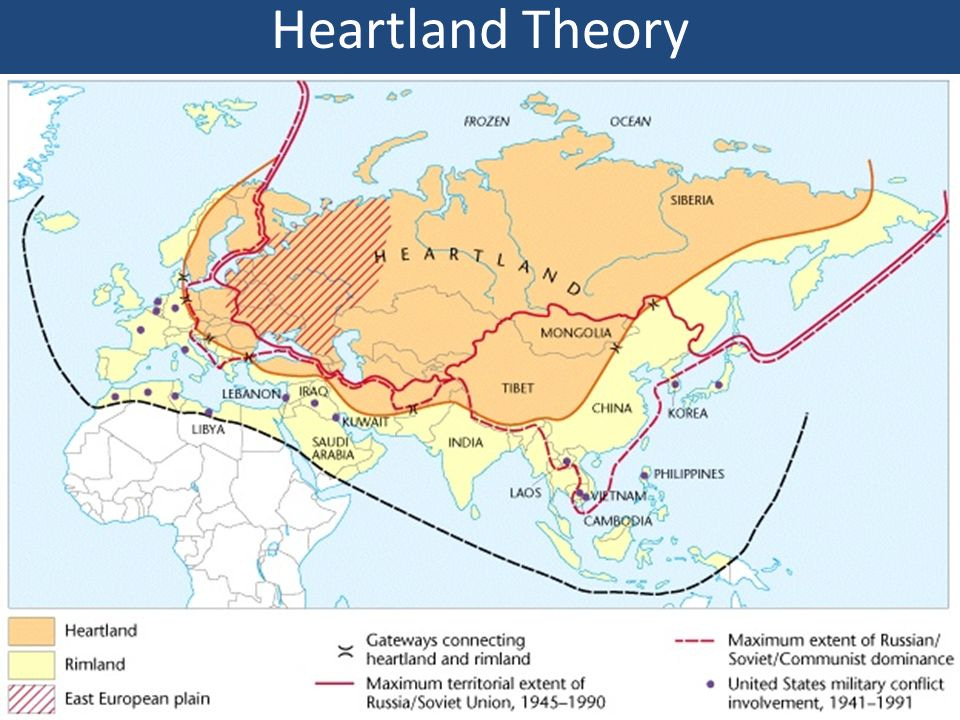
Geography also played a central role in early theories of global power. Halford Mackinder’s views are best captured in his work Democratic Ideals and Reality. Mackinder focused on the strategic importance of large landmasses, transportation routes, and defensible terrain, attempting to explain variation in global dominance.
Mackinder’s most famous example was the Eurasian Heartland, a vast interior region stretching across Eastern Europe and Central Asia. He argued that its inaccessibility to naval power made it defensible, while its extensive land routes made it a base for expansion. He contrasted this with maritime powers like Britain, which relied on naval dominance but were more vulnerable to shifts in global trade routes and technology.
Ellsworth Huntington
These ideas reached one of their most explicit and systematic forms in the work of Ellsworth Huntington, especially in Civilization and Climate. Huntington focused on climate variability, temperature, and seasonality, attempting to explain differences in economic productivity and civilizational achievement across regions.
Huntington argued that temperate climates with seasonal variation, such as those found in Western Europe and the northeastern United States, were most conducive to sustained effort and innovation. In contrast, he pointed to tropical climates, particularly in parts of Africa and Southeast Asia, where high heat and humidity were associated with lower productivity and greater disease burden. He also emphasized the role of climatic variability, suggesting that regions with moderate fluctuations in weather stimulated human activity more than regions with constant conditions.
Across these thinkers, geography was not a single variable but a set of concrete mechanisms:
Climate (temperature, seasonality)
Land and resource endowments
Spatial position and connectivity
Strategic terrain and defensibility
Each thinker focused on a different subset of these variables and used them to explain different kinds of variation: political systems, state power, global dominance, or economic productivity. Together, they formed a tradition that treated geography as a system-level force shaping the structure and trajectory of human societies.
At the same time, this tradition had clear limitations. While these theories identified important relationships between geographic conditions and social outcomes, they did not provide a clear account of how geography translated into sustained economic progress. The mechanisms linking climate, terrain, or location to long-term growth were often implicit rather than explicit, and the theories rarely distinguished between explaining broad differences in social organization and explaining the specific transition to industrialization.
As a result, geography was often treated as a direct and dominant cause, without a well-defined causal chain connecting environmental conditions to economic development over time. This made the theories difficult to test, easy to overgeneralize, and poorly suited to explaining variation within similar environments or the timing of economic change. These weaknesses would eventually contribute to a decline in geographic explanations, even as the underlying patterns they sought to describe remained central to the study of human development.
Why Geography Has Fallen Out of Fashion
Despite its early prominence, geography gradually moved from the center of explanations of human development to the margins. This shift was not driven by a single discovery, but by a growing recognition of a fundamental limitation: geography appeared better at explaining differences between societies than changes within them over time.
The early geographic tradition, exemplified by thinkers like Ellsworth Huntington, identified real relationships between environmental conditions and social outcomes. Climate, terrain, and location clearly influenced agriculture, settlement patterns, and political organization. These theories were often persuasive when explaining broad contrasts, such as differences between temperate and tropical regions, or between fertile river valleys and arid zones.
However, they struggled to explain one of the most important developments in human history: the sudden and sustained acceleration of economic growth associated with industrialization. If geography was the dominant force shaping societies, it was unclear why progress occurred when and where it did. Many regions shared similar climates or resource endowments, yet experienced very different trajectories over time. Geography appeared relatively fixed, while economic outcomes changed rapidly.
This created a deeper problem. Geographic theories did not provide a clear mechanism linking environmental conditions to long-term economic growth. They could explain why some societies were organized differently, but not why some societies transitioned to sustained innovation and rising productivity. The causal chain from climate or terrain to industrialization remained largely implicit.
As a result, geography came to be seen as insufficient for explaining dynamic processes. Researchers increasingly turned toward explanations that could account for change, factors where the mechanisms appeared more direct and testable:
institutions
technological innovation,
capital accumulation, and
government policy.
Geography, by contrast, was associated with static conditions and long-run constraints rather than short- or medium-term transformation.
Geographical constraints deemed morally suspect
There was also a deeper intellectual discomfort with geographic explanations. Unlike variables such as policy, institutions, or investment, geography lies largely outside human control. If geography plays a major role in shaping development, it implies that some regions face structural disadvantages that cannot be easily remedied through reform or better governance. This runs counter to the preference, especially in modern economics and politics, for explanations that emphasize agency, choice, and the potential for improvement through deliberate action.
As a result, geographic explanations came to be seen not only as analytically limited, but also as normatively problematic. The idea that climate, location, or ecological conditions could systematically influence long-term outcomes suggested a degree of predetermined inequality that was uncomfortable for many researchers. This further contributed to the shift away from geography as a central explanatory framework, even as its underlying influence remained evident in historical patterns of development.
Rise of quantitative research
At the same time, the rise of modern economics reinforced this shift. Researchers favored variables that could be formalized and tested using statistical methods. Geography, being multi-dimensional and difficult to quantify, was often reduced to simple proxies or omitted altogether.
Decline of Geography as an academic discipline
These intellectual changes were accompanied by institutional decline. Geography lost its status as a central field of inquiry in many universities, and its presence in K–12 curricula diminished significantly.
Geography degrees in the United States declined from roughly 4–5,000 per year in the early 1970s to around 1,500–2,000 by the 1990s–2000s
Many universities closed or absorbed geography departments into other fields between the 1970s-90s. The most famous example was when Harvard eliminated its geography department in 1948.
Geography as a standalone subject was reduced in K–12 curricula, often folded into broader “social studies” programs
Surveys, such as National Geographic studies, repeated found of low geographic literacy among students
Rather than being taught as a unified framework for understanding human societies, geographic concepts were fragmented or absorbed into other disciplines. As a result, fewer researchers were trained to think in geographic terms, and the conceptual tools needed to analyze geography in a systematic way became less widely understood.
At the same time, the profession of geography increasingly shifted from broad explanatory frameworks to specialized subfields, such as GIS, urban geography, and environmental studies.
Parallels with the concept of “Society Type”
A similar pattern occurred with the concept of Society Type, which I write about quite frequently. In the 19th and early 20th Century, scholars treated differences in subsistence systems, population density, and social organization as central to understanding development. But like geography, society type was better at describing structural differences than explaining rapid change. Over time, it too fell out of favor, largely disappearing from modern empirical work.


By the late twentieth century, geography had not disappeared entirely, but it was no longer treated as a primary explanatory framework. Instead, it was incorporated in a reduced form, as a set of simplified variables that could be included in regression models.
The result is a paradox. Geography was set aside in part because it did not clearly explain economic change. But rather than developing a more precise theory of how geographic conditions shape the transition to sustained growth, modern research often bypassed the problem. Geography was neither fully developed nor fully discarded: it was simplified, narrowed, and tested in ways that made its influence appear weaker than it may actually be.

The Modern Revival: Jared Diamond
The late twentieth century saw a partial revival of geographic explanations, most prominently in the work of Jared Diamond. In Guns, Germs, and Steel: The Fates of Human Societies, Diamond reintroduced geography as a central force shaping the long-run development of human societies, offering one of the most influential modern arguments in its favor.
First I must start with mentioning that this is one of my favorite books of all time. I first read it when it was published in 1998 and have reread it many times since. While many of Diamond’s specific claims fail, I think that he deserves great credit for reviving geography as an explanatory variable among the college-educated mass readership.
Jared Diamond’s core objective was to explain a broad and historically significant pattern: why Eurasian societies came to dominate other regions of the world by the early modern period. Rather than attributing this outcome to cultural or biological differences, he argued that it could be explained largely by differences in geographic endowments.
Jared Diamond’s explanation focused on three primary geographic factors. First, he emphasized the availability of domesticable plants and animals, noting that Eurasia possessed a disproportionately large number of species suitable for early agriculture and animal husbandry. Crops such as wheat and barley, along with animals like cattle and horses, enabled the development of productive farming systems, higher population densities, and more complex societies.
Diamond was not the first to make this claim. Nikolai Vavilov made a similar claim a half-century earlier, but few Westerners were aware of it. Nevertheless, Diamond rightly deserves credit for popularizing the claim with a modern audience.

The availability of the wild ancestors of domesticable plants and animals enabled much higher levels of food production than in the rest of the world. The greater food production led to:
Larger populations
Denser populations (i.e. cities).
Specialized craft specialist who developed technologies.
Writing technology. This made it easier to transfer ideas and inventions to and from other societies.
Chiefs, king and bureaucrats
Second, Diamond highlighted the importance of densely inhabited agricultural societies with large numbers of domesticated animals in close proximity to humans created new disease environments which eventually led to immunities that rural populations did not have. This promoted a dying off as agricultural societies spread. These diseases created mass epidemics in non-agricultural societies with lower biological immunity, enabling agricultural societies to expand their territory, particularly in the New World.
Third, Diamond highlighted the importance of continental orientation. Eurasia’s east–west axis allowed crops, animals, and technologies to spread across regions with similar climates and day lengths. This facilitated the diffusion of agricultural practices and innovations over long distances. By contrast, the north–south orientation of the Americas and Africa created ecological barriers that slowed the spread of crops and technologies across different climate zones.
This meant that innovations developed in one part of Eurasia could spread relatively quickly to other societies, whether through migration, trade, imitation, or conquest. Over time, this created a cumulative process in which advances built upon one another across a large and interconnected region.
Agricultural Head Start theory
Taken together, these mechanisms can be understood as a version of what might be called an “Agricultural Head Start” theory. While Jared Diamond does not use this term explicitly, his argument consistently emphasizes that regions with early and productive agriculture gained a long-term developmental advantage.
In this framework, the early availability of domesticable plants and animals leads to higher food production, which supports larger and denser populations. These, in turn, enable specialization, technological innovation, writing systems, and more complex political organization. The long head start and faster rate of innovation of the Eurasian continent enabled them to far more powerful militaries, polities and economies which made it easy for them to conquer the rest of the world.
Cultural, technological and institutional developments are therefore treated as largely downstream consequences of an earlier agricultural transition, which itself is shaped by geography.
A crucial component of this argument is scale. It is not only the early development of agriculture that matters, but its emergence within a geographically large and connected region, such as Eurasia. This allows innovations to diffuse across multiple societies, reinforcing and amplifying early advantages over time.
I go into more detail on this theory here:

I think that he could have clear up a great deal of confusion, if he had explicitly endorse the “Agricultural Head Start” theory in the text. Diamond adds relatively little on how agriculture leads to major long-term advantages for a society.
But does Diamond explain why Europe got rich first?
This interpretation also helps clarify an important source of confusion in Diamond’s argument. His theory is primarily designed to explain why Eurasia as a whole developed earlier and more extensively than regions such as Africa, North America, South America, and Australia. The key mechanisms—early agriculture, large population scale, and diffusion across a connected landmass—operate at this continental level.
However, many readers interpret his argument as addressing a different question: why Europe, rather than other parts of Eurasia such as China or the Middle East, became the dominant global power during the early modern period. Diamond occasionally gestures toward this question, but does not provide a systematic geographic explanation for it.
At times, Diamond suggests that Europe’s rise was contingent or partly the result of historical accidents, including political fragmentation and competition between states. But these explanations sit somewhat uneasily alongside his broader geographic framework, and the distinction between the variation he is explaining (Eurasia versus the rest of the world) and the variation readers often care about (Europe versus the rest of Eurasia) is not always clearly maintained.
To the best of my knowledge, Diamond does not advocate for a clear geography-driven explanation for why Europe, and particularly Britain, industrialized first. Nor does he seek to explain how geography determined the later sequence of national industrialization.
Jeffrey Sachs
The most prominent modern attempt to extend geographic explanations into the contemporary world is associated with Jeffrey Sachs. While Jared Diamond focused on deep historical divergence, Sachs seeks to explain persistent differences in economic development today, particularly why some regions remain significantly poorer than others. Sachs most clearly expressed this in “Tropical Underdevelopment” (my summary is here)
Sachs’ central objective is narrower and more policy-relevant than Diamond’s. He aims to explain why certain countries, especially in Sub-Saharan Africa, have struggled to achieve sustained economic growth in the modern era. His framework emphasizes the continuing influence of geography through climate, disease, and transport constraints.
First, Sachs highlights the role of disease environments, particularly the burden of malaria and other tropical diseases. He argues that high disease prevalence reduces labor productivity, increases mortality, and discourages investment in both human and physical capital. Regions with heavy disease burdens face persistent challenges in maintaining a healthy and productive workforce.
Second, he emphasizes agricultural constraints in tropical climates. Compared to temperate regions, tropical soils are often less fertile and more prone to degradation, while high temperatures and variable rainfall can reduce crop yields. These conditions make it more difficult to generate consistent agricultural surpluses, which historically have been important for supporting population growth and economic specialization.
Third, Sachs focuses on transport costs and geographic isolation. Countries that are landlocked or located far from major markets face higher costs of trade, limiting their ability to participate in global commerce. Even within coastal regions, poor natural harbors or long distances to navigable waterways can raise the cost of exporting goods and importing capital and technology.
Taken together, these factors form a theory in which geography imposes ongoing constraints on development, even in the modern world. Unlike Diamond’s emphasis on early advantages, Sachs focuses on persistent disadvantages that continue to affect economic performance.
This gives his theory a different structure. Geography is not treated as a source of early advantage, but as a set of ongoing constraints on productivity, health, and trade. His framework is therefore more directly connected to contemporary policy debates, including the role of foreign aid, infrastructure investment, and disease control in overcoming these barriers.

What These Modern Geography Theories Explain
The modern revival of geographic explanations, particularly in the work of Jared Diamond and Jeffrey Sachs, has reintroduced geography as an important factor in understanding global development. However, these theories are best understood not as general explanations of material progress, but as partial theories that explain specific types of variation.
It is therefore understandable why many modern economists, historians, and development researchers remain unconvinced of their broader explanatory power.
Diamond’s framework is most effective at explaining very large-scale historical divergence, particularly the differences between Eurasia and the rest of the world prior to the modern era. His emphasis on domesticable species, agricultural development, and continental scale provides a compelling account of why some regions developed dense populations, complex societies, and technological capabilities earlier than others. In this sense, his theory explains the initial conditions of development at a continental level.
Sachs’ framework, by contrast, is most effective at explaining persistent underdevelopment in the modern world, especially in regions facing significant geographic constraints. His focus on disease burden, agricultural limitations, and transport costs helps account for why certain countries, particularly in Sub-Saharan Africa, continue to experience lower productivity and slower economic progress. His theory therefore explains ongoing constraints on development, rather than its origins.
It is also not at all clear that a significant expansion of foreign aid, Sachs’ favored solution, will overcome these geographical constraints. In some cases, Sachs seems to be looking for a justification for increased foreign aid, rather than actually understanding geographical constraints. I, for one, am very skeptical that increased foreign aid will achieve overcome geographical constraints.

Taken together, these modern geographies theories cover two distinct but limited domains. Diamond explains early divergence across continents, while Sachs explains persistent disadvantages in specific regions today. Both identify real and important mechanisms, but neither provides a general account of how societies transition from pre-industrial conditions to sustained economic growth.
This distinction is critical. The central question in the study of material progress is not simply why some regions developed earlier or why some remain poor, but why industrialization occurred when and where it did, and why it spread in the sequence that it did.
On this question, modern geographic theories remain incomplete and not very persuasive. They explain the extremes, early advantages and persistent disadvantages, but leave largely unanswered the variation that matters most: differences in timing, sequencing, and the transition to sustained growth.
Testing These Theories Against the Evidence
Theories of geography should be evaluated by whether their core mechanisms match observable historical patterns. The following cases are chosen to show where these theories clearly fit the evidence and where they fail to account for important outcomes.
Jared Diamond
Diamond’s theory predicts that regions with early agriculture, large populations, and the ability to share ideas across a large landmass will develop more advanced societies and dominate others.
This prediction fits when comparing Eurasia to the Americas, Africa, or Australia.
Eurasia had many plants and animals that could be domesticated
This led to higher food production
Higher food production supported larger populations
Larger populations supported cities, specialization, and new technologies
Ideas and technologies spread across Eurasia because many regions had similar climates
The Americas, Africa, and Australia had fewer domesticable plants and animals and more barriers to the spread of crops and ideas. These differences match Diamond’s prediction.
However, the same logic does not explain what happened within Eurasia. China, India, and the Middle East all had:
early agriculture
large populations
long histories of technological development
By Diamond’s theory, these regions should have had a similar chance of industrializing first. But industrialization began in Britain and spread first to Northwest Europe. These sub-regions within Eurasia were actually relatively late to adopt agriculture.
This is the key test. The theory explains why Eurasia developed earlier than other continents, but it does not explain why one part of Eurasia industrialized before the others.
Jeffrey Sachs
Sachs’ theory predicts that regions with high disease burdens, difficult agricultural conditions, and high transport costs will have lower income levels than regions without these constraints.
This prediction fits broad global patterns. Sub-Saharan Africa has higher rates of diseases such as malaria, more challenging agricultural conditions in many areas, and higher transport costs due to distance from major markets and limited infrastructure. These factors are associated with lower income levels relative to Europe, North America, and East Asia.
However, the theory becomes less precise when comparing regions with similar geographic conditions.
Large parts of Latin America and Southeast Asia share tropical climates and exposure to similar diseases. These regions also face agricultural challenges and, in some cases, high transport costs. Yet they have achieved higher income levels than most of Sub-Saharan Africa.
This is the key test. If Sachs’ geographic variables strongly determine income levels, regions with similar conditions should have similar outcomes. That is not what we observe.
The theory identifies important constraints, but it does not fully explain the differences in income levels across regions that face similar geographic conditions. It focuses on disease, climate, and transport, but does not account for other geographic factors that may also influence development.
Synthesis
Both theories match the evidence in very narrow cases:
Diamond explains why Eurasia developed earlier than the Americas and Australia
Sachs explains why regions with severe disease and poor agriculture tend to be poorer
But both fail on the most important question:
Why did industrialization begin in one place and not another?
Why do some countries overcome geographic disadvantages while others do not?
These are not minor gaps. They are the central questions in the study of material progress.
What They Do Not Explain
The limits of modern geographic theories become clearer when framed as a set of unanswered questions. These questions define the core agenda of Progress Studies and highlight the gaps that existing geography-based explanations leave unresolved.
Why did industrialization begin in Britain rather than other parts of Eurasia?
If geography explains Eurasia’s early advantages, it does not explain why industrialization emerged specifically in one region rather than others with similar agricultural and ecological conditions.Why did industrialization occur when it did, rather than earlier or later?
Geographic conditions were largely stable over long periods, yet the transition to sustained economic growth occurred abruptly in the late 18th century.Why did industrialization spread in a particular sequence across countries?
After its emergence, industrialization diffused unevenly: first within Western Europe, then to North America, then East Asia, and later to other regions. Geography alone does not explain this ordering.How do societies overcome geographic constraints?
Some countries with significant geographic disadvantages have achieved rapid development, suggesting that geography is not determinative.What role does geography play after industrialization begins?
As technology, trade, and institutions evolve, the direct influence of geography appears to diminish, but the process by which this occurs is not well specified.How does geography interact with diffusion and the ability to copy other societies?
The spread of ideas, technologies, and practices is central to development, but geographic theories do not fully explain variation in the speed and extent of this process.How does geography shape the security environment and external pressures faced by societies?
Competition, invasion, and geopolitical position influence development, but these dynamics are not systematically incorporated into modern geographic frameworks.
How Geography Is Tested
The way geography is tested in modern research reflects the weaknesses of the underlying theories. Because there is no widely accepted framework explaining how geography influences long-term economic development, researchers do not test a coherent model. Instead, they typically include a set of geographic variables as controls within broader regressions.
Convenient metrics, rather than theoretically important metrics
In practice, this means relying on a small number of standardized proxies:
Latitude
Tropical location
Landlocked status
Distance to the coast
Disease environment
These variables are chosen not because they emerge from a unified theory, but because they are easy to measure, widely available, and plausibly related to development. They serve as rough proxies for climate, disease, or transport costs, but they are not intended to capture geography as a complete system.
The availability of data and ease of measurement play a central role in their selection. In most cases, geography is included not as the primary focus of analysis, but as a set of background factors that must be accounted for.
As a result, geography is not treated as a primary explanatory framework, but as a collection of secondary factors to be “controlled for.” Researchers include a handful of convenient metrics, test whether they are statistically significant, and then move on. The deeper question of how geography shapes the structure and trajectory of societies is largely left unaddressed.
Trying to explain the wrong variation
This problem is compounded by the choice of dependent variable (i.e the variation that is be explained). Most modern studies test geographic variables against economic growth rates, especially in the post-1950 era.
But by that stage, many of the most important effects of geography have already played out. Britain, for example was the first to industrialize, but this does not show up in the economic growth rates since 1950. Nor does Japanese growth rates today indicate that it was the first Asian nation to industrialize.
Industrialization has already occurred or failed to occur. Technologies developed elsewhere have diffused across borders. The global trading system has reduced the importance of many local geographic constraints.
Geography is therefore being tested at exactly the timepoint where its direct effects should be weakest.
This approach has predictable consequences. Without a clear theory guiding variable selection or interpretation, the results are often weak or inconsistent. Different studies use different combinations of proxies and different time periods, leading to different conclusions. In this context, it is not surprising that geography appears to have limited explanatory power.
But this reflects a problem of specification, not necessarily a lack of importance. In this sense, modern empirical work does not reject geography so much as sidestep it. Without a strong theoretical foundation, geography is reduced to a residual category: something to control for, rather than something to explain.
Conclusion
Geographic theories of material progress are both influential and intuitive. It is easy to see how climate, disease, agriculture, and transport could shape the development of human societies.
The evidence shows that these theories capture only part of the story. Jared Diamond explains why Eurasia developed earlier than the Americas and Australia by emphasizing differences in agriculture, population size, and the spread of ideas. Jeffrey Sachs explains why regions with high disease burdens, difficult agricultural conditions, and high transport costs tend to have lower income levels than other parts of the world.
These are real patterns, and the mechanisms they identify are valid.
But the broader conclusion that geography plays a limited role in development does not follow from this evidence. It follows from weak theories and poor measurement.
Existing geographic theories rely on a narrow set of variables and explain only part of the observed variation. Empirical research then tests these limited variables against outcomes where geography’s influence is already reduced. When the results are weak, the conclusion is that geography does not matter very much.
This is the wrong conclusion.
Geography has not been shown to be unimportant. It has been poorly specified and poorly tested.
The more accurate interpretation is that geography plays a fundamental role in shaping the starting conditions of societies before industrialization and the order in which they develop, but this role is not captured by existing theories.
In my own work, I develop a more complete framework that identifies a broader set of geographic factors and explains how they constrain the development paths of human societies.
If you’ve been enjoying these essays but only follow me here, you’re not getting them by email. Followers see Notes; subscribers receive every new piece on the history and future of progress.
Subscribe free here 👉:
If you enjoyed this article, you should read my From Poverty to Progress book series.
I question Diamond’s assertion that some regions had more domesticable plants and animals. He asserts IIRC for instance that zebras are too aggressive and ill-tempered to be domesticated. But wouldn’t early wild horses have likely been as temperamental as zebras, and become more docile through domestication? And the Americas actually had a lot of large animals including I think horses, before early humans wiped them out.
I did like his explanation that areas, like Europe and the Mediterranean region, linked by relatively easy sea and river transit, had an advantage over the interior or Eurasia for instance, where the fastest way to get around was horseback. Easier travel led to more sharing of ideas and innovations, which makes sense when you think about the concentration of innovation in Greece, Italy, and the British Isles—areas obviously very accessible by water. And continental Europe as well with its rivers and coasts.
The within-Eurasia problem is the right test, and the society-type parallel the piece draws actually helps identify what's missing. Both geography and society type are good at explaining structural differences between societies: why one region started with denser populations, more productive agriculture, and more complex political organisation. But both struggle to address questions of timing and sequence, i.e., why one configuration eventually leads to industrialisation while a comparable one doesn't. The question is what kind of variable could actually do so.
The candidate is whether the governing coalition is organised around producing things or extracting from them. Britain in 1760 didn't have a uniquely favourable geography. China, India, and the Middle East shared most of the same endowments. What Britain had, following the political settlement of the previous century, was a dominant coalition whose interests had aligned with expanding productive output. The geography was similar. The coalition structure was not. Even if geography helped produce the coalition, there would still be a question of why then?
The post-1960 record is where this becomes testable rather than illustrative. Of the countries that have made a sustained industrial transition since independence, the patterns look coalitional rather than geographic. Taiwan and South Korea are not better located than the Philippines or Indonesia. Vietnam's trajectory since the 1990s doesn't read as a geography story. In each case, the structure of the governing arrangement — what it was organised to produce — seems to be doing the explanatory work that geography cannot.
Nonetheless, the argument that geography deserves better specification rather than abandonment is probably right. But the version of that claim that might actually survive the within-Eurasia test is more specific: does geography shape the probability that a productive coalition forms in the first place? If it does, geography recovers explanatory power, not as a direct cause of industrialisation, but as a prior condition that makes certain coalitional outcomes more or less likely. The within-Eurasia problem would then be about why northwest Europe produced that coalition when it did. That's a narrower claim than existing geographic theories are making. It might also be a more defensible one.