
Why Developing Countries Struggle to Build Advanced Industries
How a popular theory of industrial development explains part of the story, and what it leaves out

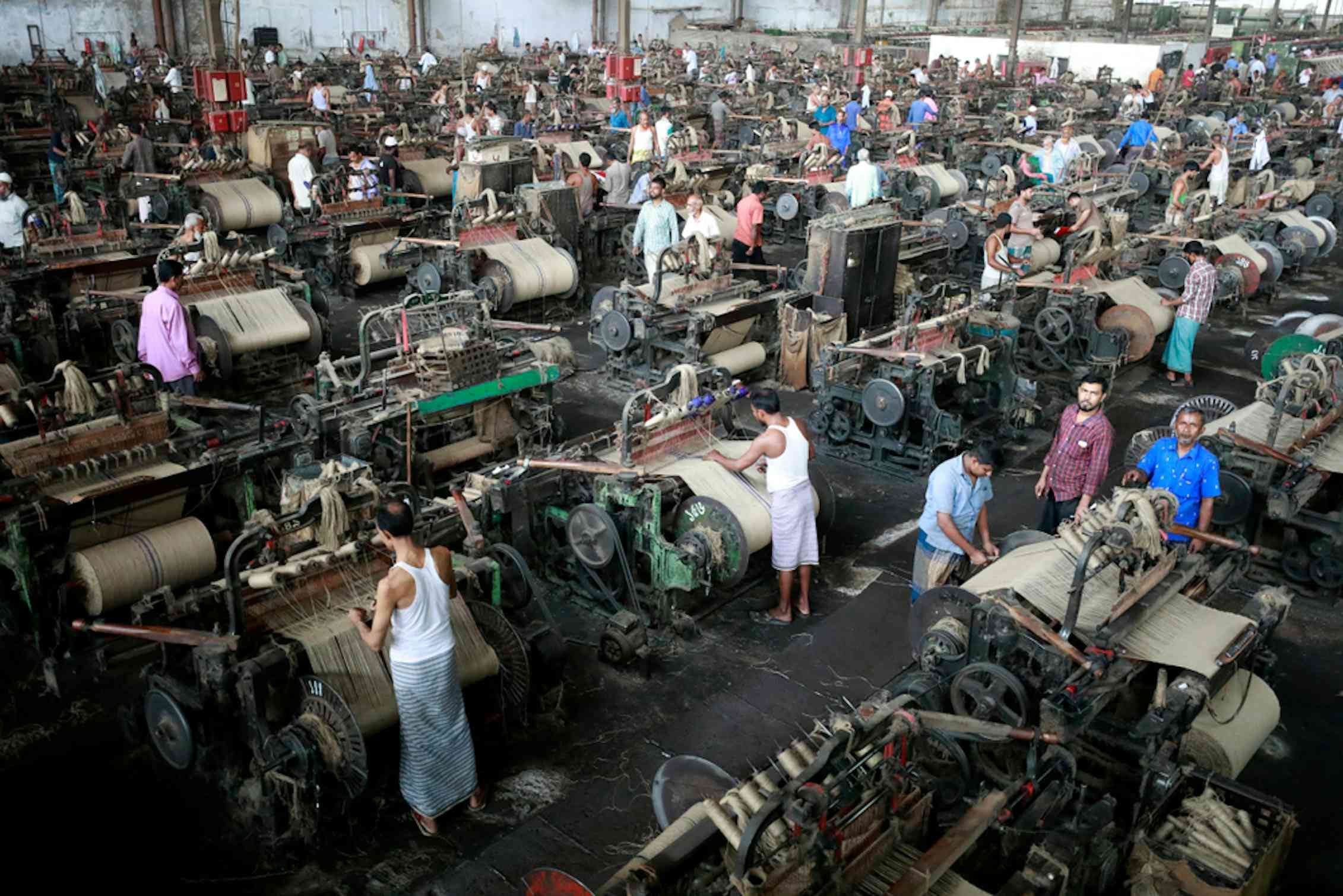
Most development theories explain how economies grow, but not how they get started. The missing preconditions matter more than you think.
If you’re following me but don’t yet receive these essays by email, you’re missing most of them. Substack doesn’t email articles to followers—only to subscribers. You can get every new essay free in your inbox by subscribing 👉:
Across the world, some nations steadily climb the ladder of industrial development while others struggle to move beyond a narrow set of exports.
South Korea moved from textiles and simple manufacturing into automobiles, shipbuilding, and eventually semiconductors. Taiwan followed a similar path, building on light industry to become a global leader in electronics. Germany expanded from basic manufacturing into advanced machinery and chemicals, while Japan climbed from low-cost consumer goods to high-end industrial production.
Meanwhile, dozens of other developing nations remain seemingly trapped exporting low-value-added raw materials. These patterns are not random. They reveal something fundamental about how modern economies develop.
One of the most compelling modern explanations comes from the theory of Economic Complexity, developed by economists such as César Hidalgo. It argues that economies can only move into industries that are closely related to what they already know how to do. In the book, The Atlas of Economic Complexity (my summary here), Hidalgo et al compare a nation trying to industrialize to a monkey in a forest searching for bananas.
The Monkey in the Forest: How Economies Move into New Industries
Imagine a monkey trying to cross a forest. It begins on a tree with only a few bananas and wants to reach another part of the forest where the trees are full of fruit. The monkey cannot jump anywhere it wants. It can only move to nearby branches: those that are within reach. If it tries to leap too far, it will fall.
Economic development works in much the same way. Every industry requires a specific combination of skills, technologies, suppliers, and organizational knowledge. A country that already produces textiles may find it relatively easy to move into garments, but much harder to jump directly into semiconductor manufacturing. The capabilities required for each industry overlap to varying degrees, and economies tend to expand into those industries that are closest to what they already know how to do.
This insight, often visualized as a “Product Space” of related industries, helps explain why industrialization is usually gradual and path-dependent. Countries do not leap randomly into entirely new sectors. Instead, they build on existing strengths, moving step by step into more complex and higher-value industries.
Over time, these small, incremental moves can transform an economy, but only if each step is within reach.
If you enjoy this article, you should read my From Poverty to Progress book series.

The Product Space: A Useful Idea
The idea behind the Product Space is simple but powerful. Every product requires a specific combination of capabilities: skills, technologies, supply chains, institutions, and forms of organizational knowledge. Some of these capabilities are highly specialized, while others can be used across many different industries.
For example, a country that produces garments already has experience with textiles, factory organization, quality control, and export logistics. Those capabilities make it easier to move into related industries such as footwear or more advanced apparel. By contrast, industries like semiconductors or pharmaceuticals require very different capabilities, making them much harder to enter without a long process of capability building.
The Product Space maps these relationships. See above for a graphical representation of the Product Space. Each node is a specific industry, and related industries are close to each other. Some industries sit in dense clusters with many nearby connections, while others are more isolated. Countries tend to move through this network gradually, expanding into industries that are closely connected to what they already produce.
The structure of the Product Space is derived from observed trade patterns rather than direct measurement of capabilities. If two products are frequently exported together by the same countries, they are assumed to require similar underlying capabilities and are placed close together in the network.
Over time, this creates a map with a densely connected “core” of industries, typically advanced manufacturing in wealthy nations, and a more sparsely connected “periphery,” where agricultural and mineral products are often located. Developing nations tend to specialize in these nodes. This arrangement reflects patterns of global production, not necessarily how difficult an industry is in terms of skill or knowledge.
This helps explain why some development paths are much easier than others. Nations that begin with industries located in dense parts of the Product Space have many possible directions for expansion. Each successful move opens up new opportunities, creating a chain of diversification over time.
By contrast, nations that specialize in isolated industries, such as raw materials or basic commodities, have far fewer nearby options. They may find themselves stuck, not because growth is impossible, but because the next step is too far away.
The Product Space therefore provides a useful way to think about industrial strategy. It suggests that development is not about jumping directly into the most advanced industries, but about identifying the next feasible step: one that builds on existing capabilities while moving toward higher-value production.
The Product Space Did Not Always Exist
The Product Space is a powerful tool for understanding how economies diversify, but it has an important limitation. It describes the structure of existing industries at a given moment in time, yet it does not explain how those industries came into existence in the first place.
In effect, it provides a snapshot of the forest, but not the process by which the forest grew. The Product Space did not spring into existence fully formed. It was built gradually over centuries by early industrializing nations. Each “node” in the Product Space, each industry that countries can potentially enter, was created through a long and often difficult process that combined:
new technologies,
new skills,
new forms of organization, and
new sources of capital.
Consider the British cotton textile industry in the late 18th century. This was not simply a nearby branch waiting to be reached. It was constructed through a sequence of innovations: the spinning jenny, the water frame, and the power loom dramatically increased productivity. But these technologies only worked when combined with new organizational forms, most notably the factory system, which concentrated labor and machinery in a single location. Workers had to be trained to operate and maintain machines, managers had to coordinate production at scale, and supply chains had to be organized for raw cotton and finished goods. The capital required to build mills and purchase machinery came from merchant fortunes, reinvested profits, and a growing financial system that was learning how to fund industrial ventures. Together, these elements created one of the first major industrial “nodes” in the modern Product Space.
A similar process occurred in the development of the steel industry in 19th-century Britain. Advances such as the Bessemer process made it possible to produce steel at scale, but this required far more than a single invention. Steel production depended on access to coal and iron ore, the development of large integrated plants, and a workforce of skilled engineers and technicians. It also required massive capital investment in furnaces, railways, and transport infrastructure. This capital was mobilized through expanding financial institutions and retained earnings from earlier industries. Once established, steel became a foundational node that enabled railroads, shipbuilding, and heavy machinery.
In late 19th-century Germany, the synthetic dye industry provides another example. German firms such as BASF and Bayer did not simply enter an existing industry: they helped create it. This required the integration of university-based chemical research with industrial production, producing a new class of scientifically trained workers. Firms developed laboratories, research departments, and organizational structures that linked discovery to commercialization. Capital was provided by universal banks that actively financed and coordinated industrial expansion. This combination of science, industry, and finance created a new node that later expanded into pharmaceuticals and advanced chemicals.
Japan’s modern shipbuilding industry, developed in the late 19th and early 20th centuries, followed a similar pattern. Japanese firms and the state imported foreign designs, hired foreign engineers, and trained domestic workers to build and operate modern shipyards. Over time, they developed their own technical expertise and managerial capabilities. Large-scale shipbuilding required coordinated supply chains, skilled labor, and substantial capital investment, which came from a mix of state support and private industrial groups. What began as imitation gradually became a self-sustaining industrial capability.
In the early 20th century, the United States created the modern automobile industry. While the basic idea of the automobile existed elsewhere, American firms developed a new production system. The moving assembly line allowed for mass production at unprecedented scale, but it depended on standardized parts, specialized machinery, and a large semi-skilled workforce. Firms built complex supply chains and distribution networks, while capital was mobilized through corporate structures, financial markets, and reinvested profits. This combination of technology, skills, organization, and capital created a new industrial node that transformed transportation and manufacturing.
These examples illustrate a broader point. The Product Space is not a timeless map of industries. It is a snapshot of the global economy at a particular moment, reflecting the industries that have already been created. Each node represents the outcome of a historical process in which societies developed the necessary technologies, trained workers with the right skills, created organizations capable of coordinating production, and mobilized the capital required to sustain it.
The Product Space is therefore a useful tool for mapping existing industries and identifying nearby opportunities for diversification. But it does not explain how those industries were created in the first place. It shows how economies move between branches, but not how the branches themselves came into being.
The Product Space Starts in the Middle of the Story
The Product Space is a powerful way to map how economies move between industries. But it does so by starting from a world in which all of those industries are already feasible.
Every node in the Product Space represents an industry that can be produced somewhere in the world. That fact alone implies the existence of a deeper set of conditions that make industrial production possible at all. Before any country can produce textiles, steel, chemicals, or automobiles, it must first overcome more basic constraints: it must produce enough food to free labor from agriculture, sustain large populations living in cities, support systems of trade and exchange, maintain a degree of stability that allows firms to operate and invest, and generate sufficient energy to power large-scale production.
These are not industry-specific capabilities. They are general preconditions required for all modern industries.
Within the Product Space framework, these preconditions are largely invisible. They do not appear as nodes or connections because they are assumed to already exist. The framework instead focuses on how countries move between industries once those underlying conditions are in place.
This is what makes the Product Space so useful for understanding diversification within the modern global economy. But it also reveals its boundary. It explains how countries move between industries once societies have achieved the basic conditions required for sustained industrial production, but not how those preconditions are established in the first place.
The Problem with Many Development Theories
The “starting in the middle of the story” problem is not unique to the Product Space. It appears across many of the most influential theories of economic development.
Each theory of economic development identifies a real driver of growth, but does so by focusing on mechanisms that operate after the basic conditions for modern industry are already in place. As a result, they tend to explain how economies grow once development is underway, while leaving unanswered how societies first create the conditions that make that growth possible.
Human Capital theory is a clear example. It argues that education and skill formation drive economic growth by increasing worker productivity. This is true within industrial and commercial economies where large numbers of people already live in cities, work outside agriculture, and are employed in firms that require specialized skills.
But Human Capital theory assumes that societies have already achieved high levels of agricultural productivity, freeing most of the population from food production, and that they have dense urban labor markets where skills can be applied. Without these conditions, expanding education alone does not generate modern industries. The theory explains how skills improve productivity within an existing economic structure, but not how that structur:e based on surplus food, urbanization, and abundant energy, is created.
Innovation and R&D-focused theories follow a similar pattern. They emphasize the role of new technologies, scientific research, and entrepreneurial experimentation in driving long-term growth. These mechanisms depend on an environment in which firms compete, experiment, and invest in new ideas, often for commercial advantage in domestic and export markets. They also require substantial energy inputs to scale production and apply new technologies at industrial levels.
In societies where firms are not yet engaged in sustained competition, where markets are limited or inward-looking, or where energy availability constrains production, innovation cannot play the same role. Historically, most countries grew by adopting existing technologies long before they began producing new ones at the frontier.
Institutional economics identifies another important factor: the role of secure property rights, contract enforcement, and effective governance. These institutions support investment and allow markets to function more efficiently. But they operate within a broader context in which economic activity is already organized around trade, production, and exchange rather than subsistence. They also tend to be most effective when political and economic power is sufficiently decentralized to allow competition among firms and regions.
In highly centralized or extractive systems, or in economies that lack productive agriculture or abundant energy, improvements in formal institutions alone do not automatically produce industrial growth. The theory explains how rules improve the functioning of markets, but not how large-scale market-based production emerges in the first place.

Even economic complexity theory, as discussed earlier, fits this pattern. It explains how countries diversify into new industries by building on existing capabilities, but it assumes that a wide range of industries can already be produced somewhere and that countries are integrated into systems of trade that allow them to export and learn. It also assumes that the basic inputs to production, surplus food, labor, capital, and especially energy, are available at sufficient scale to support industrial activity. Without these underlying conditions, the movement between industries that the Product Space describes cannot occur.
Across these theories, the pattern is consistent. They focus on mechanisms that drive growth within economies that have already achieved key preconditions: surplus food production that frees labor, large and dense urban populations, systems of trade and exchange, competitive environments that allow firms to experiment, integration into export markets, and access to abundant energy.
They provide valuable insights into how development proceeds once it has begun. But they leave a critical question unanswered: how do societies create these foundational conditions in the first place?
Why Food, Energy, and Geography Still Matter
To understand what is missing from these theories, we have to look beneath industries, institutions, and capabilities to the most basic constraints that have shaped human societies. For most of history, economic development was not limited by a lack of ideas or skills, but by far more fundamental factors: the ability to produce enough food, access to usable energy, and the geographic constraints that determined how easily people could produce surplus food and useful energy in their local environment.
Food is the first constraint. Before societies can develop any industry, they must produce enough food to support large populations without requiring most people to work in agriculture. This is not simply a matter of feeding people; it determines whether a society can sustain cities, specialization, and the division of labor required for industrial production. Societies that fail to achieve high agricultural productivity remain trapped with too few workers available to build and operate even the simplest industries.

Energy is the second constraint. Industrial production requires the ability to power machines, transport goods, and operate complex systems at scale. Pre-industrial energy sources, such as human labor, animal labor, wood, wind, and water, place strict limits on output. The widespread use of fossil fuels dramatically expanded the range of industries that were technically and economically feasible. Many of the central nodes in the modern Product Space, such as steel, chemicals, transportation equipment, and large-scale manufacturing, depend on dense, reliable energy supplies.

Geography shapes both of these constraints and adds a third layer of influence. Access to fertile land affects agricultural productivity. Proximity to navigable rivers and deep-water ports lowers the cost of trade and enables export industries to develop. The location of energy resources, such as coal, historically determined where early industrialization could occur. Geography does not determine outcomes on its own, but it strongly influences how easily societies can overcome the constraints of food and energy and integrate into global markets.

If you want to go to an even deeper level, you can introduce biology as a fourth constraint.

The Product Space helps explain how economies diversify once these constraints have been addressed. But it does not fully account for how difficult it is to overcome them in the first place. Food production, energy availability, and geographic position shape which societies are able to build the initial industries and how quickly they can expand into new ones. These factors operate beneath the surface of the Product Space, but they continue to influence the pace and direction of development even in the modern world.
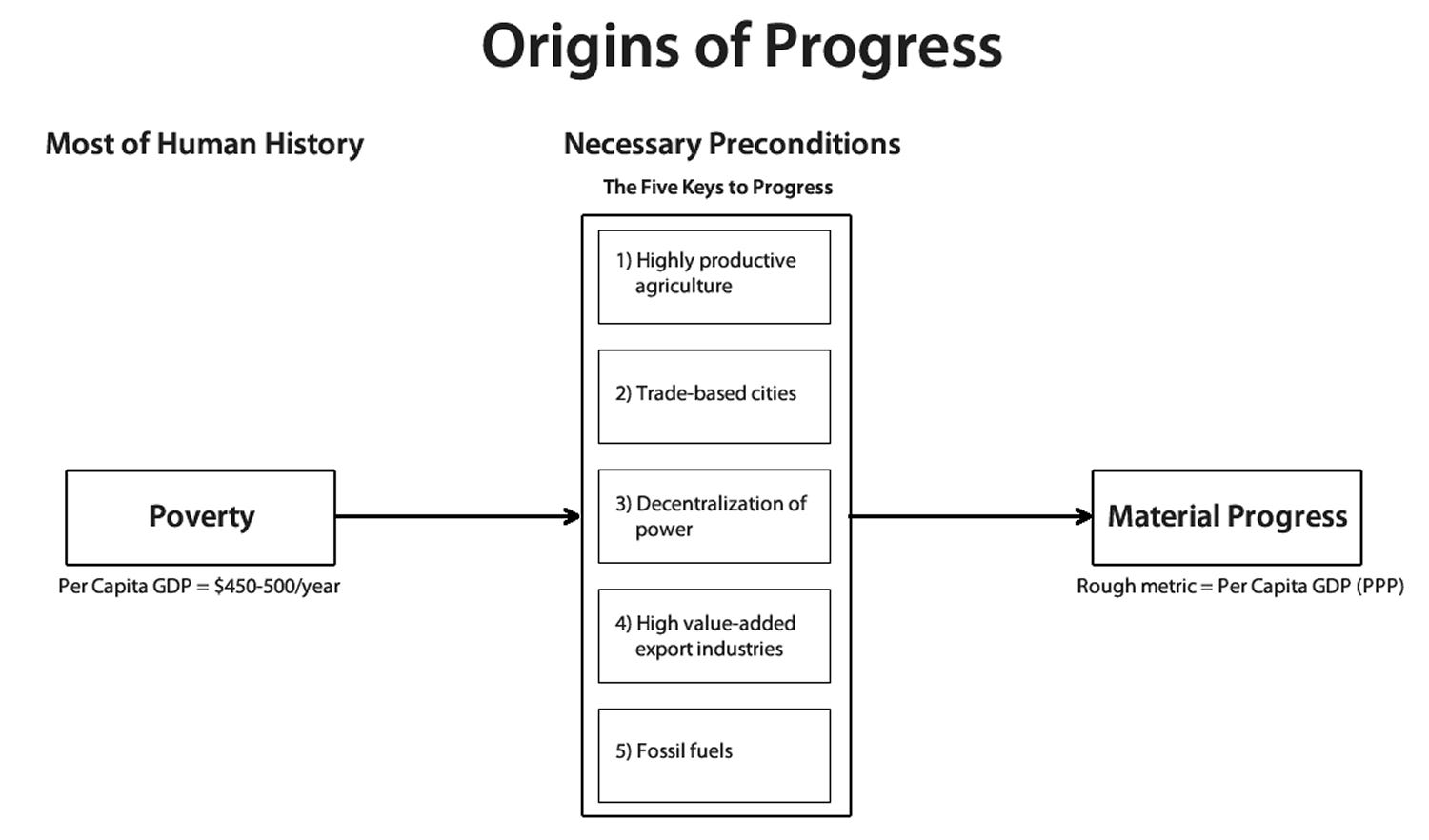
Necessary Preconditions
The basic constraints of food, energy, and geography do not disappear on their own. Societies that achieve sustained progress do so by developing a specific set of conditions that allow them to overcome those fundamental constraints.
I call these necessary preconditions the Five Keys to Progress. To transition from poverty to progress, a society needs to acquire the following preconditions:
A highly efficient food production and distribution system. This enables societies to overcome geographical constraints to food production so that large numbers of people can focus on solving problems other than getting enough food to eat.
Trade-based cities packed with a large number of free citizens possessing a wide variety of skills. These people innovate new technologies, skills, and social organizations and copy the innovations made by others.
Decentralized political, economic, religious, and ideological power. It is of particular importance that elites are forced into transparent, non-violent competition that undermines their ability to forcibly extract wealth from the masses. This also allows citizens to freely choose among institutions based upon how much they have to offer to each individual and society in general.
At least one high-value-added industry that exports to the rest of the world. This injects wealth into the city or region, accelerates economic growth and creates markets for smaller local industries and services.
Widespread use of fossil fuels. The incredible energy density of fossil fuels injects vast amounts of useful energy into society enabling it to solve a wide variety of problems. Without this energy, life would return to the daily struggle for survival that dominated most of human history.
Each of the Five Keys to Progress is necessary for a society to transition from a state of poverty to a state of progress, but none are sufficient by themselves.
Once a society acquires the Five Keys to Progress, that society can transform itself into a vast, decentralized problem-solving network. Instead of people competing against each other for scarce resources such as food, status, and land, individuals can focus on solving each other’s problems at scale by cooperation through market exchange.
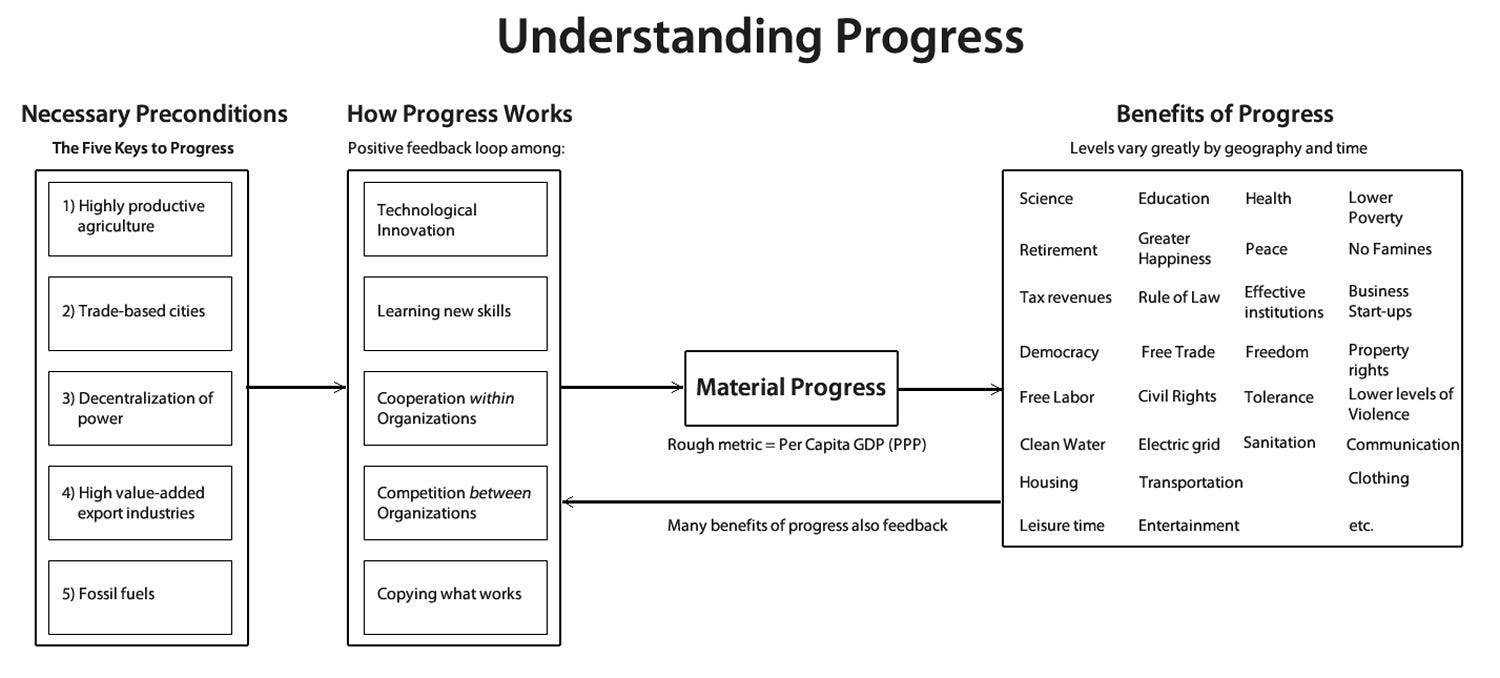
This transformation creates a powerful positive feedback loop:
Technological innovation. This includes radical innovations such as the railroad, electrical grid, computers, and the internet, as well as the ongoing incremental improvement and differentiation of thousands of other existing technologies.
People learning new skills to support those technologies. Without these skills, technologies are not useful, a fact that is often forgotten.
People cooperating within organizations. Those people work together using a wide variety of skills and technologies to accomplish a common goal.
Competition between organizations for scarce resources. In the past, this was usually food, while now it is usually revenue. This competition forces organizations to embrace new technologies, skills, and processes to out-compete other organizations. It also forces people within the group to cooperate more closely and enables new organizations to be founded and older organizations to fail.
People copying successful technologies, skills, and organizations and then modifying them to solve different problems. This enables innovations that work to spread into new companies, new sectors of the economy and new geographical regions. This step is critical to ensure that progress is widely shared.
Consumption of vast amounts of useful energy. Without energy, none of this can happen. Today the vast majority of that energy comes from fossil fuels.
How the Product Space Fits into the Five Keys
The Product Space and the Five Keys describe the same process at different levels.
The Five Keys explain the conditions under which modern industries can exist at all.
The Product Space explains how economies move between those industries once those conditions are in place.
Each of the Five Keys contributes directly to the ability of a society to move through the Product Space.
A highly efficient food production and distribution system frees large numbers of people from agriculture, creating the labor pool required for industrial production. Without this surplus, there are not enough workers available to staff factories, develop supply chains, or support the specialization required for even the simplest industries.
Trade-based cities concentrate people with a wide variety of skills in close proximity. This concentration allows capabilities to accumulate and combine, which is exactly what the Product Space measures. The dense clusters of related industries that appear in the Product Space are a direct reflection of these urban capability networks.
Decentralized political, economic, religious, and ideological power creates a competitive environment in which firms can experiment with new products and processes. This competition drives the trial-and-error process required to move from one industry to another. Without it, economies tend to stagnate or remain locked into a narrow set of activities.
Export-oriented industries connect firms to global markets, where they are forced to meet higher standards of cost and quality. This exposure accelerates learning and creates the revenue needed to sustain further expansion. It also provides the external demand that allows industries to scale beyond the limits of domestic markets.
Widespread use of fossil fuels provides the energy required to power industrial production at scale. Many of the industries in the Product Space, such as steel, chemicals, transportation equipment, and modern manufacturing, are simply not viable without large, reliable energy inputs.
When these conditions are in place, societies become capable of sustained movement through the Product Space. Firms experiment, workers learn new skills, organizations compete, and successful practices spread. Each step into a new industry creates additional capabilities, which in turn open up further opportunities for diversification.
In this way, the Product Space can be understood as a map of possible moves within a system, while the Five Keys explain how that system is created and sustained.
How the Product Space Strengthens the Five Keys
The Five Keys explain the conditions required for sustained progress, but they are abstract. They describe the environment that makes development possible, not the specific path that countries are likely to follow. The Product Space strengthens this framework by making it more concrete and directly applicable to modern economies.
In particular, it shows that development is not an open-ended process. Even when the necessary preconditions are in place, countries cannot move into any industry they choose. They are constrained to a relatively small set of feasible next steps: industries that are closely related to what they already produce. This provides a practical guide for how nations can gradually ratchet their way up the value-added chain.
For pre-industrial and early-industrial nations, this insight is especially important. Consider a country that exports raw cotton. It can move relatively easily into spinning yarn and then into weaving textiles, because these industries share machinery, skills, and supply chains. From textiles, it can expand into garments, and from there into more complex products such as synthetic fabrics or specialized apparel.
By contrast, jumping directly from raw cotton to semiconductor manufacturing is not feasible, because the required capabilities, such as precision engineering, advanced materials, and highly specialized production systems, are entirely different. The Product Space makes these pathways visible by showing which industries are nearby and therefore achievable.
One important clarification is that what the Product Space refers to as “complexity” does not measure how difficult an industry is in terms of knowledge or skill. Agricultural production, for example, often requires highly specialized knowledge of soil, climate, and biology.
Instead, what the framework captures is something different: how dependent an industry is on dense, transferable networks of capabilities rather than on local geographic conditions. Agricultural and mineral products tend to be widely produced because they depend heavily on geography, while advanced manufacturing depends more on human-built systems such as supply chains, organizations, and specialized labor. In this sense, what appears as “complexity” in the Product Space is closely tied to the degree to which production is independent of geography.
The Product Space concept also explains why development is difficult, even though copying existing industries may appear straightforward. Copying a product is not enough. Each industry requires a bundle of supporting capabilities:
reliable suppliers,
trained workers,
organizational know-how, and
access to foreign markets with unmet demand for that specific product.
If any of these elements are missing, attempts to enter a new industry are likely to fail. The Product Space captures this difficulty by showing that many industries are effectively out of reach until a country has accumulated the necessary intermediate capabilities.
In this way, the Product Space complements the Five Keys by translating a set of broad preconditions into a more specific map of feasible actions. The Five Keys explain why sustained progress is possible; the Product Space helps explain how it actually unfolds in practice.
What This Means for Developing Nations
Taken together, the Five Keys and the Product Space provide a much clearer picture of how development actually occurs. The Five Keys define the conditions that make sustained industrial growth possible. The Product Space shows how that growth proceeds in practice through a sequence of incremental moves into related industries.
This has several important implications for developing nations.
First, development is not a matter of choosing the “right” industry in isolation. Countries cannot simply decide to enter advanced sectors such as semiconductors or pharmaceuticals because those industries are attractive. They must build the underlying conditions that make industrial production possible and then move step by step into industries that are within reach. Attempting to leap too far ahead usually results in failure, wasted resources, and disillusionment.
Second, development is path-dependent. A country’s existing industries strongly influence what it can do next. Nations that specialize in isolated, low-value-added exports often have few nearby opportunities in the Product Space, making diversification difficult. This helps explain why many resource-dependent economies struggle to industrialize. It is not simply a matter of policy failure, but of structural position.
Third, copying is both essential and difficult. Much of development involves adopting technologies and organizational practices that already exist elsewhere. But copying an industry requires far more than replicating a final product. It requires assembling the full set of supporting conditions: reliable suppliers, skilled workers, functioning firms, access to export markets, and sufficient energy. Without these, attempts to copy even relatively simple industries will fail.
Fourth, material progress is cumulative and requires patience. Each successful move into a new industry expands the set of capabilities available to the economy, opening up additional opportunities. But this process takes time. Countries that attempt to accelerate it too quickly often skip necessary intermediate steps and undermine their own progress.
Finally, policy should focus less on picking winners and more on enabling movement. Governments can play a constructive role by improving the underlying conditions for industrial production, particularly in food systems, urban development, trade infrastructure, and energy, and by helping firms enter industries that are closely related to existing capabilities. The goal is not to direct the economy toward a fixed end state, but to create an environment in which continuous movement through the Product Space becomes possible.
When viewed in this way, development is neither mysterious nor arbitrary. It is a structured process, constrained by underlying conditions and guided by the accumulation of capabilities over time.


Conclusion
The Product Space provides a powerful and intuitive explanation for how economies diversify. It shows that development is not random, but path-dependent. Countries tend to move into industries that are closely related to what they already produce, advancing step by step through a network of capabilities.
But this insight begins in the middle of the story.
It assumes a world in which modern industries are already feasible: i.e. where societies have overcome the fundamental constraints that once limited human activity. It assumes the existence of surplus food, large urban populations, systems of trade, competitive environments, and abundant energy. These conditions are not universal. They are the result of a long and rare historical process.
The Five Keys to Progress explain how societies overcome these constraints. A highly efficient food system, trade-based cities, decentralized power, export industries, and widespread use of fossil fuels together create the conditions that make sustained industrial production possible. Without these preconditions, movement through the Product Space cannot begin.
When these perspectives are combined, a clearer picture of development emerges. The Five Keys to Progress establish the environment in which industrial growth can occur. Within that environment, the Product Space provides a practical guide to how that growth unfolds in practice. It shows the pathways that are within reach, and why progress typically proceeds through a sequence of incremental steps rather than sudden leaps.
Development, in this view, is neither mysterious nor automatic. It is a structured process shaped by underlying constraints and guided by the accumulation of capabilities over time. Understanding both layers, the Five Keys to Progress and the Product Space, is essential for explaining how nations move from poverty to sustained material progress.
If you’ve been enjoying these essays but only follow me here, you’re not getting them by email. Followers see Notes; subscribers receive every new piece on the history and future of progress.
Subscribe free here 👉:
See also my other articles on:
If you enjoyed this article, you should read my From Poverty to Progress book series.
Have you published a deep dive into any particular country?
As in where it stands in terms of development and what it can do to get ahead.
My personal interest would be in India but would be curious to read on any other large developing country as well.