
Did Useful Knowledge Cause Modern Prosperity?
Why some societies generated useful knowledge while others did not.

Did the Scientific Revolution and Enlightenment cause the Industrial Revolution? An article testing the evidence.
If you’re following me but don’t yet receive these essays by email, you’re missing most of them. Substack doesn’t email articles to followers—only to subscribers. You can get every new essay free in your inbox by subscribing 👉:
Imagine trying to explain modern prosperity to someone living in the year 1500. You would probably begin with the technologies that transformed the world: steam engines, railroads, electricity, automobiles, antibiotics, computers, and the internet. Behind each of these breakthroughs was new knowledge about how the natural world works. It is therefore tempting to conclude that the growth of useful knowledge was the key force behind humanity's escape from poverty.
This article is part of my Mythbusting Theories of Material Progress series, which examines some of the most influential explanations for why modern prosperity first emerged in a handful of societies and later spread across much of the world. Previous articles have explored theories based on institutions, slavery, European imperialism, geography, education, and other factors.
In this article, we turn to the Useful Knowledge theory, most closely associated with economic historian Joel Mokyr. In 2025, Mokyr received the Nobel Memorial Prize in Economic Sciences for his work on technological change, knowledge, and long-run economic growth.
According to Mokyr, Europe experienced a unique intellectual transformation during the Scientific Revolution and the Enlightenment. New ways of thinking encouraged the systematic pursuit of useful knowledge and its application to practical problems. As scientific and technical knowledge expanded, new technologies emerged, productivity increased, and sustained economic growth became possible.
In the pages that follow, we will examine the intellectual foundations of the Useful Knowledge theory, the logic behind it, and the strongest evidence offered by its supporters. We will then examine a series of objections and ask a simple question: How much of humanity's escape from poverty can really be explained by the growth of useful knowledge?
Mythbusting Theories of Material Progress

Testing the main theories on the causes of long-term economic growth against the actual historical record.
If you enjoy this article, you should read my From Poverty to Progress book series.

Intellectual Foundations
The Useful Knowledge theory contains two related but distinct claims.
A general theory of economic growth. The Useful Knowledge theory argues that the accumulation and application of useful knowledge is the primary driver of long-run increases in productivity and living standards.
The second is a more specific historical claim. The Useful Knowledge theory argues that the unique intellectual transformation occurred in Europe during the Scientific Revolution and Enlightenment lead to a rapid expansion of useful knowledge and ultimately created the Industrial Revolution.
The Useful Knowledge theory is most closely associated with economic historian Joel Mokyr, one of the leading scholars of the Industrial Revolution and long-run economic growth. Over several decades, Mokyr developed both the general theory of useful knowledge and the historical explanation for why Europe industrialized first.
Mokyr developed this argument across several major works.
In The Gifts of Athena (my summary here) Mokyr argued that economic growth depends on the creation and diffusion of useful knowledge.
In The Enlightened Economy (my summary here), Mokyr examined the relationship between the Enlightenment and Britain’s Industrial Revolution.
In A Culture of Growth (my summary here), Mokyr explored how intellectual changes in Europe encouraged the production and dissemination of new knowledge.
A central concept in Mokyr’s work is the distinction between two types of knowledge.
Propositional knowledge, which refers to knowledge about how the natural world works. It includes fields such as physics, chemistry, biology, and astronomy..
Prescriptive knowledge, which refers to practical knowledge about how to accomplish specific tasks. It includes techniques for building machines, producing goods, treating diseases, and solving engineering problems.
Mokyr uses the term useful knowledge to describe both forms of knowledge taken together. One of his central arguments is that economic growth accelerated when advances in propositional knowledge increasingly improved prescriptive knowledge. As understanding of the natural world expanded, inventors and entrepreneurs were able to develop better technologies, leading to higher productivity and rising living standards.
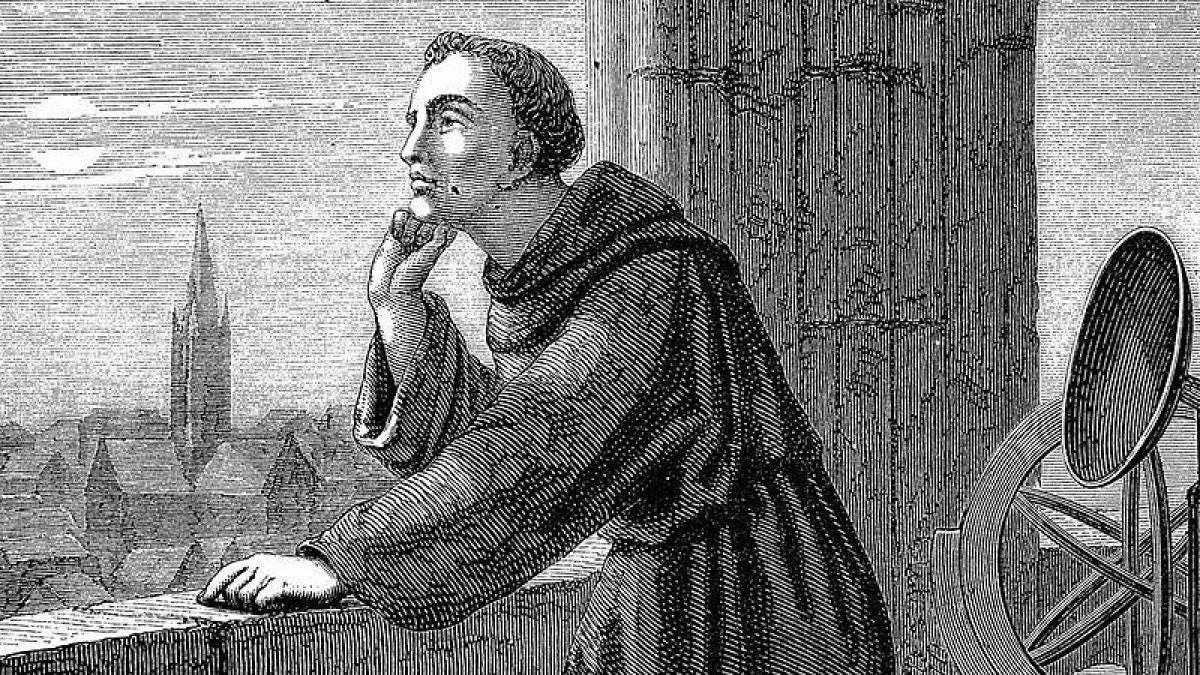
In Mokyr’s account of the growth of European useful knowledge, a central figure is Francis Bacon (see above). Writing in the early seventeenth century, Bacon argued that knowledge should be used to improve the human condition. Rather than pursuing knowledge solely for philosophical or religious purposes, scholars should investigate nature in ways that could generate practical benefits. Mokyr views this Baconian vision as an important step toward the modern world.
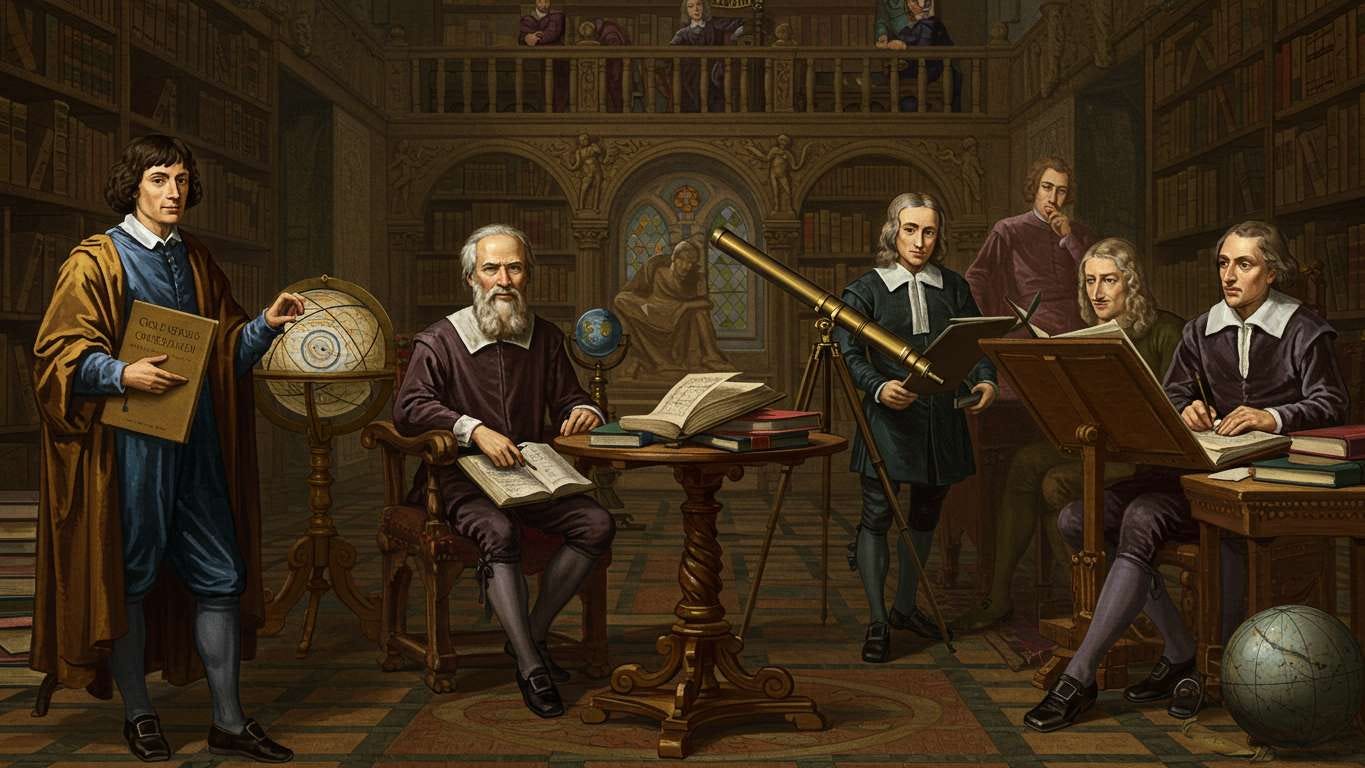
A second pillar of Mokyr’s theory is the Scientific Revolution. During the sixteenth and seventeenth centuries, European thinkers increasingly relied on observation, experimentation, and mathematics to understand the natural world. Figures such as Galileo Galilei, Johannes Kepler, and Isaac Newton helped establish new methods for investigating nature that would later influence scientists, engineers, and inventors.
The Enlightenment also plays a major role in Mokyr’s explanation. During the eighteenth century, intellectuals across Europe exchanged ideas through books, journals, letters, universities, scientific societies, and informal discussion groups. Mokyr refers to this international community of scholars and intellectuals as the “Republic of Letters.” He argues that these networks helped spread new ideas, encouraged debate, and made it easier for useful knowledge to accumulate over time.
Taken together, Baconian ideas about useful inquiry, the Scientific Revolution, the Enlightenment, the Republic of Letters, and the growth of useful knowledge form the intellectual foundation of Mokyr's explanation for modern economic growth.

The Causal Logic
At the heart of the Useful Knowledge theory is a simple idea: societies become wealthier when they become better at understanding the natural world and applying that understanding to practical problems.
Mokyr’s argument can be summarized as the following chain of causality:
Propositional Knowledge → Prescriptive Knowledge → Technology → Productivity → Long-Term Economic Growth
According to Mokyr, economic growth accelerates when advances in propositional knowledge lead to improvements in prescriptive knowledge. As people develop a better understanding of nature, they become better able to manipulate nature for practical purposes.
For example, advances in chemistry can lead to improved industrial processes. Advances in physics can lead to new machines and technologies. Advances in biology can lead to improvements in medicine and agriculture. In each case, scientific understanding is translated into practical techniques that increase productivity.
As productivity rises, workers can produce more output using the same amount of labor, land, capital, and raw materials. Businesses become more efficient, incomes rise, and living standards improve. When this process continues over many decades, sustained economic growth becomes possible.
Mokyr argues that this mechanism operated throughout the modern era, but that it became especially powerful after the Scientific Revolution and Enlightenment. During these periods, Europe experienced a rapid expansion of propositional knowledge and developed institutions that made it easier to share, debate, preserve, and apply new ideas. As a result, useful knowledge accumulated more rapidly and generated a growing stream of technological innovations.
The theory therefore contains two closely related claims.
The first is that useful knowledge is the primary driver of long-term economic growth.
The second is that Europe experienced a unique intellectual transformation that greatly increased the production and application of useful knowledge, helping to create the conditions that led to the Industrial Revolution.
These two claims form the foundation of Mokyr’s explanation for the rise of the modern world.
It is important not to overstate Mokyr's position. He does not argue that useful knowledge develops independently of society or that institutions, incentives, political stability, and markets are unimportant. On the contrary, these factors play an important role in his work because they influence the creation, spread, and application of useful knowledge.
The central claim of the Useful Knowledge theory is not that ideas exist apart from society, but that the growth and application of useful knowledge is the primary driver of long-run technological and economic progress.
Why the Theory Is Plausible
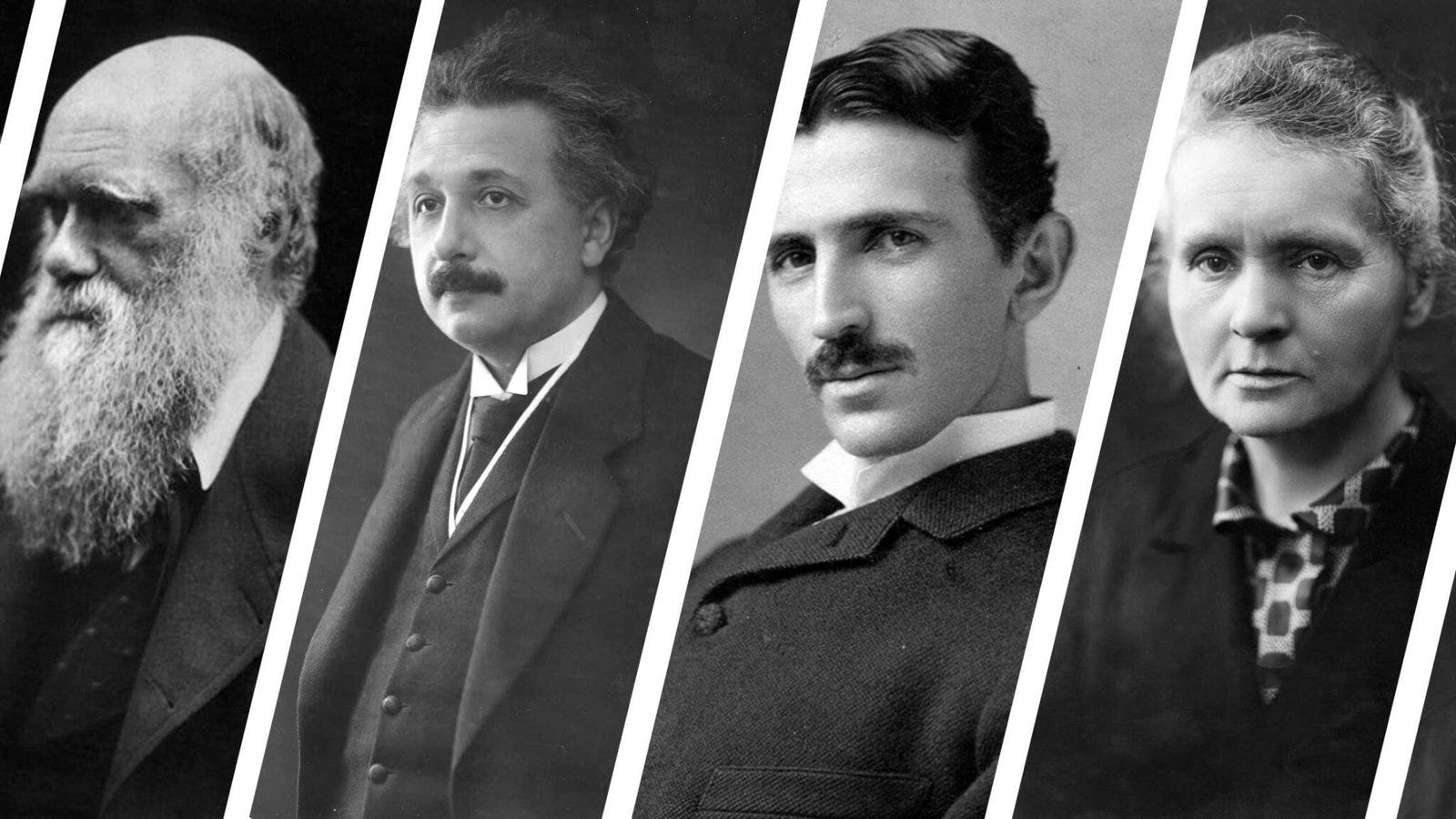
The Useful Knowledge theory is attractive because it appears to match many of the most important developments in modern history. Some of the technologies that transformed the world were directly connected to advances in scientific and technical knowledge.
Consider medicine. As scientists gained a better understanding of bacteria, viruses, and the human body, doctors developed more effective methods for preventing and treating disease. New medical technologies and treatments improved health, reduced mortality, and increased life expectancy.
Agriculture provides another example. Advances in biology and chemistry led to a better understanding of plant growth, soil nutrients, and disease. Farmers then applied this knowledge through improved seeds, fertilizers, and farming techniques. Agricultural productivity increased, allowing fewer workers to feed larger populations.
The same pattern can be seen in modern communications. Scientific advances in electricity and electromagnetism eventually led to practical technologies such as the telegraph, telephone, radio, and internet. These innovations dramatically reduced the cost of transmitting information and helped integrate larger markets.
Supporters of the theory argue that the Industrial Revolution reflects the same process on a larger scale. As scientific and technical knowledge expanded, inventors and entrepreneurs developed new machines and production methods. These technologies increased productivity in sectors such as textiles, mining, transportation, and manufacturing, helping to generate sustained economic growth.
The theory is therefore appealing because it provides a clear and intuitive explanation for how ideas can produce economic change. Better understanding leads to better techniques. Better techniques lead to better technologies. Better technologies increase productivity. Higher productivity raises living standards. At first glance, this appears to describe many of the most important technological advances of the modern era.
Strongest Evidence in Its Favor
Supporters of the Useful Knowledge theory argue that Europe experienced a profound intellectual transformation in the centuries before the Industrial Revolution. They point to a combination of cultural changes, new institutions, expanding intellectual networks, and technological advances that appear consistent with Mokyr’s explanation.
The Emergence of a Market for Ideas
One of Mokyr’s central arguments is that Europe developed an unusually competitive intellectual environment. Unlike large centralized empires, Europe was divided among many states, universities, churches, and centers of learning. Scholars who encountered opposition in one jurisdiction could often continue their work elsewhere.
Supporters argue that this competition helped create a market for ideas. New theories could be debated, criticized, and improved rather than suppressed by a single authority. Over time, this environment encouraged intellectual experimentation and increased the production of new knowledge.
The Republic of Letters
Mokyr places particular emphasis on the Republic of Letters, a network of scholars, scientists, inventors, and intellectuals who exchanged ideas across Europe. Through books, journals, correspondence, and scientific societies, intellectuals could communicate with one another despite political borders.
Supporters argue that this network made knowledge increasingly cumulative. Discoveries made in one country could be shared, tested, and expanded upon elsewhere. Rather than remaining isolated, useful knowledge became part of a growing body of information that could be accessed by future generations.
Changing Attitudes Toward Useful Knowledge
Supporters also point to changes in elite attitudes during the Scientific Revolution and Enlightenment. Thinkers such as Francis Bacon argued that knowledge should not be pursued solely for philosophical or religious purposes. It should also be used to improve the human condition through practical applications.
According to Mokyr, this shift encouraged greater interest in science, experimentation, invention, and technological improvement. Intellectuals increasingly viewed the investigation of nature as a worthwhile activity that could generate tangible benefits for society.
The Increasing Connection Between Science and Technology
A key prediction of the Useful Knowledge theory is that scientific understanding should become increasingly connected to practical innovation. Supporters argue that this is exactly what occurred.
While many earlier inventions emerged through trial and error, the eighteenth and nineteenth centuries saw growing interaction between scientists, engineers, and entrepreneurs. Scientific discoveries increasingly contributed to improvements in manufacturing, transportation, agriculture, medicine, and mining. This appears consistent with Mokyr’s claim that advances in propositional knowledge were generating advances in prescriptive knowledge.
The Rise of Science-Based Industries
Supporters argue that some nineteenth-century industries provide especially strong evidence for the theory. Industries such as chemicals, pharmaceuticals, electrical equipment, and advanced metallurgy relied heavily on scientific discoveries and trained specialists.
These industries seem to follow Mokyr’s proposed causal chain quite closely. Advances in scientific understanding led to new production techniques, new technologies, and new products. In these cases, the connection between knowledge and economic activity appears particularly direct.
Quantitative Indicators
Although useful knowledge itself is difficult to measure, supporters point to several trends that they believe are consistent with the theory.
Between the seventeenth and nineteenth centuries, Europe experienced rapid growth in book production, scientific journals, learned societies, patenting activity, and the number of scientists and engineers.
The number of patents issued in Britain increased dramatically during the Industrial Revolution
Scientific societies and technical publications expanded across much of Europe.
Supporters view these developments as evidence that the production, dissemination, and application of useful knowledge were increasing at an unprecedented rate.
The Timing of the Industrial Revolution
Finally, supporters point to timing. The Scientific Revolution, the Republic of Letters, the Enlightenment, the growth of scientific institutions, and the expansion of technological innovation all occurred during the centuries immediately preceding and during the Industrial Revolution.
To supporters of the theory, this pattern is difficult to dismiss as coincidence. The rapid expansion of useful knowledge occurred at the same time that Europe experienced the first sustained acceleration of economic growth in human history. This timing is one of the strongest reasons many historians and economists find Mokyr’s argument persuasive.
Definitional Problems
Now that I given you what I believe is an even-handed description of the Useful Knowledge theory, I want to explain some serious problems with the theory that I and other scholars have noted.
One of the biggest weaknesses of the Useful Knowledge theory is that its central concept is difficult to define and even more difficult to measure. The theory treats useful knowledge as the primary driver of long-term economic growth, yet there is no widely accepted way to determine how much useful knowledge a society possesses or how it should be compared across societies and across time.
What Makes Knowledge Useful?
The first problem is determining what qualifies as useful knowledge. Some forms of knowledge clearly contribute to production, transportation, agriculture, medicine, or manufacturing. Other forms of knowledge may be intellectually interesting without having any obvious economic value.
The boundary between useful and non-useful knowledge is often unclear. Knowledge that appears useless in one period may later become economically important. Conversely, knowledge that is highly valuable in one society may have little value in another. Before useful knowledge can explain economic growth, the theory must first explain what makes knowledge useful and how that usefulness should be evaluated.
Measuring Useful Knowledge
Even if useful knowledge could be clearly defined, measuring it presents another problem. Unlike population, literacy, urbanization, coal production, or income, useful knowledge cannot be directly counted.
Supporters of the theory therefore rely on indirect measures such as books, scientific journals, patents, scientific societies, scientists, engineers, and inventions. The problem is that these are proxies rather than direct measurements. A rise in patents does not necessarily indicate a rise in useful knowledge. A rise in scientific publications does not necessarily indicate a rise in economically important knowledge. Each measure captures something different, making it difficult to determine what is actually being measured.
Quantity or Importance?
The theory also struggles to distinguish between the quantity of knowledge and its economic significance. A society may possess thousands of pieces of practical knowledge related to hunting, farming, construction, and food storage. Another society may possess a much smaller number of discoveries related to chemistry or engineering.
Which society possesses more useful knowledge? The theory provides no obvious answer. Counting knowledge and measuring its economic importance are not the same thing, yet the concept often blends the two together.
The Problem of Circular Reasoning
The most serious problem is that useful knowledge is often identified by its success. Knowledge is considered useful because it eventually contributed to technological progress or economic growth.
This creates a risk of circular reasoning. Economic growth is explained by useful knowledge, while useful knowledge is identified by its contribution to economic growth. The theory therefore risks defining its central variable in terms of the outcome it is supposed to explain.
A Difficult Theory to Test
These problems do not prove that the Useful Knowledge theory is wrong. They do, however, make it unusually difficult to test (and also make it difficult for me to write this article!). Before useful knowledge can explain economic growth, it must first be defined and measured in a way that allows meaningful comparisons across societies and across time. On this point, the theory remains surprisingly vague.

Traditional Societies Possessed Enormous Amounts of Useful Knowledge
A second weakness of the Useful Knowledge theory is that it struggles to explain why human beings remained poor for so long if useful knowledge is the primary driver of economic growth. Long before the Scientific Revolution, the Enlightenment, or the Industrial Revolution, societies around the world possessed large amounts of knowledge that was directly relevant to survival, production, and warfare.
The existence of useful knowledge is not unique to modern societies. What varies is the type of knowledge that societies possess and the purposes to which it is applied.
The Knowledge of Hunter-Gatherers
Hunter-gatherer societies depended on detailed knowledge of their local environments. Survival often required understanding hundreds of plant and animal species, seasonal weather patterns, migration routes, water sources, and methods of navigation. Many hunter-gatherers could identify edible, medicinal, and poisonous plants that would be indistinguishable to most modern people.
They also possessed sophisticated practical knowledge related to tracking, toolmaking, shelter construction, hunting techniques, food preservation, and resource management. In many environments, failure to acquire this knowledge could mean starvation.
By Mokyr’s definition, much of this knowledge was clearly useful. It solved practical problems and improved the ability of people to survive and reproduce. Yet hunter-gatherer societies did not experience sustained economic growth.

The Knowledge of Traditional Farmers
Traditional farmers also possessed enormous amounts of useful knowledge. Successful farming required understanding soils, rainfall patterns, growing seasons, crop varieties, irrigation techniques, drainage systems, animal husbandry, seed selection, food storage, and pest management. This knowledge was often accumulated through centuries of observation, experimentation, and experience.
Farmers learned which crops grew best in particular soils, when to plant and harvest, how to rotate crops, how to manage livestock, and how to preserve food through periods of scarcity. In many societies, entire communities depended on this accumulated knowledge to avoid famine.
Agricultural knowledge also continued to evolve. Farmers regularly adopted new crops, new tools, new cultivation techniques, and new methods of managing land. Much of this knowledge was highly practical and directly connected to production. Yet even societies with centuries of accumulated agricultural expertise generally remained poor by modern standards.

The Historical Puzzle
The existence of useful knowledge in traditional societies does not disprove Mokyr’s theory. However, it does create an important problem. If useful knowledge is the primary driver of long-term economic growth, then we must explain why societies possessing large amounts of useful knowledge failed to generate sustained increases in living standards. And this was not an edge case. This was the dominant state of the humanity for virtually all of its history.
The historical record suggests that useful knowledge has existed for thousands of years. The real question is not whether useful knowledge existed before the modern era. The question is why useful knowledge produced sustained economic growth in a small number of societies and not in countless others.


Useful for What?
The previous section highlighted a problem for the Useful Knowledge theory. Useful knowledge existed long before the Industrial Revolution. This raises an obvious question: if useful knowledge has always existed, why did it only generate sustained economic growth in a handful of societies?
Part of the answer may lie in the word useful itself. Knowledge is not useful in the abstract. It is useful for achieving particular goals.
Throughout most of history, the two most important challenges facing human societies were subsistence and warfare. Not surprisingly, much of humanity’s useful knowledge was devoted to those activities. Hunter-gatherers accumulated knowledge related to finding food and surviving in difficult environments. Farmers accumulated knowledge related to agriculture and food storage. States accumulated knowledge related to taxation, administration, and military power.
This creates a problem for the Useful Knowledge theory. Useful knowledge is often treated as a single category that naturally leads toward economic growth. In reality, useful knowledge can serve many different purposes. A better irrigation system, a more effective military to conquer other polities, a more effective tax system to extract wealth from the peasantry, and a more productive manufacturing process are all forms of useful knowledge, yet they are likely to have very different effects on long-term economic growth.
Simply showing that useful knowledge is increasing therefore does not explain why living standards are rising. We must also ask what kinds of knowledge are increasing and what purposes they serve.
Knowledge Often Follows Innovation
One of the most important weaknesses of the Useful Knowledge theory is that it often assumes knowledge comes before innovation. In practice, the historical relationship is frequently the reverse. People often discover how to do something long before they understand why it works.
Agriculture provides many examples. Farmers practiced crop rotation for centuries before anyone understood soil chemistry. Plant and animal breeding improved crops and livestock long before the development of genetics. Practical success often emerged through observation, experimentation, and trial and error rather than scientific understanding.
The same pattern appears during the Industrial Revolution itself. The early steam engine was developed long before scientists understood the laws of thermodynamics. Iron production techniques improved long before metallurgy became a modern science. Many important technologies emerged from practical experimentation by craftsmen, mechanics, and entrepreneurs rather than from advances in scientific theory.
This creates a problem for Mokyr’s causal chain:
Propositional Knowledge
→ Prescriptive Knowledge
→ Technology
→ Economic Growth
In many important cases, the sequence appears to be closer to:
Practical Experimentation
→ Technology
→ Scientific Understanding
Rather than scientific knowledge creating technology, technology often created new opportunities for scientific investigation.
The steam engine provides a good example. Scientists did not first develop thermodynamics and then build steam engines. Instead, engineers built steam engines, improved them through decades of experimentation, and only later did scientists develop a deeper theoretical understanding of how they worked.

This does not mean that scientific knowledge is unimportant. Scientific understanding often helps improve existing technologies and can sometimes contribute to entirely new ones. However, the historical record suggests that innovation does not always depend on prior advances in propositional knowledge. In many cases, innovation itself becomes a source of new knowledge.
As a result, the relationship between knowledge and innovation appears far more complicated than the Useful Knowledge theory suggests. Rather than a simple one-way flow from scientific understanding to technology, the two often develop together and frequently influence one another.
Skills Matter More Than Knowledge
A second weakness of the Useful Knowledge theory is that it places most of its emphasis on knowledge while giving less attention to skills. Yet many of the activities that drive technological progress depend as much on practical ability as on formal understanding.
Knowing how a technology or raw material works is not the same as being able to build it, repair it, improve it, or operate it. A person may understand the principles of metallurgy without being a skilled blacksmith. A person may understand the theory of engineering without being able to construct a reliable machine. In many fields, practical competence is acquired through years of experience doing something rather than through books or scientific study.

This distinction was especially important before the modern era. Many technological advances were developed by craftsmen, mechanics, millwrights, miners, shipbuilders, and other skilled workers. Their expertise was often acquired through apprenticeship and repeated practice. Much of what they knew could not easily be written down or communicated through scientific publications.
The Industrial Revolution itself provides many examples. Some of the most important improvements in machinery emerged from workshops rather than universities. Inventors and mechanics frequently solved practical problems through experimentation, observation, and accumulated experience. Their success often depended less on scientific knowledge than on their ability to work with materials, tools, and machines.
This creates a problem for the Useful Knowledge theory. If economic growth depends primarily on the ability to transform ideas into working technologies, then skills may belong at the center of the story rather than knowledge. In that case, the Useful Knowledge theory may be emphasizing the wrong link in the causal chain.
Material Progress Creates Knowledge
Every theory of long-run material progress eventually identifies one or more primary causes. At that point, an important question arises:
What caused variation in the proposed cause?
Why did it emerge in some societies but not others?
If a theory cannot answer that question, then it has probably stopped the causal chain too soon.
This question is particularly important for the Useful Knowledge theory. Rather than asking only whether useful knowledge produces material progress, we should also ask what causes useful knowledge itself to grow. Once we ask that question, the direction of causality becomes much less clear. Material progress may not simply result from useful knowledge. It may also create the conditions that encourage the production, spread, and application of useful knowledge.
In other word, the Useful Knowledge theory may reverse the direction of causality. Rather than knowledge creating material progress, material progress creates many the conditions that allow useful knowledge to expand.
Mokyr places useful knowledge near the beginning of the causal chain. Knowledge leads to better technologies, which increase productivity and generate economic growth. Yet the historical record suggests that economic growth itself can dramatically increase the production of knowledge.
Wealthier societies can support larger numbers of people who do not need to spend most of their time producing food. They can afford universities, laboratories, libraries, scientific instruments, publishers, and educational institutions. They can also support growing numbers of scholars, scientists, engineers, and inventors whose full-time occupation is the creation and dissemination of knowledge.
The relationship becomes even stronger as societies accumulate more resources. Rising incomes allow families to spend more time and money on education. Governments and private organizations can devote more resources to research. Businesses can hire engineers and scientists to solve technical problems. As prosperity increases, the number of people engaged in producing new knowledge tends to increase as well.
Technological advances can further accelerate this process. The printing press reduced the cost of storing and transmitting information. Modern communications technologies have reduced it even further. Wealthier societies are generally better able to build and maintain the institutions and infrastructure that support the production and dissemination of knowledge.
This creates a major problem for the Useful Knowledge theory. Much of the evidence used to support the theory can be interpreted in two very different ways. A growing number of books, journals, scientists, engineers, laboratories, and research institutions may indicate that useful knowledge is driving economic growth. It may also indicate that economic growth has already occurred and is generating more resources for the production of knowledge.
If this interpretation is correct, then the Useful Knowledge theory has mistaken an effect for a cause. The expansion of knowledge would not explain the rise of modern prosperity. Instead, rising prosperity would help explain the expansion of knowledge.
The Origins of Europe's Great Intellectual Movements

Why did Europe's greatest intellectual movements emerge in a handful of distinctive regions before spreading across the continent?
Did the Enlightenment Cause the Growth of Useful Knowledge?
The most controversial part of Mokyr’s theory is not the claim that useful knowledge contributes to economic growth. It is the claim that a unique intellectual transformation during the Scientific Revolution and Enlightenment greatly increased the production and application of useful knowledge.
The problem is that Mokyr treats these intellectual movements primarily as causes when they may also be effects.
The Scientific Revolution, Baconian philosophy, and the Enlightenment did not emerge randomly. They appeared first and most strongly in some of the most economically advanced and commercially developed parts of Europe. These regions already possessed growing cities, expanding trade networks, rising literacy, printing industries, universities, and increasing specialization.
This raises an important question. Did these intellectual movements cause the expansion of useful knowledge, or did changing economic and social conditions create an environment in which such movements could flourish?
A few weeks ago, I published an article arguing the latter. The dynamic Commercial societies of Northwest Europe laid the material foundations for the Renaissance, Scientific Revolution, and Enlightenment.. The most important of these Commercial societies were:
The city-states of Northern Italy (roughly 1200–1500)
Flanders (roughly 1200–1600)
The Dutch Republic (roughly 1550–1700)
Pre-industrial England (roughly 1600–1800)
A scattering of German trade-based cities.
The same issue applies to Bacon’s call for practical knowledge. Mokyr presents Baconian ideas as an important turning point in European intellectual history. Yet one could just as easily argue that Bacon was articulating values that were already becoming more common in England and other Commercial societies. Growing trade, manufacturing, navigation, and technological activity had already created demand for practical improvements long before Bacon wrote about them.
A similar problem appears with the Enlightenment. Mokyr argues that Enlightenment intellectual culture encouraged the growth of useful knowledge. Yet the Enlightenment itself depended on institutions such as universities, publishers, scientific societies, and educated urban populations that originated in Commercial societies. These institutions did not emerge spontaneously. They were products of broader social and economic developments that were already underway in a few unique societies.
The Useful Knowledge theory therefore risks placing intellectual movements at the beginning of the causal chain when they may belong much closer to the middle. The Scientific Revolution, Baconianism, and the Enlightenment may have helped accelerate the growth of useful knowledge. However, they may themselves have been consequences of deeper forces that the theory leaves largely unexplained: the evolution of a constellation of Commercial societies in Northwest Europe.

Why the Internet Has Not Eliminated Global Poverty
If the Useful Knowledge theory is correct, the modern world presents an important test. Never before has so much useful knowledge been so widely available. Scientific papers, engineering textbooks, technical manuals, online courses, software, and instructional videos can now be accessed almost anywhere with an internet connection. A farmer in Kenya, an entrepreneur in India, or an engineer in Nigeria can learn techniques that would have been available only to a handful of experts a century ago.
If useful knowledge were the primary driver of long-run economic growth, then the dramatic reduction in the cost of acquiring and transmitting that knowledge should have accelerated global convergence in living standards.
Yet national per capita GDP and its rates of growth remain highly uneven. Some countries continue to experience sustained economic growth, while others remain poor despite unprecedented access to the world’s accumulated knowledge.
This does not mean that knowledge is unimportant. Access to better information has undoubtedly improved education, medicine, agriculture, and countless individual lives. But books, journals, scientific papers, textbooks, and the internet demonstrates that making useful knowledge widely available is not sufficient to produce industrialization or sustained economic growth.
Instead, the ability to transform knowledge into productive activity appears to depend on factors beyond knowledge itself. Two countries may have access to the same engineering textbooks, scientific discoveries, and manufacturing techniques, yet achieve dramatically different economic outcomes.
The internet has therefore strengthened an important conclusion. Useful knowledge is easier to share than ever before, but prosperity remains difficult to create. Knowledge can spread almost instantly across national borders. Sustained economic growth cannot.
Conclusion
Joel Mokyr has made an important contribution by showing that knowledge matters. Scientific discoveries, engineering, and practical know-how have helped create new technologies, increase productivity, and improve living standards. Few historians would disagree with that basic point.
The problem is that the Useful Knowledge theory asks us to treat ideas as the starting point of the story. Knowledge is presented as the independent variable that drives technology, economic growth, and rising living standards. Yet the historical evidence can also be read in the opposite direction. As societies become wealthier, more specialized, and more technologically advanced, they can support more scientists, engineers, inventors, universities, laboratories, publishers, and schools. In that view, the growth of useful knowledge is not just a cause of material progress. It is also one of its results.
This makes the theory difficult to test. Useful knowledge is hard to define, hard to measure, and closely tied to the outcome it is supposed to explain. As a result, almost any sign of progress can also be treated as evidence that useful knowledge has increased.
The modern world reinforces this problem. Today, useful knowledge is easier to acquire than at any time in history. Yet countries with access to the same books, scientific papers, engineering manuals, and internet resources continue to experience very different rates of economic growth. Knowledge clearly matters, but access to knowledge alone does not explain why some nations become rich while others remain poor.
Useful knowledge is an important part of the story of modern prosperity. But it is not the beginning of the story. The deeper question is why some societies generate, adopt, and apply useful ideas while others do not. Answering that question requires explaining:
how material conditions shape the creation and spread of ideas, and
how those ideas, once adopted, contribute to further material progress.
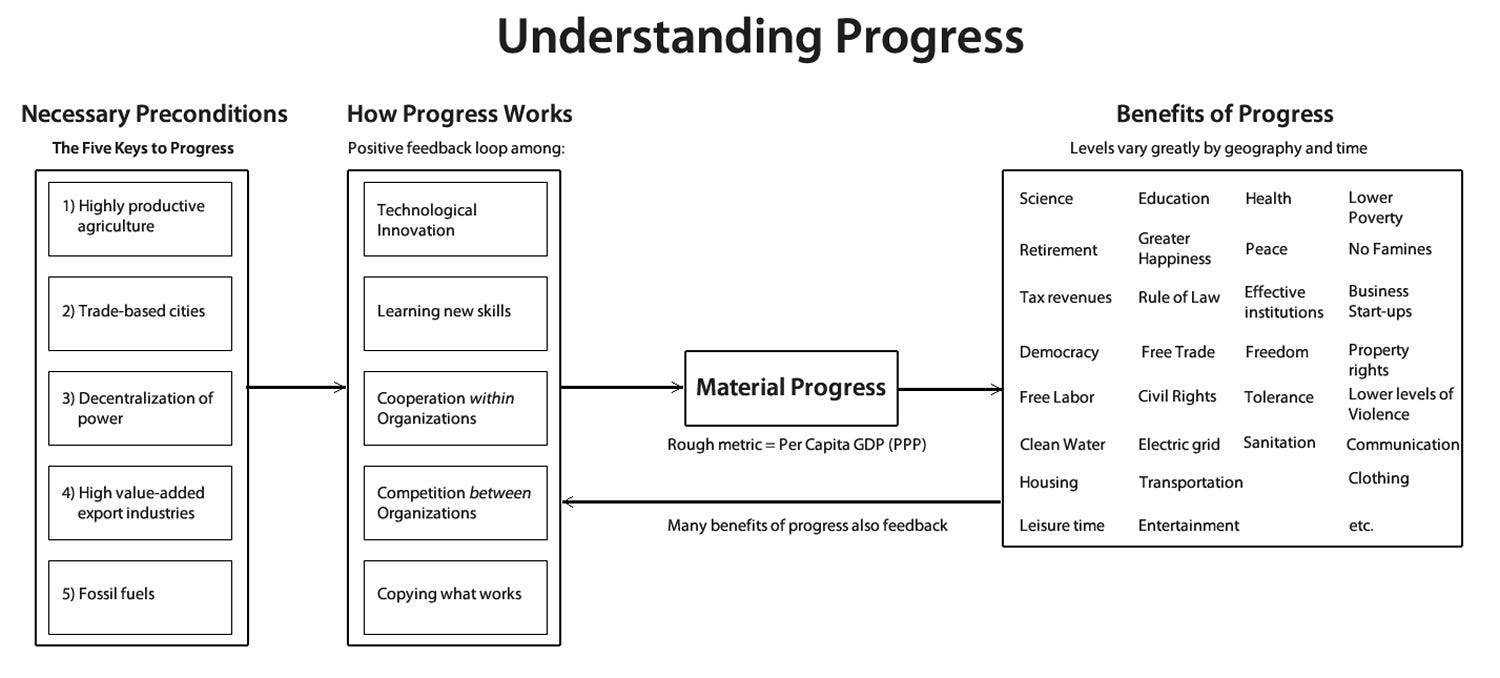
In another series of articles, I explain my theory on the cause of modern material progress:
The Five Keys to Progress (the necessary preconditions for a society changing from a state of poverty to a state of widely-shared long-term economic growth).
How Progress Works (human behaviors that create progress in our daily lives once the Five Keys are present).
If you’ve been enjoying these essays but only follow me here, you’re not getting them by email. Followers see Notes; subscribers receive every new piece on the history and future of progress.
Subscribe free here 👉:
See also my other articles on:
Mythbusting Theories of Material Progress
Testing the main theories on the causes of long-term economic growth against the actual historical record.
If you enjoyed this article, you should read my From Poverty to Progress book series.
Russia: The Exception that Proves the Rule
By Melgar du Poseidon
(This is abridged from its original version.)
In stark contrast to its Western European cousins, Russia was a backwater exception with many of its own brilliant writers and thinkers, but its Tsarist regime repressed enlightened ideas from becoming mainstream.
My main observation highlights a fascinating paradox in history: Imperial Russia was an autocratic, economically backward state that somehow produced one of the most brilliant, sophisticated cultural explosions in human history.
When looking through the lens of Michael Magoon's framework, Russia serves as the ultimate "control case." It completely validates the idea that ideas alone cannot create progress if the underlying material conditions are missing.
1. Ideas Without the "Five Keys"
By the 19th century, Russia’s elite had fully absorbed Western European Enlightenment concepts. Writers like Leo Tolstoy, Fyodor Dostoevsky, and Alexander Herzen were actively wrestling with the highest ideals of human progress, freedom, and morality.
However, Magoon's structural "keys" to practical progress were heavily suppressed or absent:
* The Trap of Serfdom: While Western Europe built trade-based cities and commercial agriculture, Russia remained shackled to a massive, low-productivity agrarian economy powered by serfs until 1861.
* Over-Centralized Power: Instead of the fruitful, decentralized political competition seen in Western Europe, the Tsar held an absolute monopoly on power. Innovation was actively choked out by a ruthless police state and strict imperial censorship.
2. The Birth of the "Intelligentsia"
Because these brilliant thinkers had no practical economic or political outlets to test their ideas, Russia gave birth to a unique social class: the intelligentsia.
In the West, engineers, merchants, and local politicians were actively building and reshaping society. In Russia, the educated elite were completely alienated from practical governance. They became a class defined entirely by "pure thought" and moral passion. They split into fierce factions debating Russia's destiny:
* The Westernizers: Argued that Russia was a "blank slate" that desperately needed to adopt Western technology, industry, and constitutional law.
* The Slavophiles: Maintained that Western rationalism was soulless and that Russia should chart its own path based on the spiritual communion of the peasant village.
3. The Tragedy of Top-Down Progress
When progress did happen in Russia, it was always forced from the top down by autocrats like Peter the Great or Catherine the Great. They imported the symptoms of Western progress—like European military tactics, dress codes, and courtly arts—without allowing the organic, bottom-up conditions (like free markets and individual rights) to take root.
Because the regime refused to bend, the brilliant imagination of Russia's writers eventually turned radical and destructive, laying the intellectual groundwork for the total collapse of the Romanov dynasty in 1917.